
“Planning to start a travel agency in Japan? With 42.68 million international visitors in 2025 and government targets of 60 million by 2030, the opportunity is substantial but the regulatory landscape has changed significantly.”
| Requirement | Class 1 |
|---|---|
| Minimum base asset amount (基準資産額) | ¥30 million |
| Security deposit (営業保証金) | ¥70 million |
| Or Bond deposit with JATA/ANTA membership (弁済業務保証金分担金) | ¥14 million |
| Registration authority | Japan Tourism Agency (観光庁) |
| Registration fee | ¥90,000 |
| Travel supervisor required | General (総合旅行業務取扱管理者) |
Key Takeaways
Japan welcomed 42.68 million international visitors in 2025 | With government targets of 60 million visitors and ¥15 trillion in tourism spending by 2030. The travel business opportunity remains substantial, but entry requirements have changed significantly.
The October 2025 Business Manager Visa reforms are now in effect. Foreign entrepreneurs must now meet both a ¥30 million capital requirement (up from ¥5 million) AND employ at least one full-time Japanese resident. Additional requirements include Japanese language proficiency (B2/JLPT N2), management experience or an advanced degree, and professional verification of your business plan.
Four types of travel business licenses exist in Japan: Class 1 (全ての旅行業務), Class 2 (国内募集型企画旅行), Class 3 (地域限定の募集型企画旅行), and Regional Limited. Each has different capital requirements, security deposits, and business scope limitations. Joining JATA or ANTA reduces security deposit requirements by 80%.
A lower-barrier alternative exists: Travel Service Arrangement Business (旅行サービス手配業) registration—commonly called “Land Operator”—requires no capital or security deposit and allows B2B inbound services, making it accessible for entrepreneurs building toward full licensing.
Expo 2025 Osaka concluded in October 2025, but legacy infrastructure and government funding (¥250 million in 2026) continue supporting Kansai-region tourism development. GREEN×EXPO 2027 in Yokohama represents the next major international event opportunity.
Your Travel Business in Japan Starts with the Right Structure
- Company incorporation handled end to end, fully in English.
- Bank account preparation with documents structured for Japanese review.
- Trusted by 100+ companies incorporated across Japan.
- Key Takeaways
- "Why Start a Travel Agency in Japan?"
- Why Japan's Tourism Boom Creates Unprecedented Business Opportunities
- October 2025 Regulatory Changes Now in Effect
- Understanding Japan's Travel Business License Requirements
- Step-by-Step: Launching Your Travel Business in Japan
- Step 5 – Post-Incorporation Steps: Ensuring Tax Compliance and Regulatory Filings
- Step 6: Get Your Travel Business License Approved
- Step 7 – Establish Strong Partnerships and Secure Reliable Suppliers
- Alternative Entry: Travel Service Arrangement Business
- Need Expert Guidance to Launch Your Travel Business in Japan?
“Why Start a Travel Agency in Japan?”
Is now the right time to start a travel business in Japan? With 36.87 million international visitors in 2024 surpassing pre-pandemic records by 16%, and projections exceeding 40 million for 2025, the answer is a resounding yes. But here’s what most entrepreneurs don’t know: setting up a company in Japan is an important step for foreign entrepreneurs looking to enter the market, especially with a major regulatory change in October 2025 that makes it 6x harder to do so.
Is now the right time to start a travel business in Japan? A record-breaking 42.68 million international visitors entered Japan in 2025, surpassing even the most optimistic projections and government targets of 60 million visitors generating ¥15 trillion by 2030. The answer is a resounding yes. But here’s what most entrepreneurs must understand: the October 2025 regulatory reforms have fundamentally changed the landscape for foreign entrepreneurs, requiring 6x more capital than before.
This is part of our series offering valuable tips on incorporating a business in Japan. To learn more about setting up your company and achieving your dreams, see how SmartStart can help you get started.
Why Japan’s Tourism Boom Creates Unprecedented Business Opportunities
Japan’s tourism industry has achieved unprecedented heights. In 2025, the country welcomed 42.68 million international visitors—a 15.8% increase over 2024’s already record-breaking 36.87 million. Inbound tourism consumption reached ¥9.46 trillion (approximately $63 billion USD), cementing tourism as one of Japan’s largest export industries.
What makes this growth particularly compelling for new businesses is the government’s unprecedented commitment to tourism development. The Japan Tourism Agency’s budget for 2026 stands at ¥138.3 billion—a 2.4x increase from 2025—with major investments in regional tourism infrastructure, overtourism countermeasures, and digital transformation initiatives. The upcoming fifth Japan Tourism Promotion Basic Plan (2026-2030) sets ambitious targets of 60 million visitors generating ¥15 trillion in revenue by 2030.
This isn’t just wishful thinking. Market-by-market analysis shows diverse growth: Korea led with 9.46 million visitors in 2025, followed by China (9.1 million), Taiwan (6.76 million), and the United States (3.31 million). Australia became the seventh market to exceed 1 million annual visitors. The geographic diversification of source markets—with strong growth from Europe, the Middle East, and Southeast Asia—creates opportunities for travel businesses targeting specific niches.

Expo 2025 Legacy: What Comes Next
The Expo 2025 Osaka concluded on October 13, 2025, having welcomed over 28 million visitors during its six-month run. For travel businesses, the expo’s legacy presents ongoing opportunities. The permanent infrastructure developed in the Yumeshima area—including improved transportation links, hospitality facilities, and event venues—continues to attract visitors and create business opportunities.
According to Japan Tourism Agency findings, the expo had “a certain effect on increasing domestic travel centered on the Osaka area and attracting visitors to regions outside Kansai.” Smart entrepreneurs are now positioning themselves to capture this legacy traffic—particularly in MICE (Meetings, Incentives, Conferences, Exhibitions), corporate travel, and regional tourism packages that leverage the enhanced Kansai infrastructure.
The government has allocated ¥250 million for “Expo Legacy Projects” in the 2026 budget, supporting initiatives to distribute tourists across the broader Kansai region. Additionally, GREEN×EXPO 2027 in Yokohama represents the next major international event opportunity, with dedicated inbound promotion funding already secured.
October 2025 Regulatory Changes Now in Effect
This is the most important section of this guide. As of October 16, 2025, Japan implemented significantly stricter Business Manager Visa requirements that have fundamentally changed the landscape for foreign entrepreneurs. The changes were designed to ensure only well-capitalized, serious businesses enter the market, and they have created substantial barriers for startups and smaller operators.
What Changed: Before vs. After October 16, 2025
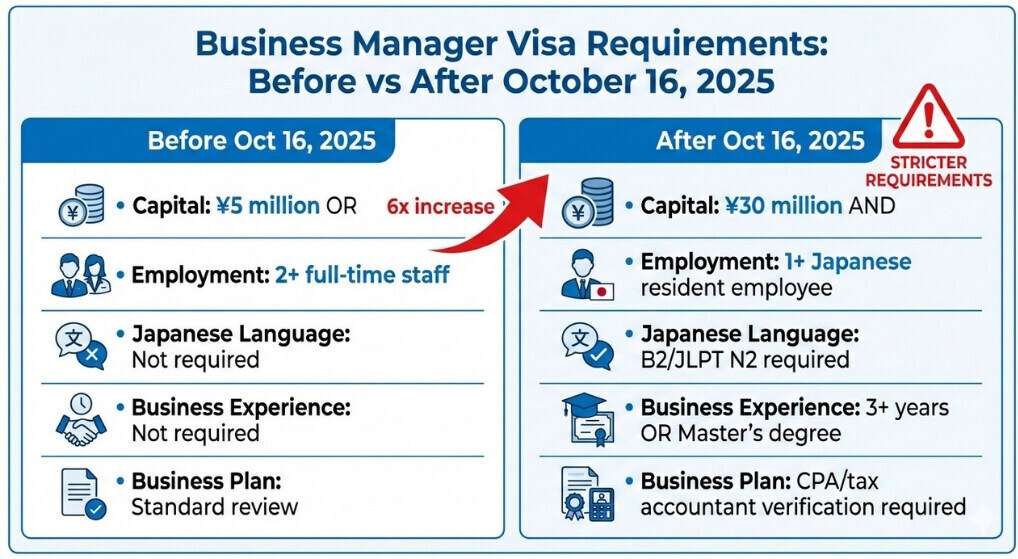
| Requirement | Before October 16, 2025 | After October 16, 2025 |
| Capital | ¥5 million (~$33,000 USD) OR | ¥30 million (~$200,000 USD) AND |
| Employment | 2+ full-time staff | 1+ full-time Japanese resident employee |
| Combined requirement | Either/or | Both required simultaneously |
| Japanese language | Not required | B2/JLPT N2 level (applicant or employee) |
| Business experience | Not specifically required | 3+ years management experience OR Master’s degree in management |
| Business plan verification | Standard review | Mandatory review by CPA, tax accountant, or SME consultant |
What This Means for Foreign Entrepreneurs
The new requirements represent a 6x increase in capital requirements and eliminate the previous flexibility where capital OR employment could satisfy the business scale requirement. Now, you must meet both conditions:
- ¥30 million in capital (for corporations, this means paid-in capital; for sole proprietors, this means total business investment including office, equipment, and one year of employee wages)
- At least one full-time employee who is a Japanese resident (this can be a Japanese national or foreign national with appropriate work authorization)
Not Sure You Qualify Under the New Visa Rules?
- Business Manager Visa assessment based on your current situation.
- Guidance on capital structuring, employment, and language requirements.
- 60+ visas granted for foreign entrepreneurs in Japan.
Transition Period for Existing Visa Holders
If you already hold a Business Manager Visa, the Immigration Services Agency has provided a three-year transition period (until October 16, 2028). During this period, renewal applications will be evaluated flexibly, considering your business track record and prospects for meeting the new requirements. However, planning your compliance strategy now is essential.
Alternative Pathways
For entrepreneurs who cannot immediately meet the ¥30 million capital requirement, consider these options:
- Startup Visa (特定活動51号): If you applied for or held this visa before October 16, 2025, the previous Business Manager Visa requirements apply when you transition.
- Investment through established businesses: Partnering with or investing in existing Japanese companies may provide alternative entry paths.
Verification note: Immigration requirements can change, and individual circumstances vary significantly. Confirm current requirements with the Immigration Services Agency or a qualified immigration specialist before making business decisions.
Understanding Japan’s Travel Business License Requirements
Unlike many countries where travel businesses can operate with minimal regulation, Japan requires specific licenses based on the Travel Agency Act. The licensing system reflects Japan’s commitment to consumer protection and industry standards, but it also means careful planning is essential for market entry.
The licensing structure divides travel businesses into distinct categories based on their scope of operations. Each license type carries different capital requirements, operational limitations, and growth potential. Understanding these distinctions is crucial for choosing the right entry strategy for your business.
Travel Business License Classifications
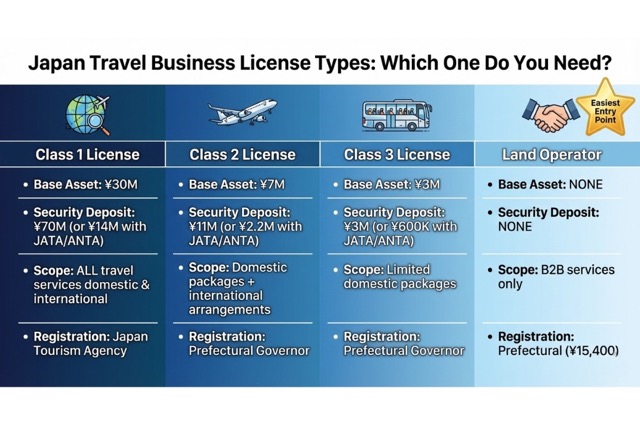
Class 1 License (第1種旅行業) represents the gold standard for travel businesses in Japan. It allows complete operational freedom, including organizing both domestic and international recruitment-type package tours (募集型企画旅行), custom tours (受注型企画旅行), and arrangement services (手配旅行). The requirements are substantial:
Class 2 License (第2種旅行業) offers a balanced middle ground that works well for most foreign-owned travel businesses. You can organize domestic recruitment-type package tours and handle international custom tours and arrangement services, though you cannot organize recruitment-type overseas package tours yourself.
| Requirement | Class 2 |
|---|---|
| Minimum base asset amount | ¥7 million |
| Security deposit | ¥11 million |
| Or Bond deposit with JATA/ANTA membership | ¥2.2 million |
| Registration authority | Prefectural Governor |
| Registration fee | Varies by prefecture |
| Travel supervisor required | General or Domestic (国内旅行業務取扱管理者) |
Class 3 License (第3種旅行業) serves businesses focusing on domestic travel with limited geographic scope for package tours. Package tours are limited to areas within and adjacent to your office’s municipality.
| Requirement | Class 3 |
|---|---|
| Minimum base asset amount | ¥3 million |
| Security deposit | ¥3 million |
| Or Bond deposit with JATA/ANTA membership | ¥600,000 |
| Registration authority | Prefectural Governor |
| Registration fee | Varies by prefecture |
| Travel supervisor required | General, Domestic, or Regional (地域限定旅行業務取扱管理者) |
Regional Limited Travel Business (地域限定旅行業) is designed specifically for “landing-type tourism” (着地型旅行) businesses focusing on local experiences within their municipality and adjacent areas.
| Requirement | Regional Limited |
|---|---|
| Minimum base asset amount | ¥1 million |
| Security deposit | ¥150,000 |
| Or Bond deposit with JATA/ANTA membership | ¥30,000 |
| Registration authority | Prefectural Governor |
| Travel supervisor required | General, Domestic, or Regional |
Travel Service Arrangement Business (旅行サービス手配業), commonly known as “Land Operator” registration, is fundamentally different from travel business licenses. This registration is for businesses that arrange travel services (hotels, transportation, guides) on behalf of travel agencies, rather than selling directly to travelers. This is an excellent entry point for entrepreneurs focused on the B2B inbound market.
| Requirement | Travel Service Arrangement |
|---|---|
| Minimum base asset amount | None |
| Security deposit | None |
| Registration authority | Prefectural Governor |
| Registration fee | ¥15,400 |
| Manager required | Travel Service Arrangement Business Manager (旅行サービス手配業務取扱管理者) |
The JATA/ANTA Advantage: 80% Security Deposit Reduction
Here’s a strategy that can save millions of yen: joining the Japan Association of Travel Agents (JATA) or All Nippon Travel Agents Association (ANTA) reduces your required security deposit by 80%. For a Class 1 license, this means reducing your deposit from ¥70 million to ¥14 million, a ¥56 million difference in required funds.
| License Type | Security Deposit (No Association) | Bond Deposit (With Association) | Savings |
|---|---|---|---|
| Class 1 | ¥70 million | ¥14 million | ¥56 million |
| Class 2 | ¥11 million | ¥2.2 million | ¥8.8 million |
| Class 3 | ¥3 million | ¥600,000 | ¥2.4 million |
| Regional Limited | ¥150,000 | ¥30,000 | ¥120,000 |
Beyond the financial benefits, association membership provides credibility, networking opportunities, consumer protection dispute resolution support, and regulatory guidance that prove invaluable for foreign-owned businesses navigating the Japanese market.
Important: Association membership requires annual fees and an initial joining fee that vary between JATA and ANTA, and within ANTA by prefecture. In some prefectures, ANTA membership requires a recommendation from an existing member company. Factor these costs and requirements into your business planning.
*Association fees and joining requirements vary. Contact JATA or your local ANTA branch for current rates and procedures.
Step-by-Step: Launching Your Travel Business in Japan
Step 1: Strategic Business Structure Selection
The choice between Kabushiki Kaisha (KK/株式会社) and Godo Kaisha (GK/合同会社) structures impacts everything from your company’s credibility to its operational flexibility.
Important consideration for Business Manager Visa applicants: Under the new October 2025 requirements, your company must have ¥30 million in paid-in capital (for KK, this is 資本金; for GK, this is 出資の総額). This requirement applies regardless of which structure you choose. The visa capital requirement is separate from travel business license base asset requirements.
A Kabushiki Kaisha (Stock Company) remains the gold standard for businesses seeking maximum credibility with Japanese partners, customers, and financial institutions. Despite higher incorporation costs (our fee: ¥431,500 including all government fees) and more complex administration, a KK structure signals serious long-term commitment to the Japanese market. It’s particularly valuable for travel businesses planning to work with established Japanese hotels, transportation companies, and tourism boards who often prefer or require KK partners.
The Godo Kaisha (Limited Liability Company) provides an efficient entry path while maintaining professional credibility, with lower incorporation costs (our fee: ¥186,500). Digital-first travel businesses, niche tour operators, and businesses primarily serving international clients often find the GK structure perfectly adequate. You can convert to a KK structure later as your business grows.
Our comprehensive guide to company structures provides detailed comparisons and case studies to help you make the right choice.
Step 2: Securing Your Official Business Address
Japanese law mandates that travel businesses maintain a physical office—virtual offices are explicitly prohibited for licensed travel operators. This requirement stems from consumer protection concerns and the need for regulatory oversight, but it also serves a practical purpose: Japanese customers expect legitimate businesses to have a physical presence.
The Tokyo office market offers various solutions at different price points. Serviced offices, ranging from ¥20,000-50,000 monthly, provide an excellent starting point with included utilities, reception services, and meeting room access. These facilities often cater to international businesses and provide bilingual support, making them ideal for foreign entrepreneurs. Shared offices with dedicated addresses (¥30,000-80,000/month) offer a middle ground, while traditional office leases (¥200,000-300,000/month in central Tokyo) become necessary as you scale operations.
Location matters significantly in Japan’s travel industry. Proximity to major stations enhances credibility and convenience for both partners and clients. Areas like Shinjuku, Shibuya, and Tokyo Station command premium rents but provide unmatched accessibility and prestige. Our rental office guide includes neighborhood analyses and negotiation strategies specific to foreign businesses.
Step 3: Navigating Japan’s Banking System
Opening a corporate bank account remains one of the most challenging aspects of establishing a business in Japan, particularly for foreign-owned companies. Banks’ risk-averse nature and language barriers can turn what should be a simple process into a months-long ordeal without proper preparation.
Shinsei Bank has emerged as the go-to option for foreign businesses, offering full English support and online banking capabilities. Their understanding of international business needs and streamlined application process can save weeks of frustration. Seven Bank provides another foreigner-friendly option, particularly for smaller businesses. For companies requiring comprehensive banking services, including international transfers and credit facilities, establishing relationships with megabanks like MUFG or Mizuho becomes necessary, though these require stronger documentation and often Japanese language capability.
The key to successful bank account opening lies in preparation. Banks want to see detailed business plans (in Japanese), proof of office lease, capital verification, and increasingly, existing business relationships in Japan. Our banking guide includes document templates and bank-specific strategies that have achieved a 95% first-attempt success rate for our clients.
Incorporation, Visa, and Banking in One Place
- Company incorporation in Japan, handled in English from start to finish.
- Bank account preparation with structured documentation for Japanese banks.
- Business Manager Visa support from assessment through approval.
Step 4: Securing Your Certified Travel Supervisor
Every travel business in Japan must employ at least one full-time Certified Travel Supervisor (旅行業務取扱管理者). This isn’t merely a regulatory checkbox—this person becomes legally responsible for ensuring your business operates within Japanese travel law. For businesses employing 10 or more people, additional supervisors are required.
The certification comes in two levels: Domestic Travel Supervisor and General Travel Supervisor (for international operations). Finding qualified supervisors can be challenging, as demand exceeds supply, particularly for supervisors willing to work with foreign-owned startups. Options include hiring experienced professionals from established agencies (expect ¥4-6 million annual salary), supporting existing staff to obtain certification (6-12 month process), or partnering with certified consultants for smaller operations.
Step 5: License Application and Approval Process
The travel business license application process typically takes 2-3 months but can extend longer without proper preparation. Beyond basic requirements like business registration certificates and financial proof, authorities examine your business plan’s viability, marketing strategy, and operational procedures in detail. They want assurance that your business can deliver promised services and protect consumer interests.
Documentation must be submitted in Japanese, following specific formatting requirements that vary by prefecture. Our application templates and review process ensure first-time approval in over 90% of cases. The license remains valid for 5 years before requiring renewal, giving you ample time to establish and grow your operations.
Visa & Residency Requirements for Foreign Entrepreneurs
For non-Japanese entrepreneurs looking to establish a travel business, obtaining the right visa and residency status is essential. The October 2025 reforms have significantly changed the landscape.
Business Manager Visa (経営・管理)
This is the primary visa for foreign entrepreneurs, but requirements have become substantially stricter since October 16, 2025:
New Requirements (Post-October 2025):
- Capital: ¥30 million minimum (6x the previous ¥5 million requirement)
- Employment: At least 1 full-time Japanese resident employee (mandatory, not optional)
- Japanese language: B2/JLPT N2 level required for either the applicant or a full-time employee
- Experience/Education: 3+ years management experience OR Master’s/Doctoral degree in management
- Business plan: Must be verified by a CPA, tax accountant, or SME consultant
- Physical office: Required (home office generally not accepted under new rules)
For detailed requirements and application guidance, read our guide on How to Get a Business Manager Visa in Japan.
Startup Visa (特定活動51号)
The Startup Visa provides a preparation period for entrepreneurs who need time to establish their business before meeting full Business Manager Visa requirements. Key points:
- Available in participating municipalities with approved startup programs
- Provides 6-12 months to prepare your business
- If you applied for or held a Startup Visa before October 16, 2025, you may transition to a Business Manager Visa under the previous, less stringent requirements
To better understand the process and requirements, refer to this in-depth guide on obtaining a Startup Visa in Japan.
Alternative Pathways
For entrepreneurs who may not immediately meet the new ¥30 million capital requirement:
- Spouse or dependent visa holders: If you hold a spouse visa, dependent visa, or permanent residency, you can start a business without Business Manager Visa restrictions
- Working with existing businesses: Joining as an employee or partner in an established travel business, then transitioning to your own company
- Regional programs: Some prefectures offer special startup support programs with more flexible initial requirements
*Immigration requirements change frequently, and individual circumstances vary significantly. Consult with an immigration specialist (行政書士 specializing in immigration) for current requirements and personalized guidance.
Step 5 – Post-Incorporation Steps: Ensuring Tax Compliance and Regulatory Filings
Launching a travel business in Japan doesn’t end with incorporation. To operate legally and avoid penalties, companies must fulfill mandatory tax filings and registrations with national and local authorities. Japan has strict corporate tax laws, and failing to comply with deadlines can result in steep penalties. Additionally, businesses hiring employees must complete labor and social insurance registrations.
If a company hires employees, it must register for labor insurance and social security programs to ensure compliance with Japan’s employment laws. Businesses must notify tax authorities at the national, prefectural, and municipal levels regarding their incorporation and tax obligations.
Mandatory Post-Incorporation Filings and Registrations
| Document | Where to File | Deadline | Description |
|---|---|---|---|
| Notification of Incorporation (法人設立届出書) | District Tax Office (税務署, Zeimusho) | Within 2 months after company registration | Officially informs tax authorities of the company’s establishment. |
| Notification of Establishment of an Office Paying Salaries (給与支払 事務所等の開設届出書) | District Tax Office (Zeimusho) | Within 1 month after hiring staff | Notifies tax authorities about the commencement of salary payments to employees. |
| Application for Blue Form Tax Return (青色申告承認申請書) | District Tax Office (Zeimusho) | Before the earlier of 3 months after incorporation or the end of the first business year | Allows businesses to benefit from favorable tax treatments, such as loss carryforwards. |
| Prefectural and Municipal Tax Notifications | Prefectural Tax Office (都道府県税事務所, Todofukenzei Jimusho) and Municipal Tax Office (市区町村役所, Shikuchouson Yakusho) | Within 15 days after starting business operations | Registers the company for local taxation purposes. |
| Labor Insurance Registration (労働保険関係成立届) | Labor Standards Inspection Office (労働基準監督署, Rōdō Kijun Kantokusho) or Public Employment Security Office (ハローワーク, Hello Work) | Within 10 days of hiring the first employee | Enrolls the company in Workers’ Accident Compensation and Employment Insurance. |
| Employment Regulations Submission (就業規則届出) | Labor Standards Inspection Office (Rōdō Kijun Kantokusho) | Required if the company employs 10 or more workers | Ensures workplace policies comply with Japan’s Labor Standards Act. |
| Health & Pension Insurance Registration (健康保険・ 厚生年金保険 新規適用届) | Japan Pension Service (日本年金機構, Nihon Nenkin Kiko) | Within 5 days of hiring employees | Registers employees for national health and pension insurance programs. |
| Employment Insurance Registration (雇用保険適用 事業所設置届) | Public Employment Security Office (ハローワーク, Hello Work) | Within 10 days of hiring the first worker | Enrolls the company in the employment insurance system. |
Step 6: Get Your Travel Business License Approved
Once your company is legally registered, the next critical step is obtaining a Travel Business License. In Japan, the travel industry is heavily regulated, and businesses cannot legally sell tours, arrange travel services, or book transportation without proper licensing. This process ensures consumer protection and industry compliance, but it also means that strict requirements and documentation must be met.
Application Process & Documentation
Applying for a Travel Business License in Japan requires detailed paperwork and strict compliance with regulatory guidelines. To successfully obtain approval, your business must submit:
- Business Registration Certificate – Proof that your company is officially registered.
- Financial Proof of Capital Deposit – Ensuring the company meets the minimum capital requirements for the selected license class.
- Office Lease Contract – Verification of a physical office location, as travel businesses cannot operate remotely.
- Appointment of a Certified Travel Supervisor – A legally required individual responsible for ensuring compliance with travel industry laws.
In addition to meeting these requirements, businesses must pay the application fee and allow time for license processing:
- Class 1 Travel Business License – Costs 90,000 JPY, with an approval timeline of 2–3 months.
- Class 2 & 3 Travel Business Licenses – Fees vary based on the prefecture, with an estimated processing time of 1–2 months.
Appoint a Certified Travel Supervisor
A key requirement for all travel businesses in Japan is appointing at least one full-time Certified Travel Supervisor. This position is responsible for regulatory compliance, safety oversight, and business accountability.
- The Certified Travel Supervisor must hold an official qualification, either as a General Travel Supervisor or Domestic Travel Supervisor, depending on the services offered.
- If the company employs 10 or more workers, an additional supervisor is required to maintain legal compliance.
For startups, finding a qualified supervisor can be challenging, but hiring an experienced professional or having a co-founder obtain the necessary certification can streamline the process.

Step 7 – Establish Strong Partnerships and Secure Reliable Suppliers
Launching a travel business in Japan isn’t just about obtaining licenses and setting up an office—success depends on building strong partnerships with key industry players. Whether you’re crafting luxury tours, cultural experiences, or adventure packages, having reliable suppliers is crucial for ensuring a seamless experience for your customers.
Partnering with Hotels, Airlines, and Local Vendors
One of the most valuable assets in the travel industry is access to quality accommodations, transportation, and unique experiences. To stay competitive, your business must build and maintain strong relationships with service providers in Japan, including:
- Hotels & Traditional Ryokan Inns – Partnering with well-established hotels and authentic Japanese Ryokan(traditional inns) can provide your clients with an unforgettable travel experience. Many travelers seek culturally immersive stays, so working with onsen (hot spring) resorts, temple lodgings, and boutique hotels can give your business an edge.
- Airlines & Japan Rail Pass (JR Pass) Distributors – Offering convenient domestic and international travel solutions is essential. Establishing direct contracts with airlines and JR Pass providers can allow your company to bundle transportation services into your packages, making it easier for travelers to explore Japan.
- Local Tour Operators & Experience Providers – Japan’s tourism industry thrives on curated experiences. Collaborating with local tour guides, cultural activity organizers, and adventure tourism providers (such as ski resorts, diving centers, and hiking guides) will enhance your offerings and help differentiate your services from competitors.
Building these partnerships requires negotiation and relationship management. Hotels and airlines may offer special rates, commissions, or exclusive package deals if they see value in your business. Establishing trust and reliability with vendors ensures long-term success and priority bookings for your clients.
Understanding Distribution Channels
Even with the best travel packages, your business won’t succeed without a solid distribution strategy. Japan’s travel market is highly digital, and customers rely on multiple channels when booking their trips. To maximize sales and reach a broader audience, businesses should leverage a mix of:
- Direct Bookings via Your Website – Having a well-designed, mobile-friendly website with a clear booking system is essential for direct sales. Offering discounts for direct bookings can help drive customers away from third-party platforms and toward your own services.
- Online Travel Agencies (OTAs) – Platforms like Rakuten Travel, Jalan, Klook, and GetYourGuide dominate Japan’s online travel market. Listing your services on these platforms can significantly increase visibility and attract international travelers who rely on these trusted brands for bookings.
- Affiliate Networks & Travel Platforms – Collaborating with influencers, travel bloggers, and affiliate networks can help promote your business to niche audiences. Many travelers rely on word-of-mouth and expert recommendations, so offering commission-based incentives to affiliates can drive bookings.
Alternative Entry: Travel Service Arrangement Business
A Lower-Barrier Entry Point: Travel Service Arrangement Business
For entrepreneurs focused on the B2B inbound market, the Travel Service Arrangement Business (旅行サービス手配業), commonly called “Land Operator” or “Tour Operator” registration, offers a significantly lower barrier to entry than full travel business licensing.
What Land Operators Do:
Land operators work behind the scenes, arranging travel services on behalf of travel agencies (including foreign travel agencies). Typical services include:
- Arranging transportation (buses, trains, taxis) for tour groups
- Booking hotels and ryokan accommodations
- Coordinating tour guides (excluding nationally licensed interpreter guides)
- Arranging visits to shops, restaurants, and experiences
- Coordinating with local service providers
Key Advantages:
| Factor | Travel Business License | Land Operator Registration |
|---|---|---|
| Base asset requirement | ¥1-30 million | None |
| Security deposit | ¥150,000-70 million | None |
| Clients | Direct to travelers (B2C) | Travel agencies only (B2B) |
| Registration fee | ¥15,400-90,000 | ¥15,400 |
| Manager required | Travel Supervisor (exam) | Travel Service Arrangement Manager (training course) |
Who Should Consider This Path:
- Entrepreneurs with strong local knowledge and supplier relationships
- Those focusing on inbound tourism from specific countries
- Businesses that prefer B2B relationships over direct consumer sales
- Entrepreneurs building experience before pursuing full travel business licensing
Requirements:
- Physical office in Japan (same as travel business)
- Travel Service Arrangement Business Manager for each office (requires completing a training course or passing the Travel Supervisor exam)
- Registration with your prefectural government
- No financial requirements (base assets or security deposits)
Important limitations:
- You cannot sell directly to travelers
- You cannot organize your own tours
- Your revenue depends on travel agency relationships
- The 2018 registration requirement was introduced following safety concerns, so high ethical standards are expected
Need Expert Guidance to Launch Your Travel Business in Japan?
If you’re looking for personalized assistance in setting up and scaling your travel business in Japan, our expert team is just an email away. From navigating business registration and licensing to understanding corporate taxes and compliance, we’re here to help you every step of the way.
Get in touch with us today, and let’s turn your vision into a thriving business in Japan! With the right strategy and support, you can confidently enter the Japanese market and unlock its full potential.