The Startup Visa in Japan has become one of the most practical entry points for foreign entrepreneurs who want to explore business opportunities in Japan without committing significant capital upfront. In 2026, the program is especially relevant as long-term business visas now carry higher capital thresholds and stricter requirements. The Startup Visa allows founders to legally reside in Japan while preparing to launch a business, conduct market research, build local networks, and lay the groundwork for future operations—all before transitioning to a standard business residence status.
This guide explains how Japan’s Startup Visa works in 2026, who qualifies, how much it realistically costs, and how long the process takes from planning to entry. It also outlines what founders can do during the visa period, how to avoid common application mistakes, and how to prepare early for long-term residency. Whether you are testing the Japanese market for the first time or repositioning after recent global visa changes, this article is designed to help you approach Japan’s Startup Visa strategically and with clear expectations.
- Key Takeaways
- What is a Startup Visa in Japan?
- What are the requirements for Japan's Startup Visa?
- Who Can Apply For a Startup Visa
- How much does the Startup Visa cost?
- How long does the application process take?
- What can you do during the 2-year Startup Visa period?
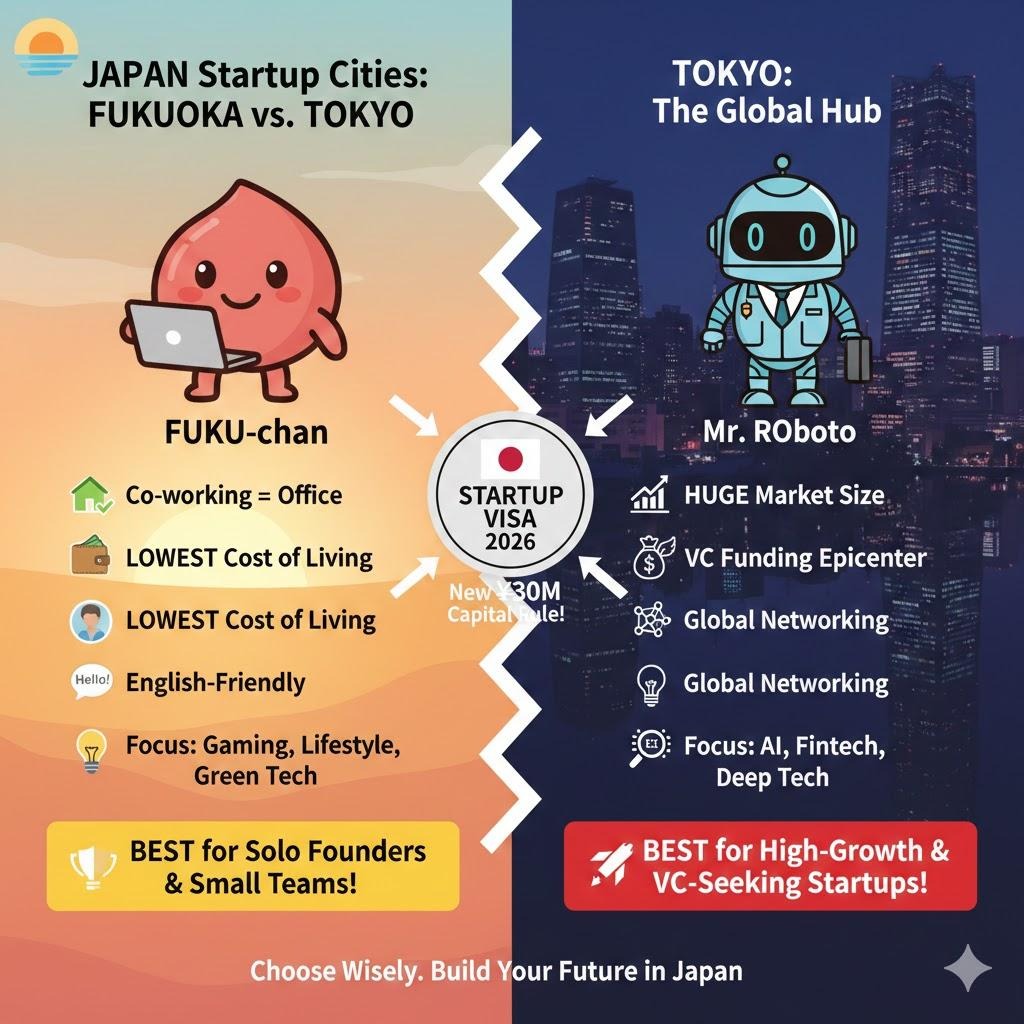
- Which city should I choose to start my company in?
- Can You Bring Your Family on a Startup Visa?
- How to avoid getting your Startup Visa application rejected
- Transitioning From a Startup Visa to Long-Term Residency
- Conclusion
Key Takeaways
- Zero-capital entry with no office or employee requirement
- Up to 2 years to prepare and validate a business in Japan
- Nationwide program overseen by METI with local governments
- Low application fees, but realistic living and operating costs of ¥6–15M
- Typical processing time of 3-6 months
- Approval depends on a strong, city-aligned business plan
- Transition planning is essential due to the ¥30M Business Manager Visa requirement
What is a Startup Visa in Japan?
Japan’s Startup Visa is a temporary residence status designed to allow foreign entrepreneurs to enter Japan and prepare to launch a business before qualifying for a standard long-term business visa.
Duration & Renewal:
- Initial grant: 6 months or 1 year (varies by municipality)
- Extension possibility: Some cities allow renewal up to maximum 2 years total
- Tokyo: Typically 1 year initial, renewable to 2 years with progress checks
- Fukuoka (previous system): 6 months initial + 6 months renewal
- Startup Visa itself is NON-RENEWABLE beyond maximum period; must transition to Business Manager Visa or leave Japan
What are the requirements for Japan’s Startup Visa?
Japan’s Startup Visa is intended for foreign entrepreneurs planning to start an innovative business in Japan that offers clear economic or social value. Eligible applicants typically have a viable business idea, relevant professional or entrepreneurial experience, and sufficient personal funds to support themselves during the preparation period. The business must demonstrate potential to contribute to Japan through innovation, job creation, technology development, or by addressing local or societal needs.
Applicants must also submit a credible business plan showing an understanding of the Japanese market, realistic financial projections, and a clear roadmap for transitioning to a Business Manager Visa, including plans for capital accumulation, securing an office, and hiring employees during the Startup Visa period.
City Endorsement Process:
- 1: Choose participating municipality aligned with your business sector
- 2: Submit “Startup Preparation Activity Plan” to designated organization
- 3: Present business plan (some cities require in-person presentation/interview)
- 4: City evaluation criteria:
- Business feasibility
- Alignment with city’s priority industries
- Applicant’s background/experience
- Realistic path to success
- 5: If approved, receive “Certificate of Confirmation of Startup Activity”
Certificate validity: Typically 3 months to submit to Immigration
Who Can Apply For a Startup Visa
Background Check:
Applicants must pass a standard background review conducted by both the municipality and immigration authorities. This includes confirming that the applicant has no serious criminal history and has complied with Japanese immigration laws in the past, with no record of visa overstays or violations. In addition, founders must demonstrate financial stability by providing proof of sufficient personal funds to cover living expenses during the preparation period. While exact requirements vary by municipality, applicants are generally expected to show access to at least ¥2–3 million to support themselves for one year in Japan.
Language Requirements:
The Startup Visa does not require formal Japanese language proficiency at the time of application. However, business plans often need to be submitted in Japanese, and some municipalities conduct interviews or presentations in Japanese.
Industry Focus:
Tokyo: Emphasizes finance, large-scale technology, and creative industries
- Finance & fintech, including financial services and related business models
- Technology and innovation, such as IT, AI, and digital platforms
- Healthcare and life-related services, including medical care, welfare, and health tech
- Sustainability and energy, covering environmental solutions and green technologies
- Creative and consumer industries, including culture, arts, gaming, content creation, and retail-oriented businesses
Industry focus comparison: Yokohama
Yokohama focuses more on applied science and industrial innovation.
- Life sciences and biotechnology
- Medical devices and healthcare technology
- Advanced manufacturing and robotics
- Environmental and smart-city technologies
How much does the Startup Visa cost?
Application and administrative costs
The direct application costs for Japan’s Startup Visa are relatively low compared to other long-term residency options. City application fees vary by municipality and typically range from ¥0 to ¥50,000. In addition, immigration charges a standard visa application fee of ¥4,000. Applicants may also incur translation and documentation expenses, particularly if business plans or supporting materials must be submitted in Japanese.
Living and operating costs during the visa period
Monthly living costs vary significantly depending on the city and personal lifestyle, with major urban areas such as Tokyo requiring higher budgets. Founders should also account for business-related expenses, including product development, legal and accounting services, and other professional fees. Maintaining an emergency financial buffer is strongly recommended, as it provides flexibility if revenue generation takes longer than expected.
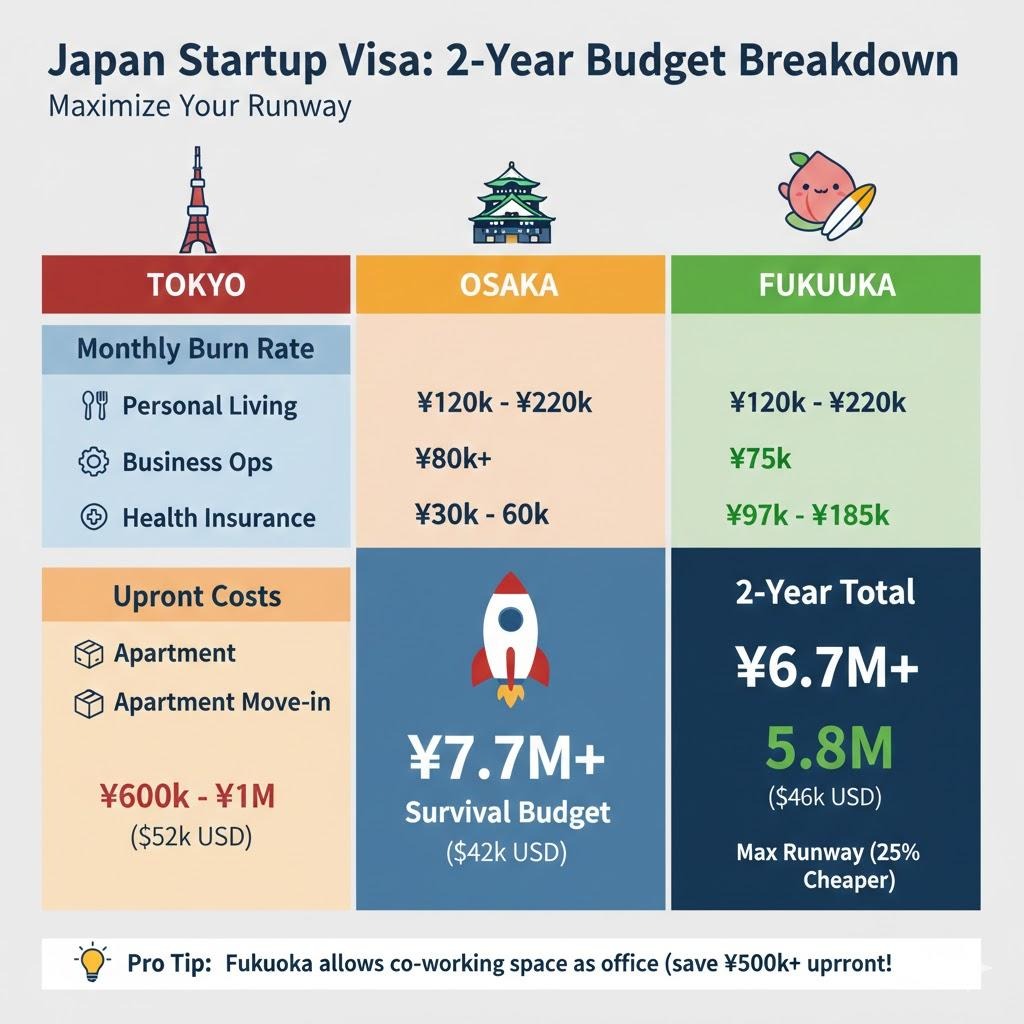
For founders who want a deeper breakdown of how different Japanese cities compare, visit this resource: 5 Japanese Cities to Consider Starting Your Incorporation Journey in
How long does the application process take?
Timeline breakdown
PHASE 1: Business Plan Preparation & Pre-Application Setup (2-4 weeks)
The Startup Visa application process is completed in several stages and typically takes between one and three months, depending on the municipality and the completeness of the application. Phase 1 focuses on business plan preparation and generally takes two to four weeks. During this stage, founders conduct market research, refine their business concept, and prepare documentation. This includes writing a comprehensive business plan—often 15 to 30 pages in length—developing three- to five-year financial projections, and gathering supporting materials such as a résumé or CV, educational certificates, records of previous business experience, a portfolio of past work, bank statements showing proof of living funds, and a housing plan in Japan.
PHASE 2: Municipal Endorsement/City Review & Approval (1-2 months)
The second phase involves city endorsement and can take anywhere from one to three months. Applicants begin by contacting the designated organization within their chosen municipality and submitting a Startup Preparation Activity Plan, along with any required city application fees. Some municipalities also require an in-person presentation or interview. During the review period, the city evaluates the business plan through an internal committee process. If approved, the municipality issues a Certificate of Confirmation of Startup Activity, which is typically valid for three months and must be submitted to immigration. In Tokyo, this certificate is issued through the Tokyo Metropolitan Government and requires the purchase of ¥300 in revenue stamps.
PHASE 3: Immigration Application (3-6 weeks)
After receiving approval from the municipality, applicants proceed to the immigration stage by submitting an application for a Certificate of Eligibility (COE) or a status change, depending on whether they are applying from outside or inside Japan. Certificate of Eligibility (COE): An official document issued by Japanese immigration authorities confirming that the applicant meets the requirements for a specific residence status and is eligible to enter Japan under that visa category.The application is submitted to the appropriate Regional Immigration Services Bureau or a designated immigration counter.
Required documents typically include the certificate issued by the municipality, a valid passport, recent identification photos (4 cm × 3 cm), completed application forms, a copy of the business plan, financial documents proving sufficient funds, housing documentation in Japan, and proof of return airfare. Once the application is submitted, immigration issues an official application receipt, which confirms that the review process has begun. Processing at this stage generally takes between three and six weeks, although additional documents may be requested during the review period
Immigration Review
- Immigration Services Agency examines application
- Background checks
- Business plan viability assessment
- Financial stability review
- May request additional documentation (respond within 2 weeks)
COE Issuance
- If approved: Receive “Certificate of Eligibility for Status of Residence” (COE) by mail
- If denied: Receive “Notice on non-issuance” with reasons
- Processing time: Average 3-6 weeks (can be faster or slower)
PHASE 4: Visa Issuance (1-2 weeks)
For applicants already in Japan:
- Can apply for status change at Regional Immigration Bureau
- Processing similar to COE application
- Can remain in Japan during processing if current status valid
For applicants outside Japan:
Applicants applying from outside Japan must take their Certificate of Eligibility to a Japanese embassy or consulate in their home country and submit a visa application. Processing usually takes between three to five business days, though it can take up to two weeks in some cases. Once approved, the visa is stamped into the applicant’s passport. It is important to note that a Certificate of Eligibility is generally valid for three months from the date of issuance.
Entry to Japan:
After receiving the visa, the applicant may enter Japan and complete the landing procedures at the port of entry. Residence cards are issued immediately at major airports, while those entering through smaller ports must register at their local municipal office within 14 days of arrival to receive their residence card.
| Scenario | Business Plan | City Endorsement | Immigration Review | Embassy Visa | Total Time |
| Fast Track (everything goes smoothly) | 2 weeks | 6-8 weeks | 3 weeks | 1 week | 3-4 months |
| Typical (standard processing) | 3 weeks | 8-12 weeks | 5 weeks | 1 week | 4-5 months |
| Delayed (complications arise) | 4 weeks | 12-16 weeks | 8 weeks | 2 weeks | 6-7 months |
What can you do during the 2-year Startup Visa period?
During the two-year Startup Visa period, founders are permitted to actively develop and operate their business in Japan.
- Product or service development (e.g., building prototypes, refining offerings, testing concepts in the Japanese market)
- Client acquisition and relationship building
- Revenue generation aligned with approved business activities
- Formal engagement in commercial transactions related to the business
Startup Visa holders are also allowed to take key operational steps, including hiring employees, opening a business bank account, and incorporating a company in Japan. For founders who are unfamiliar with the setup process, it is recommended to review the Guide to Setting Up a Business in Japan and Incorporation Timeline in Japan, which outline the legal, banking, and administrative steps involved.
Founders may pursue capital raising and business development activities essential to growth. This includes seeking investment from angel investors, venture capital firms, and startup funds; launching crowdfunding campaigns; applying for government grants or subsidies; and, in some cases, securing loans. Entrepreneurs are also encouraged to focus on partnership building by networking with Japanese businesses, joining chambers of commerce, attending industry events, and forming strategic alliances. Marketing and branding activities—such as building a website, managing social media, running campaigns, and engaging in press or media outreach, are also permitted to help establish visibility in the Japanese market.
MONTHLY REPORTING REQUIREMENTS:
All municipalities require:
- Check-in meetings (in-person or virtual)
- Documentation of:
- Business development activities
- Client/partnership progress
- Capital raising status
- Incorporation steps taken
RENEWAL PROCESS (If offered by city)
- Not all cities allow renewal
- If renewable: Must show progress toward Business Manager Visa requirements
- Evaluation criteria:
- Progress on capital accumulation
- Client acquisition
- Office/hiring plans
- Business viability demonstration
- Renewal application: Submit 2-3 months before expiration
Which city should I choose to start my company in?
Can You Bring Your Family on a Startup Visa?
Yes, Japan’s Startup Visa allows eligible family members to accompany the main applicant under dependent visa status. Spouses and dependent children may apply for dependent visas, and the duration of their stay generally matches the validity period of the primary Startup Visa holder. This enables families to reside in Japan together while the founder works on establishing and developing their business.
Work and school considerations
Spouses on a dependent visa may work part-time if they obtain the required permission from immigration, typically allowing up to a limited number of hours per week. Dependent children are permitted to attend Japanese public or private schools, and many municipalities provide language support for foreign students. However, bringing family members significantly increases financial requirements, as founders must demonstrate sufficient income or savings to support their household, including higher housing, living, and healthcare costs.
VISA DURATION & RENEWAL:
Dependent visa period:
- Matches primary Startup Visa holder’s period
- If you have 1-year Startup Visa, dependents get 1-year
- Renewals coincide with primary visa renewal
Housing Impact:
- Single: 1R or 1K sufficient
- Couple: 1DK or 1LDK needed
- Family with kids: 2LDK or 3DK needed
- Cost impact: Family-sized apartments cost 50-100% more than singles
How to avoid getting your Startup Visa application rejected
Common rejection reasons
- Vague or generic business plans
Applications that do not clearly explain the product or service, target customers, revenue model, or competitive advantage raise immediate concerns about feasibility. - Weak or superficial market research
Business plans that lack Japan-specific insights—such as customer behavior, competitors, or industry structure—suggest the applicant does not fully understand the local market. - Misalignment with municipal priorities
Each city has defined focus industries. Applications that do not align with a municipality’s strategic goals or regional strengths are less likely to receive endorsement. - Limited founder credibility or unclear role
A lack of relevant experience, technical background, or a clearly defined role within the business can undermine confidence in the founder’s ability to execute the plan.
How to strengthen your application
To improve approval chances, founders should engage with local customers, partners, or industry stakeholders as early as possible and incorporate those insights into the business plan.
Choosing the right municipality strategically is equally important, as cities vary in their startup focus, review standards, and support structures. Financial projections should be realistic, well-structured, and consistent with the scale of the proposed business, avoiding overly optimistic assumptions.
Finally, applicants should clearly show a credible path to long-term residency by explaining how the business will meet the requirements for a Business Manager Visa within the Startup Visa period, demonstrating both commitment and long-term feasibility.

Transitioning From a Startup Visa to Long-Term Residency
Transitioning from a Startup Visa to a Business Manager Visa is a critical step for founders who want to remain in Japan long term. Immigration authorities will look for clear proof that your business has moved beyond preparation and is operating in a stable, sustainable way. The most successful applicants treat the Startup Visa period as a runway to build the evidence they will need for a long-term status.
- Confirm your target long-term visa and timeline
The Startup Visa is time-limited, so your goal should be to transition before it reaches its maximum validity. As a rule, you should start preparing the Business Manager Visa application early enough to avoid any gap in legal residency, especially if your city requires additional reporting or progress checks before issuing renewals. - Meet the business “scale” requirement (capital or staffing)
A key approval point for the Business Manager Visa is demonstrating that the business has sufficient scale and stability. This is commonly shown by either investing at least ¥5 million in capital or employing two full-time staff members who reside in Japan. Immigration uses this as a signal that the business is real, financially viable, and positioned to operate beyond the startup-prep stage. - Secure a physical office suitable for operations
Immigration typically expects a dedicated office space that supports business activity. This means you should plan ahead for leasing requirements, documentation, and timelines—especially in major cities where contracts, deposits, and screening can take time. A clear office setup helps demonstrate operational readiness and reduces doubts about whether the company can function independently. - Build a clear operating structure and staffing plan
Even if you are not hiring immediately, you should be able to explain how the business will operate day to day. If you plan to hire, show the roles, timing, and budget. If you will remain lean, clearly explain your operational workflow and how responsibilities are covered. Immigration wants to see that the business is not dependent on vague future plans and has a realistic structure for continued operations. - Prepare supporting financial and compliance documentation
Strong documentation is what turns your plan into an approvable case. Maintain organized records such as financial statements, proof of funds, tax-related documentation, contracts, corporate registrations, and any employment documents if you have staff. Consistent recordkeeping supports credibility and makes renewal processes easier later. - Show sustainable growth and a credible long-term plan.
Immigration is more likely to approve long-term residency when the business looks sustainable, not temporary. Set clear capital-raising milestones for operations and compliance costs, build a realistic hiring timeline aligned with growth, and document business progress (customers, partnerships, revenue, or product development). This creates a strong narrative that your business is actively developing and capable of long-term stability in Japan. - Submit your Business Manager Visa application before your Startup Visa expires.
The final step is timing the application properly so you remain in status throughout the transition. Submitting early also gives you room to respond if immigration requests additional documentation, which is common. Treat the application as a formal “proof package” that your startup is now operational and meets long-term requirements.
Conclusion
To sum it all up, Japan’s Startup Visa is a temporary residence program that allows foreign entrepreneurs to enter Japan and prepare to launch a business without immediate capital, office, or employee requirements. It offers up to two years to test ideas, build local knowledge, and establish operations in the Japanese market. While the program lowers the initial barrier to entry, success depends on careful planning, a strong and city-aligned business plan, and realistic financial preparation. Because the Startup Visa cannot be renewed indefinitely, founders must also plan early for the transition to a Business Manager Visa. Approached strategically, the Startup Visa can serve as an effective first step toward building a sustainable business and long-term presence in Japan.