
- Key takeaways
- Step 1 – Understand Why Japan Is a Strategic Market
- Step 2 – Plan Your Concept and Budget
- Step 3 – Register Your Business
- Step 4 – Secure a Location and Negotiate the Lease
- Step 5 – Apply for Permits and Comply with Regulations
- Cost Breakdown of opening a restaurant in Japan
- Step 6 – Align Your Concept with Japanese Consumer Expectations
- Step 7 – Launch and Promote Your Restaurant
- Case Study: Napoletan pizza in Japan
- FAQ – Opening a Restaurant in Japan
- Conclusion: Enter the Market with Confidence
Key takeaways
- 1. Opening a restaurant in Japan requires local licenses, permits, and a Business Manager Visa (if you don’t have PR) with significantly stricter requirements as of October 2025.
- 2. Restaurant Startup costs typically range from ¥6–20M+, depending on city, size, and concept.
- 3. The Business Manager Visa now requires ¥30 million capital AND at least one Japanese/permanent resident full-time employee > a major increase from previous requirements.
- 4. Cultural fit matters as Japanese customers expect consistency, impeccable service, and attention to detail.
- 5. The Startup Visa (now available nationwide) offers foreign entrepreneurs up to two years of preparation time before meeting full Business Manager Visa requirements.
This is part of our series offering valuable tips on incorporating a business in Japan. To learn more about setting up your company and achieving your dreams, check out our SmartStart service.
Step 1 – Understand Why Japan Is a Strategic Market
Japan’s growing hospitality and tourism demand
Japan’s restaurant market presents compelling opportunities for foreign entrepreneurs. Inbound tourism reached record levels in 2025, with approximately 40 million visitors spending over ¥9.4 trillion (the highest consumption total ever recorded). Notably, dining accounts for roughly 22–23% of visitor spending (approximately ¥5 trillion in food and beverage expenditure in 2025), making restaurants a direct beneficiary of this growth.
Domestic dining trends further strengthen the market. Japanese consumers increasingly embrace diverse cuisines, plant-based options, health-conscious menus, and authentic international concepts. The continued expansion of delivery services and takeout has also created new revenue streams for restaurant operators willing to adapt their models.
Beyond Tokyo: Other Cities Gaining Traction
Japan’s dense urban centers make it perfect for testing brick-and-mortar models. While Tokyo and Osaka remain top choices, cities like Fukuoka and Sapporo offer lower costs and startup-friendly incentives, including support for foreign entrepreneurs applying for the Startup Visa.
But which city is the best fit for your concept, and what kind of help can you expect? Use our Japanese Cities to Start Your Incorporation guide to compare key locations and find the right environment for your restaurant.
Step 2 – Plan Your Concept and Budget
Match your concept with Japanese preferences
With your target city selected, the next step is refining your restaurant concept and building a practical budget. Japanese consumers value authenticity and quality, but your idea also needs to align with local tastes. Whether you’re planning a cozy izakaya or a specialized bakery, research what similar establishments charge, how they attract customers, and where your niche fits.
Estimate startup costs
Startup costs depend on city, scale, and concept. According to the Japan Finance Corporation’s 2024 New Business Survey, the average startup cost for new businesses (including restaurants) is approximately ¥9.85 million, with a median of ¥5.8 million.
For restaurants specifically, expect the following ranges:
| City | Typical Investment Range |
| Tokyo (central) | ¥10–25 million |
| Tokyo (suburban) | ¥8–15 million |
| Osaka | ¥8–15 million |
| Fukuoka, Sapporo, regional cities | ¥5–12 million |
A useful rule of thumb is ¥60–100万 per tsubo (坪, approximately 3.3 m²) for total initial investment in urban areas.
The largest expenses typically include property deposits (敷金 / shikikin) and key money (礼金 / reikin), which can total 6–10 months’ rent upfront. Internal renovation and kitchen equipment often range from ¥2–6 million, depending on whether you choose an inuki (居抜き) property or build out a skelton space.
*Keep in mind that Costs vary significantly by neighborhood, property condition, and concept. Always obtain multiple quotes and consult with local agents familiar with restaurant properties.
Save Smart with Inuki properties and second-hand equipment
To stretch your budget, look for an inuki (居抜き) property (spaces already fitted with kitchen infrastructure) since these can significantly cut renovation costs. Buying second-hand kitchen gear and starting with a focused, streamlined menu also help reduce upfront spending. You can find inuki listings through platforms like 居抜き物件.com (specializing in furnished restaurant spaces, especially in Fukuoka) or by working with local bilingual agents who often have access to unlisted deals.
Explore funding sources available to foreigners
Japan Finance Corporation (JFC) – New Business/Startup Support Loan (新規開業・スタートアップ支援資金)
The JFC offers loans up to ¥72 million (of which up to ¥48 million can be for working capital) to new businesses. Key features include:
- No collateral or personal guarantor required for qualifying startups
- Interest rates typically lower than commercial banks
- Approval process averaging 3 weeks from application
- As of April 2024, the former “self-funding requirement” (10% of total capital) was formally eliminated, though having self-funding still improves approval chances
To apply, you’ll need a detailed business plan (創業計画書), financial projections, proof of self-funding; for restaurants> you will need your food service business license (飲食店営業許可).
Regional Government Subsidies and Support Programs
Many prefectures and cities offer startup subsidies, particularly for businesses opening in designated startup zones or revitalization areas. These vary by location and typically require Japanese-language applications.
Crowdfunding
Platforms like Makuake, CAMPFIRE, and Ready For allow entrepreneurs to raise early-stage capital while testing market interest. For restaurants, this can also build an initial customer base before opening. For help navigating subsidies and funding programs, see SmartStart Japan’s Government Subsidies for Small Businesses in Japan guide
Step 3 – Register Your Business
Select the right business structure for your restaurant.
To legally open a restaurant in Japan, you’ll need to establish a company and secure the appropriate visa. Most foreign founders choose either a Kabushiki Kaisha (K.K.) or a Godo Kaisha (G.K.). Kabushiki Kaisha (K.K.) is similar to a joint-stock company or corporation. It’s Japan’s most traditional and widely recognized structure. While setup costs are higher and procedures more formal, a K.K. can boost your credibility in Japan’s conservative business culture.
Where to Apply for K.K. or G.K. Incorporation
Legal Affairs Bureau, Ministry of Justice – This is the official government agency where you register your company in Japan.
- For full registration requirements and procedures, refer to the Japanese Ministry of Justice website.
- Office Locator: Find your local Legal Affairs Bureau
There’s no requirement for a Japanese partner or director, but having a local address and point of contact can make the process smoother. Our Guide to Rental Offices in Japan can help you secure a registered address if needed.
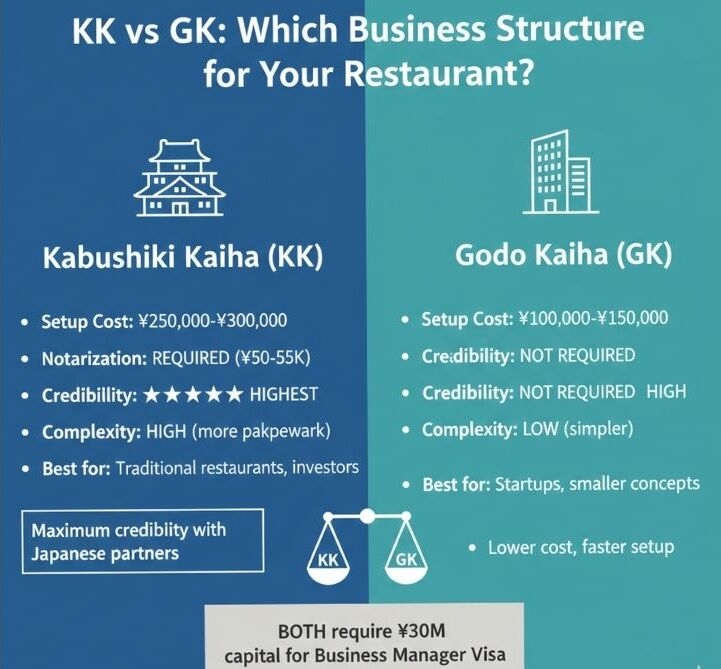
How to register your company in Japan
Once you’ve chosen your structure, you’ll need to formally register the company with the Legal Affairs Bureau (法務局, Homukyoku) in your jurisdiction. Here’s what the process involves:
1. Draft Your Articles of Incorporation (定款, Teikan)
- What it is: A legal document stating your company’s purpose, name, location, directors, shareholders, and capital.
- Where to do it: You can draft this yourself or use a judicial scrivener (司法書士, shihō shoshi). For K.K., notarization is required (see next step).
2. Have Your Articles Notarized (for K.K. only)
- What it is: K.K. incorporations must have their Articles of Incorporation notarized to become legally valid.
- Where to do it: At your local notary office (公証役場, Koushou Yakuba).
- Cost: Around ¥50,000–¥55,000 for notarization + stamp duties.
3. Submit registration documents to the Legal Affairs Bureau, including:
- Articles of incorporation (定款, Teikan) – The legal foundation of your company, includes the business purpose, name, location, capital, and director details.
- Notification of Incorporation (設立登記申請書, setsuritsu tōki shinseisho) – This is the official application form for company registration. It must match the details in your Articles of Incorporation exactly.
- Proof of paid-in capital (払込証明書, harai-komi shōmeisho) – A bank statement or capital contribution certificate showing that the startup capital was deposited into the incorporator’s account. It must be an actual bank transfer, cash deposits are not accepted.
- Registered seal (inkan) certificate (印鑑証明書, inkan shōmeisho) – After creating your company seal (hanko), it must be registered with the city or ward office. This certificate proves the legal use of your seal for corporate documents.
- Director and shareholder information – Copies of passports, residence cards (if applicable), and signature samples of all directors and shareholders. If you are not in Japan at the time of registration, notarized passport copies may be required.
After approval, you’ll receive your company registration certificate and corporate number, this is the foundation you’ll use to apply for permits, open a bank account, and apply for your visa.
(Optional) Apply for a Business Manager Visa
To run your business on the ground in Japan, foreign nationals typically need a Business Manager Visa (経営・管理ビザ). As of October 16, 2025, the Immigration Services Agency significantly revised the requirements. These changes represent the most substantial tightening of entrepreneur visa rules in over a decade.
New Requirements (Effective October 16, 2025):
| Requirement | Previous Standard | Current Standard (Oct 2025~) |
| Capital investment | ¥5 million OR 2 full-time employees | ¥30 million AND 1+ full-time employee (both required) |
| Full-time employee | Optional if capital met | Mandatory > must be Japanese national, permanent resident, or long-term resident |
| Japanese language | Not required | JLPT N2 equivalent required (applicant OR employee) |
| Education/experience | Not specified | Master’s/professional degree OR 3+ years management experience |
| Business plan verification | Self-prepared acceptable | Must be verified by licensed professional (税理士, 公認会計士, or 中小企業診断士) |
| Office space | Required | Required > home office no longer permitted |
Key implications for restaurant founders:
- Capital: You now need ¥30 million in capital (not ¥5 million as previously). This represents a 6x increase.
- Mandatory hiring: You must employ at least one full-time staff member who is a Japanese citizen, permanent resident, special permanent resident, or spouse of a Japanese/permanent resident. Workers on standard work visas (e.g., 技術・人文知識・国際業務) do not count toward this requirement.
- Japanese ability: Either you or one of your full-time employees must demonstrate Japanese proficiency at JLPT N2 level or equivalent. This can be proven through test certificates, completion of Japanese university programs, or other documentation.
- Expert verification: Your business plan must be reviewed and verified by a licensed Japanese professional (tax accountant, certified public accountant, or small/medium enterprise consultant).
- Management experience or education: You must have either three or more years of experience in business management or hold a master’s degree, doctoral degree, or professional degree.
Transitional measures: For those who already hold a Business Manager Visa under the old requirements, a three-year transition period applies (until October 16, 2028). During this period, renewals may be approved under comprehensive review even if you don’t fully meet the new standards > provided your business is operating well, taxes are paid, and you’re making progress toward compliance.
Important note on restaurant operations: The Business Manager Visa permits management activities only. You may not work in the kitchen or serve customers as your primary activity > this would require hiring staff with appropriate work authorization or Japanese residents to handle operations.
For complete guidance on the new requirements, see SmartStart Japan’s Business Manager Visa guide.
Also consider Startup Visa as an entry path
Given the significantly higher barriers for the Business Manager Visa since October 2025, the Startup Visa (スタートアップビザ) has become an even more valuable pathway for foreign entrepreneurs.
Key features of the Startup Visa:
- Nationwide availability: As of January 2025, the program was unified and expanded nationally. Previously limited to designated special zones, entrepreneurs can now apply through certified municipalities across Japan.
- Preparation period: Up to 2 years to prepare your business (extended from the previous 1-year maximum)
- Lower initial requirements: You do not need to meet the full Business Manager Visa capital and hiring requirements during the preparation period
- Activities permitted: Business planning, market research, securing office space, opening bank accounts, meeting with advisors, and other startup preparation activities (but not revenue-generating operations)
How it works:
- Apply to a certified local government (自治体) with your business plan
- Upon approval, receive certification allowing you to apply for a “Specified Activities” (特定活動) visa
- Use the 6-month to 2-year period to establish your business, secure premises, hire staff, and meet Business Manager Visa requirements
- Apply to convert to a Business Manager Visa once you meet all requirements
Important note on timing: If you received your Startup Visa confirmation before October 16, 2025, you may convert to a Business Manager Visa under the previous (lower) requirements. If your confirmation was issued after October 16, 2025, the new requirements (¥30M capital, mandatory employee, etc.) apply.
Restaurant businesses are eligible for the Startup Visa program. Use SmartStart Japan’s Startup Visa guide for detailed application steps.

Step 4 – Secure a Location and Negotiate the Lease
Be prepared for leasing challenges
Choosing the right location is critical, and navigating Japan’s commercial leasing process can be challenging for foreign entrepreneurs. Common hurdles include high upfront costs, large deposits, and landlords often requiring a guarantor (保証人, hoshōnin). Some may also be hesitant to lease to foreign-run businesses without local partners or credit history.
Work with specialists and read the fine print
To avoid surprises, work with bilingual real estate agents who understand the needs of foreign tenants. Expect to pay several months’ rent upfront in the form of a deposit and key money, and budget for guarantor service fees if you don’t have a local co-signer.
Look for high foot traffic areas that suit your concept, and revisit any inuki options identified during your planning phase to keep renovation costs down. Be sure to clarify lease terms, like renewal fees, restoration obligations, and utility responsibilities, and always have a legal advisor review your contract before signing.
Step 5 – Apply for Permits and Comply with Regulations
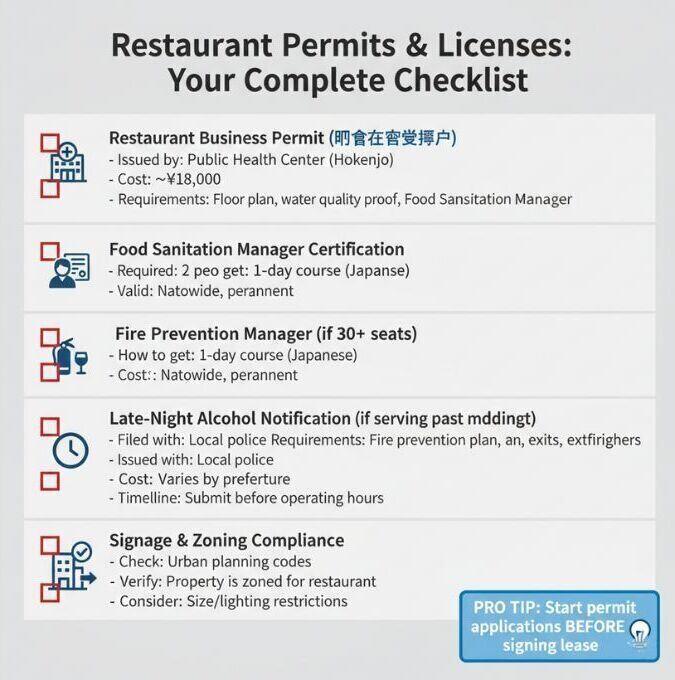
To legally operate a restaurant in Japan, you’ll need a Restaurant Business Permit (飲食店営業許可 / inshokuten eigyō kyoka) from your local public health center (保健所 / hokenjo). This permit ensures your facility meets hygiene and structural standards under the Food Sanitation Act (食品衛生法).
Application process:
- Pre-consultation (事前相談): Before construction or renovation begins, visit your local public health center with floor plans. Staff will review whether your design meets facility standards.
- Submit application: File your application approximately 10 days before your facility is ready for inspection. Required documents include:
- Restaurant Business Permit Application (飲食店営業許可申請書)
- Floor plan showing kitchen layout, equipment placement, and seating
- Proof of Food Sanitation Manager certification
- Water quality test results (if not using municipal water)
- Company registration certificate (for corporations)
- Facility inspection: A health inspector will visit to verify compliance with facility standards, including separate handwashing sinks, adequate ventilation, proper food storage, and waste disposal areas.
- Permit issuance: If you pass inspection, your permit is typically issued within 1–2 weeks. Permits are valid for 5–8 years depending on the prefecture.
Application fees vary by municipality. In Tokyo, the current fee for restaurant business permits is approximately ¥18,300 for new applications and ¥8,900 for renewals. Osaka charges approximately ¥16,000 for new permits. Always confirm current fees with your local health center.
Online application: Many health centers now accept applications through the Ministry of Health, Labour and Welfare’s Food Sanitation Application System (食品衛生申請等システム), allowing you to submit documents electronically.
Food Sanitation Manager (食品衛生責任者 / shokuhin eisei sekininsha)
Every food establishment must designate a Food Sanitation Manager. If you or a staff member don’t already hold a qualifying certification (such as 調理師 / licensed cook, 栄養士 / nutritionist, or 製菓衛生師 / confectionery hygiene supervisor), one person must complete a one-day training course.
Course options:
- In-person: Offered by local food sanitation associations, typically one day, approximately ¥10,000–12,000
- e-Learning: Now available in most prefectures through the Japan Food Sanitation Association’s online platform. Approximately 6 hours of video content completed over 30 days, same fee range
The e-learning option is particularly useful for busy entrepreneurs, though note that courses are conducted entirely in Japanese. The certification is valid nationwide once obtained.
For detailed guidance on local procedures and variations, see our restaurant Licensing in Japan article to stay compliant with food service regulations.
Fulfill fire safety and late-night alcohol laws
Fire Safety Compliance
Fire safety requirements apply to all restaurants, with additional obligations for larger venues:
- All restaurants: Must maintain clear emergency exits, post evacuation signage, and properly install fire extinguishers
- 30+ occupants: If your restaurant (including staff) can accommodate 30 or more people, you must appoint a Fire Prevention Manager (防火管理者 / bōka kanrisha) and submit a fire prevention plan to your local fire department. The manager must complete a certification course (1–2 days depending on building size).
Late-Night Alcohol Service
If your restaurant plans to serve alcohol after midnight (0:00–6:00) and alcohol is the primary offering, you must file a Late-Night Alcohol Service Notification (深夜酒類提供飲食店営業開始届出) with your local police station at least 10 days before commencing late-night operations.
This requirement applies to bars, izakayas, and similar establishments where alcohol is the main attraction. If your restaurant serves alcohol alongside substantial meals (rice dishes, noodles, or bread-based items as main courses), you generally do not need this notification > but borderline cases should be confirmed directly with the police station.
Ensure full location compliance
Before launch, confirm that your property is properly zoned for restaurant operations. This includes checking local urban planning codes and signage ordinances. Most cities restrict business types in residential areas and limit external signage sizes or lighting styles. Inspections are usually conducted by the municipal planning department during the permit process.
Finally, ensure all permits and certificates are visibly posted, and your staff is trained in basic hygiene and safety procedures before opening.
Cost Breakdown of opening a restaurant in Japan
Once you’ve registered your company and understand the permit requirements, you can estimate your total startup investment. The following table reflects typical costs for foreign-owned restaurants in Japan, updated to reflect the October 2025 Business Manager Visa changes:
| Category | Estimated Cost Range (JPY) | Notes |
| Company registration (KK or GK) | ¥200,000–¥300,000 | GK is less expensive |
| Notarization (KK only) | ¥50,000–¥55,000 | Not required for GK |
| Business Manager Visa requirements | ¥30,000,000+ | Capital requirement as of Oct 2025 |
| Office/restaurant lease (initial) | ¥1,500,000–¥5,000,000 | Deposit, key money, advance rent |
| Renovation & equipment | ¥2,000,000–¥8,000,000 | Lower with inuki property |
| Licensing & permits | ¥100,000–¥350,000 | Varies by municipality |
| Initial working capital | ¥1,500,000–¥4,000,000 | 3–6 months operating expenses |
| Professional fees (visa support, accountant) | ¥500,000–¥1,500,000 | Business plan verification now required |
| Total estimated range | ¥36,000,000–¥50,000,000+ |
Important considerations:
- The visa capital requirement (¥30M) is not “spent”—it remains as company capital. However, you must demonstrate you have these funds available.
- The above does not include personal living expenses during the startup period.
- Using an inuki property and secondhand equipment can significantly reduce renovation costs.
- Regional cities outside Tokyo may allow total investments 20–30% lower.
Verification note: These estimates are indicative. Actual costs depend heavily on location, property type, concept, and negotiated terms. Consult with professionals familiar with your specific situation.

Step 6 – Align Your Concept with Japanese Consumer Expectations
Adapt your service to Japanese expectations
To succeed in Japan’s restaurant scene, foreign founders must align their customer experience with local norms (without losing their unique brand). Japanese diners value spotless cleanliness, refined presentation, and consistent service grounded in omotenashi (thoughtful, anticipatory hospitality). Even casual restaurants are judged on fine details like staff demeanor, table setup, and noise levels.
Tailor your menu and feedback process
Keep your concept authentic, but adapt formats and portions to fit local habits. Seasonal dishes, smaller lunch sets, and clear allergen labeling help build trust. Bilingual menus are increasingly expected, especially in tourist-heavy cities. Feedback is often subtle in Japan, so monitor review platforms like Tabelog for patterns you may miss in direct conversation.
Avoid legal and cultural missteps
Due Diligence on Property Acquisition
If you’re taking over an existing property or business, conduct thorough due diligence. Check for back taxes, unpaid wages, outstanding supplier invoices, and lease obligations. Engage a legal advisor familiar with restaurant transactions before signing any agreements.
Hiring Restrictions
Staffing a restaurant as a foreign owner requires understanding Japan’s visa system:
- You (Business Manager Visa holder): May only engage in management activities. You cannot work in the kitchen or serve customers as your primary role.
- Front-of-house and kitchen staff: Must be Japanese nationals, permanent residents, or foreigners with appropriate work authorization. There is no standard visa category for restaurant service or kitchen work (unlike skilled chef positions that may qualify under the “技能” visa for specific cuisines).
- Skilled chefs: Foreign chefs with 10+ years of experience in specific cuisines (e.g., French, Italian, Thai, Indian) may qualify for a Technical Skill Visa (技能ビザ). This requires documented experience.
Cultural Business Practices
Business in Japan relies on group consensus (根回し / nemawashi) rather than quick individual decisions. Rushing negotiations or being overly transactional can damage trust. Take time to build relationships and show respect for the decision-making process—this Japanese Business Etiquette guide can help you navigate these expectations.
Step 7 – Launch and Promote Your Restaurant
Build visibility on Japan’s restaurant platforms
Launching your restaurant in Japan means building visibility where locals actually look. Platforms like Tabelog, Gurunavi, and Retty dominate restaurant discovery, so claim and optimize your listings with quality photos, clear menus, and accurate hours. For visual appeal, Instagram outperforms Google, especially among younger diners, so showcase your dishes and vibe there. To retain customers, use LINE for loyalty programs and direct promotions.
Use social and messaging platforms that locals prefer
Community outreach also matters. Partner with bilingual food influencers to tap into local and expat audiences, and connect with chambers of commerce or international entrepreneur networks to gain credibility and referrals.
To better tailor your concept to local preferences, read this article on How to Localize for the Japanese Market.
Case Study: Napoletan pizza in Japan
Italian chef Salvatore Cuomo built a restaurant empire in Japan by combining authentic Neapolitan pizza with local expectations. He adapted portion sizes, presentation, and service to match Japanese dining culture, embracing omotenashi to earn customer loyalty.
Cuomo also understood the importance of local visibility. He strategically leveraged platforms like Tabelog, collaborated with Japanese media, and tailored his branding to resonate with local sensibilities. His approach wasn’t just about food, it was about cultural fluency.
Today, his brand operates more than 85 locations across Japan and generates over €80 million annually, offering a compelling example of how foreign entrepreneurs can succeed in Japan by aligning with local expectations and building trust with Japanese consumers.
FAQ – Opening a Restaurant in Japan
How much money do I need to open a restaurant in Japan as a foreigner?
As of October 2025, you need at least ¥30 million in capital to qualify for a Business Manager Visa—this is a legal requirement, not a suggestion. Your total startup costs will typically range from ¥36–50 million or more when including company registration, permits, property costs, equipment, and working capital.
Can I work in my own restaurant kitchen?
No. The Business Manager Visa authorizes management activities only. You must hire staff (Japanese nationals or residents with work authorization) to handle kitchen and service operations. If you personally work in the kitchen or serve customers as your primary activity, you may be found to lack “management substance” and risk visa non-renewal.
Do I need to speak Japanese to open a restaurant in Japan?
Under the October 2025 visa requirements, either you or one of your mandatory full-time employees must demonstrate Japanese proficiency at JLPT N2 level or equivalent. Beyond the visa requirement, practical operations benefit significantly from Japanese ability—dealing with suppliers, health inspectors, local government offices, and many customers requires Japanese communication.
How long does it take to open a restaurant in Japan?
From initial planning to opening, expect 4–8 months at minimum. This includes company registration (2–4 weeks), property search and lease negotiation (1–3 months), renovation (1–3 months), permit applications (2–3 weeks), and visa processing (1–3 months, which can occur in parallel with other steps if using the Startup Visa pathway).
What permits do I need for a restaurant in Japan?
At minimum: Restaurant Business Permit (飲食店営業許可) from your local health center. Additional permits may include: Late-Night Alcohol Service Notification (for bars/izakayas serving past midnight), Fire Prevention Manager certification (for larger venues), and various municipal permits depending on signage and outdoor seating.
Is the Startup Visa easier than the Business Manager Visa?
The Startup Visa offers a lower initial threshold—you don’t need to meet all Business Manager Visa requirements immediately. However, you must eventually meet those requirements to convert your status. The Startup Visa is best viewed as a preparation period (up to 2 years) rather than an alternative.
Conclusion: Enter the Market with Confidence
Opening a restaurant in Japan requires careful planning, regulatory understanding, and cultural sensitivity, but with the right approach, it is entirely achievable. From selecting your business structure and securing permits to localizing your service and marketing, each step lays the groundwork for long-term success.