
Originally Written By Brady Koong, Revised May 2026
Setting up a company in Japan can feel complicated if you are new to the country. One of the first decisions you need to make is whether to register a Godo Kaisha, Kabushiki Kaisha, or Branch Office, or to operate as a sole proprietor.
A Godo Kaisha, often called a GK, is one of the most common structures for setting up a company in Japan — popular with foreign founders, small business owners, and overseas companies entering the market. It is faster and cheaper to set up than a Kabushiki Kaisha, also known as a KK. However, that does not mean it is the right choice for everyone.
This article will explain what a Godo Kaisha is, who it is suitable for, how it compares with a KK, what costs and procedures to expect, and what mistakes to avoid before registering one in Japan.
Continue reading this guide to understand whether a GK is the right structure for your business in Japan.
The information in this article has been checked by a scrivener in Japan.
A Godo Kaisha (GK) is a type of Japanese limited liability company where all members enjoy limited liability while directly managing the business. It closely resembles a US LLC in structure and flexibility. GKs are popular among small businesses, startups, and foreign companies entering Japan due to their low setup costs and simple governance.
Not Sure Which Structure Fits Your Business?
- GK or KK comparison tailored to your visa status, goals, and timeline.
- Full incorporation handled in English, from Articles of Incorporation to Legal Affairs Bureau filing.
- Trusted by 100+ companies incorporated across Japan.
Key Takeaways
- A Godo Kaisha is usually best for solo founders, small teams, freelancers upgrading from a sole proprietorship in Japan, and foreign companies setting up in Japan who want limited liability, lower setup costs, and no plans to raise VC or go public.
- Choose a KK instead if you plan to raise venture capital, issue shares, go public, or work mainly with conservative Japanese corporations or government agencies, where the KK structure still carries more credibility.
- A GK requires less paperwork than a KK because it skips notarization of the Articles of Incorporation and several related documents, making setup faster and cheaper.
- A GK-type incorporation works well for getting a corporate bank account, while a branch office has a much lower probability of getting a corporate bank account
- A GK allows you to apply for government subsidies and grants, while a branch office will have a very low probability of getting one
- Business Manager Visa applicants need more than a registered GK: the visa now requires ¥30 million in capital, one qualifying full-time employee, JLPT N2-level Japanese ability, relevant management experience or education, expert confirmation of the business plan, and a dedicated physical office.
What Is a Godo Kaisha in Japan?
A Godo Kaisha, or GK, is a limited liability company structure in Japan. It is similar in function to an LLC in some other countries, although the legal details are different.
A GK allows business owners to operate through a registered company while limiting personal liability. This means that, in most normal cases, the company’s obligations are separated from the personal assets of the members.
For many foreign founders in Japan, the GK is attractive because it is simple, flexible, and less expensive to establish than a KK. It does not require notarization of the Articles of Incorporation, and the registration process is usually faster.
However, a GK is not always the best structure. If you plan to raise venture capital, issue shares, go public, or work heavily with traditional Japanese corporations or government-related clients, a KK may be a better choice.
However, a GK is often a much better choice than a branch office, as a branch office’s liability is held by the parent company in a foreign country; banks and office owners will treat you more favorably with a GK.
For more detailed information on the Kabushiki Kaisha, refer to our article on Kabushiki Kaisha in Japan.
Governance
A Godo Kaisha’s internal structure is more flexible and less formal than a Kabushiki Kaisha (KK), but it still follows clear rules around who owns the company, who runs it, and how decisions get made.
Members (出資者)
Members own the GK. They contribute capital, such as money, assets, or in some cases services, in exchange for an ownership stake. Every member has limited liability, meaning their personal financial risk is capped at the amount they invested. Unlike a KK, members in a GK are also directly involved in running the business, rather than sitting passively as shareholders.
Executive Members (業務執行社員)
Executive members are the members responsible for the day-to-day operation and management of the company. By default, every member of a GK is also an executive member unless the Articles of Incorporation state otherwise. This means members typically wear two hats as both owner and manager.
Representative Members (代表社員)
A representative member is the person authorized to act and sign on behalf of the GK in official and legal matters, similar to a company representative or CEO. If the Articles don’t specify otherwise, every executive member has this authority by default. However, most GKs designate one specific person as the sole representative member for clarity and simpler administration, especially when dealing with banks, government offices, or contracts.
Decision Making
Under Japan’s Companies Act, major decisions in a GK generally require unanimous consent of all members, unless the Articles of Incorporation set a different rule such as majority approval. This differs from a KK, where shareholder votes are typically based on ownership percentage. Because of this, GK founders often draft custom decision-making rules into the Articles to avoid deadlock as the company grows or adds members.
Transfer of Equity
A member who wants to sell or transfer their ownership stake in a GK generally needs the consent of all other members, unless the Articles state otherwise. This protects the closely held nature of the company and prevents outside parties from joining without the existing members’ agreement. This is another notable contrast to a KK, where shares can typically be transferred more freely.
Corporate Parent Rules
A company, not just an individual, can be a member of a GK, and can even serve as an executive or representative member. When a corporate entity acts as a representative member, it must appoint a natural person to carry out those duties on its behalf. This makes the GK structure a common choice for foreign parent companies setting up a wholly owned subsidiary in Japan.
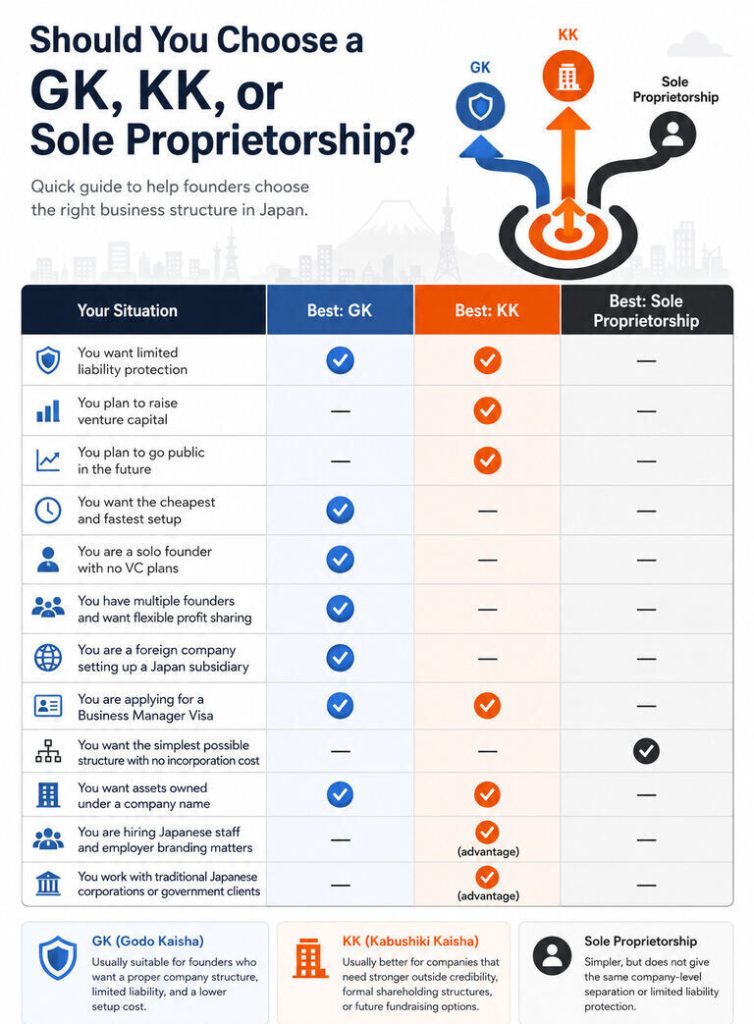
Should You Choose a GK, KK, or Sole Proprietorship?
Before setting up a GK, it is important to compare it with the other main options.
| Your Situation | Best Structure |
| You want limited liability protection | GK or KK |
| You plan to raise venture capital | KK |
| You plan to go public in the future | KK |
| You want the cheapest and fastest setup | GK |
| You are a solo founder with no VC plans | GK |
| You have multiple founders and want flexible profit sharing | GK |
| You are a foreign company setting up a Japanese subsidiary | GK |
| You are applying for a Business Manager Visa | GK or KK |
| You want the simplest possible structure with no incorporation cost | Sole proprietorship |
| You want assets owned under a company name | GK or KK |
| You are hiring Japanese staff, and employer branding matters | KK has an advantage |
| You work with traditional Japanese corporations or government clients | KK has an advantage |
In simple terms, a GK is usually suitable for founders who want a proper company structure, limited liability, and a lower setup cost.
A KK is usually better for companies that need stronger outside credibility, formal shareholding structures, or future fundraising options.
A sole proprietorship is simpler, but it does not give the same company-level separation or limited liability protection.
Who Is a Godo Kaisha Actually For?
A Godo Kaisha is often used by three main groups in Japan.
1. Foreign Companies Setting Up a Japan Subsidiary
Many large multinational companies use the GK structure in Japan. This includes well-known companies such as Amazon Japan, Apple Japan, Google Japan, Mercedes-Benz Japan, and IKEA Japan.
These companies are not choosing a GK because they want to save a small amount on registration fees. They use the structure because it gives the parent company more control and avoids some of the formal requirements of a KK, such as board structures and shareholder meetings.
Additionally, setting up a Japan subsidiary greatly increases the likelihood of getting a Japanese bank account, government subsidies and grants, real estate, and closing deals compared to a branch office.
For a foreign company entering Japan, that simplicity can be very useful.
2. Solo Founders Who Already Have Work Authorization
A GK is also suitable for foreign founders who already have a visa status that allows them to work in Japan, such as permanent residency, a spouse visa, or another valid work status.
If you already have the right to work in Japan, the Business Manager Visa capital requirement does not apply to you. This means you may be able to incorporate a GK with far less capital than someone who needs a visa.
For this type of founder, a GK can be a quick and affordable way to start operating as a company.
3. Freelancers Upgrading From Sole Proprietorship
Many freelancers begin as sole proprietors. Later, they decide to incorporate when their business grows, when a Japanese client requires that the service provider be a corporation rather than a sole proprietor, or when liability becomes a concern.
A GK can be a good middle step because it gives the founder a corporate structure without the higher setup cost and formality of a KK.
Who Should Not Choose a Godo Kaisha?
A GK is not suitable for every founder.
You should usually avoid a GK if:
- You plan to raise venture capital
- You want to issue shares
- You plan to go public
- Your clients strongly prefer dealing with a KK
- You need the strongest possible employer branding in Japan
- You are working with conservative Japanese corporations or government agencies
A GK is legally valid, but perception still matters in Japan. In some industries, a KK may feel more established and familiar to Japanese partners, employees, and clients.
If you are not sure which structure is better for your situation, it is safer to compare both before registering.
Can a GK Close Corporate Deals in Japan?
Yes, a GK can sign contracts, work with large companies, and operate legally in Japan.
No rule prevents a GK from doing business with corporations. Large companies in Japan already operate as GKs, so the structure itself is not a barrier.
However, credibility concerns can appear in certain situations.
Some Japanese job seekers search online for terms like “合同会社 やばい,” which roughly means “is a GK suspicious?” This is because some people associate GKs with smaller or newer companies, so the ease and low cost of a GK does result in lower trust from some people and organizations.
This does not mean you cannot hire good staff as a GK. It means you may need to show stronger proof that your company is real, active, and stable. One way to show a potential corporate client your reliability is by having a large amount of capital in the business.
In most sectors, such as consulting, digital services, technology, and general B2B services, the GK structure does not usually become a major issue as factors like branding, reputation, and who introduced you is more important than entity type.
What Are the Main Differences Between a GK and a KK?
The biggest practical difference between a GK and a KK is the setup process.
A KK requires more formal paperwork and notarization. A GK is simpler and skips several of these steps.
| Document or Step | KK | GK |
| Articles of Incorporation | Required | Required |
| Notarization at a notary’s office | Required | Not required |
| Certified copy of notarized articles | Required | Not required |
| Director acceptance forms | Required | Not required |
| Revenue stamp on paper articles | Required | Required, unless electronic |
| Proof of capital deposit | Required | Required |
| Company seal registration | Required | Required |
| Legal Affairs Bureau submission | Required | Required |
The notarization step is one of the main reasons a KK takes more time and costs more to establish. For a KK, you usually need to visit a notary’s office, pay notarization fees, and wait for the certified copy before completing the registration.
A GK does not require this step. You prepare the Articles of Incorporation, deposit the capital, prepare the registration documents, and submit them to the Legal Affairs Bureau.
How to Form a GK: 6 Steps
- Decide the company basics. Choose the company name, business purpose, registered address, who the members will be, and how much capital each member will contribute.
- Draft and execute the Articles of Incorporation. Members agree on and sign the Articles. Unlike a KK, a GK does not need to have these Articles notarized, which saves time and cost.
- Deposit the capital. The agreed capital amount is deposited into a bank account, and proof of the deposit is prepared for the registration filing.
- Prepare the registration documents. This includes the Articles of Incorporation, proof of capital deposit, member and representative details, and the company seal registration.
- File for company registration at the Legal Affairs Bureau. Once approved, the company is legally established and receives its corporate registry number.
- Complete post-registration filings. After incorporation, file the required notifications with the tax office, prefectural and municipal tax offices, and, if hiring, social insurance, employment insurance, and workers’ compensation.
This is why many founders choose a GK when speed and cost are important.
[We are happy to provide a free 30-minute consultation if you are not sure if a GK or a KK would be better for you. We have set up more than 60 businesses and helped our clients choose the right setup.]
Is a GK Cheaper for Tax Filing?
One common misunderstanding is that a GK is cheaper to file taxes for than a KK.
This is usually not true.
Tax filing fees are based more on the amount of accounting work than on the company structure. Accountants usually look at things such as:
- Number of invoices
- Number of expenses
- Payroll activity
- Foreign currency transactions
- Consumption tax registration
- Complexity of the business
- Number of bank accounts and payment platforms
A GK with many transactions can cost more to file than a simple KK with very few transactions.
The main cost savings of a GK are at the incorporation stage and when making certain amendments later. The ongoing tax filing cost is usually not very different from a KK.
How Much Does It Cost to Change the Articles of Incorporation?
After you establish a company in Japan, you may need to change the Articles of Incorporation if your business activities change or your company structure changes.
For example, you may need an amendment if:
- You add a new business activity
- You change certain registered details
- You restructure ownership or membership
- You need to update the company’s purpose
- You did not include broad enough business objectives at the beginning
The cost difference between GK and KK can matter here.
| Cost Item | KK | GK |
| Re-notarization | ¥30,000 to ¥50,000 | Not required |
| Amendment registration fee | Around ¥30,000 | Around ¥30,000 |
| Judicial scrivener fee | Around ¥50,000 to ¥100,000 | Around ¥30,000 to ¥70,000 |
| Approximate total | ¥110,000 to ¥180,000+ | ¥60,000 to ¥100,000 |
The reason a KK is more expensive is that certain changes require another notarization step. A GK avoids that.
Based on our experience helping more than 60 companies set up, this is why it is important to write your business objectives broadly when you first incorporate. If your objectives are too narrow, you may need to pay for amendments later.
A common Japanese catch-all phrase is:
前各号に附帯関連する一切の事業
This means all businesses incidental or related to the above.
Adding this type of clause can help reduce the risk of needing unnecessary amendments later.
Take a look at our guide for the Cost of setting up a Company in Japan if cost is a concern.
How Does Profit Distribution Work in a GK?
A GK gives founders more flexibility in profit distribution than a KK.
In a KK, profits are usually distributed according to share ownership. If one shareholder owns 60 percent of the shares, that shareholder normally receives 60 percent of the distributions.
In a GK, members can agree to a different profit split even if their capital contributions are not equal.
For example, one member may contribute more money, while another member contributes more time, operations, or local knowledge. The GK structure allows the members to agree on a profit distribution that reflects the actual business relationship.
This can be helpful for foreign founders working with a Japanese operational partner.
The agreed profit distribution should be clearly written into the Articles of Incorporation. This is a very complicated area that needs to be done properly, and we help many GK founders with shared ownership. You can book a free consultation here.

Can You Use a GK for the Business Manager Visa?
Yes, you can use a GK for the Business Manager Visa. However, choosing a GK does not reduce the visa requirements.
This is an important point.
Registering a GK and qualifying for the Business Manager Visa are separate issues. A GK itself has no minimum capital requirement. In theory, you can register a GK with a very small amount of capital.
The Business Manager Visa has its own requirements.
As of October 2025, the Business Manager Visa requires:
- ¥30 million in paid-in capital
- At least one qualifying full-time employee, limited to a Japanese national, special permanent resident, permanent resident, spouse or child of a Japanese national, spouse or child of a permanent resident, or long-term resident
- JLPT N2 Japanese ability for you or your employee
- Three or more years of management experience, or a relevant master’s degree
- A business plan confirmed by a qualified external expert, such as a licensed SME Management Consultant (中小企業診断士), CPA, or tax accountant
- A dedicated physical office
This means that using a GK instead of a KK does not reduce the ¥30 million capital requirement if you are applying for the Business Manager Visa.
A dedicated physical office is required for the Business Manager Visa. Home offices are generally not accepted, and virtual or shared offices should be treated as disqualifying for visa purposes. Immigration wants to see a real, independent business location that functions as an operating base, not only a mailing address or shared desk.
Virtual offices may still work for basic GK registration, but they create serious problems for both visa applications and corporate bank account opening.
Business Manager Visa Requirements Are Strict. Get Them Right.
- Capital planning and business plan preparation reviewed by qualified professionals.
- Office setup guidance so your physical address meets immigration standards.
- 60+ visas granted for foreign founders across Japan.
What Should You Know About Opening a Corporate Bank Account?
Opening a corporate bank account is one of the most difficult steps for many foreign founders in Japan.
Even after your GK is registered, the bank account is not automatic. Banks review the company carefully, especially if it is new, foreign-owned, or has no operating history.
GKs may face slightly stricter screening than KKs because they are cheaper and faster to set up. Banks may worry about shell companies or inactive entities.
To improve your chances, it is better to prepare:
- A clear Japanese business plan
- A dedicated physical office address — virtual offices are not accepted by most banks. *Requirements in this area can change, so confirm current expectations with a professional before applying
- Proof of real business activity
- A credible amount of paid-in capital
- A website or company profile
- A contract, invoice, or paying customer, if possible
If a megabank rejects your application, you can also consider Japan Post Bank or online banks such as GMO Aozora and Rakuten Bank. These banks may be more flexible for new companies.
For a full walkthrough, you should also read our guide on opening a corporate bank account in Japan.

What Are the Post-Establishment Filing Deadlines?
After you register a GK, the work is not finished. Several tax, pension, and labor filings may be required.
Missing these deadlines can create issues, and there is some variance. As a practical rule, SmartStart Japan recommends completing national, prefectural, and municipal tax registrations within 2 weeks of incorporation so nothing is missed.
| Deadline After Establishment | Required Action | Where To Submit |
| Within 2 months | Corporation Establishment Notification | Local Tax Office |
| Within 3 months, or before the fiscal year end | Blue-Form Tax Return Application | Local Tax Office |
| Within 15 days | Prefectural tax notification | Prefectural Tax Office |
| Within 15 days | Municipal tax notification | Municipal Office |
| Within 5 days, if hiring | Social Insurance Registration | Japan Pension Service |
| Within 10 days, if hiring | Employment Insurance | Hello Work |
| Immediately, if hiring | Workers’ Compensation Insurance | Labor Standards Inspection Office |
The social insurance deadline is especially important. If you hire an employee, the 5-day clock starts when the employee begins work.
This matters even more for founders applying for the Business Manager Visa because hiring a full-time employee may be part of the visa requirement.

What Common Mistakes Should You Avoid?
There are several mistakes that foreign founders often make when setting up a GK in Japan.
1. Mixing Up GK Registration and Visa Requirements
A GK does not require ¥30 million in capital.
The Business Manager Visa does.
These are separate processes. If you already have work authorization, you may not need the same capital level. If you need a Business Manager Visa, you must plan for the visa requirements from the beginning.
GK or KK? We Help You Choose the Right Structure.
Advice tailored to your visa status, business type, and goals. We handle the full setup in English.
2. Treating the Bank Account as a Simple Step
Many founders assume the bank account will be easy after company registration. This is often not the case. Bank accounts are the hardest part, and not setting up your entity properly can result in you getting denied over and over again – we see it all the time, so you need to make sure you
Prepare your bank application before registration is completed. A Japanese business plan, physical office, company website in Japanese, and other factors can make a big difference, so best to work with a professional who can oversee the whole process from setting up to post-incorporation setup.
3. Writing Business Objectives Too Narrowly
If your company’s objectives are too narrow, you may need to amend your Articles of Incorporation later.
Each amendment can cost money and take time. It is better to include the business activities you may reasonably pursue over the next few years.
Struggling To Set Up a Company in Japan?
Setting up a company in Japan is easier when the structure, documents, banking, tax filings, and visa plan are handled together.
If you are not sure whether a GK or KK is better for your situation, SmartStart Japan can help you compare the options and prepare the full setup process.
This is especially useful if you are a foreign founder, applying for a Business Manager Visa, opening a corporate bank account, or setting up a Japan subsidiary for an overseas company.
FAQs
How is a GK different from a US LLC?
A GK and a US LLC are similar in that both offer limited liability and flexible internal management. The main differences are legal and procedural: a GK is formed under Japan’s Companies Act, has its own rules for representative members and decision-making, and is taxed as a corporation in Japan rather than passing through to members by default.
How is a GK taxed?
A GK is taxed as a corporation in Japan, meaning it pays corporate tax, local inhabitant tax, and enterprise tax on its profits. Members are then taxed personally on any salary or distributions they receive. Tax filing costs depend on the volume and complexity of transactions, not the entity type itself.
Does a GK have directors?
A GK does not have directors in the same sense as a KK. Instead, it has members who may also serve as executive members and a representative member, who together handle the roles a director would normally hold in a KK.
Can a corporate entity be a member of a GK?
Yes. A company can be a member of a GK and can even act as an executive or representative member. When it does, it must appoint a natural person to carry out those representative duties on its behalf.
What is the minimum number of members required?
A GK can be formed with just one member, making it a practical option for solo founders. There is no upper limit on the number of members.
Can a GK be converted into a KK later?
Yes. A GK can be converted into a KK if the business grows or needs the added credibility, fundraising options, or formal shareholding structure that a KK provides. The conversion involves its own filing and cost, so it is worth planning for early if conversion is likely.
Final Thoughts
A Godo Kaisha is one of the most practical company structures for many foreign founders in Japan.
It is faster and cheaper to establish than a KK, does not require notarization of the Articles of Incorporation, and gives members more flexibility in management and profit distribution.
However, it is not the right structure for every business. If you plan to raise venture capital, go public, hire aggressively in a conservative industry, or work mainly with traditional Japanese corporations or government agencies, a KK may be more suitable.
The most important thing is to choose the structure based on your actual business plan, not only the setup cost.
If your goal is to start quickly, keep the structure simple, and operate a real business in Japan, a GK may be the right choice. If your plans change later, it is also possible to convert a GK into a KK.
For help with incorporation, banking introductions, Business Manager Visa planning, or post-establishment compliance, book a consultation with SmartStart Japan.
Have a question about whether a GK fits your situation? Use the contact form below.