
- Key Takeaways:
- Am I eligible for the J-Find Visa?
- Which universities qualify?
- How Does J-Find Compare to Other Japan Visa Options?
- What activities are allowed on J-Find?
- How long can you stay on J-Find?
- How to apply for the J-Find Visa
- Required documents checklist
- What to do after arriving in Japan
- Practical challenges to expect
- What happens after J-Find?
- J-Find for entrepreneurs: realistic Business Manager planning
- Is J-Find worth it?
- FAQ
- Getting help with J-Find and business setup
- Full List of Universities for J-Find Visa
Key Takeaways:
- J-Find is officially a Designated Activities status for “Future Creation Individual” activities.
- It is for job hunting, startup preparation, and related activities in Japan.
- You must be at least 18 years old, have a bachelor’s degree or higher from an eligible university, have graduated within the last 5 years, and show enough personal savings.
- The official financial minimum is about JPY 200,000, but this is not a realistic moving budget for most people.
- The stay can be granted in 6-month or 1-year periods, with a maximum of 2 years in total.
- Your spouse and dependent children may be able to come with you, but their ability to work is separate and should not be assumed.
- If you want to start a company, plan the Business Manager Visa requirements early. J-Find gives time to prepare, but it does not remove those requirements.
Official source: Japan’s Ministry of Foreign Affairs lists J-Find under Designated activities for Future creation individual, and the Immigration Services Agency provides the Japanese application guidance on its J-Find page.
Am I eligible for the J-Find Visa?
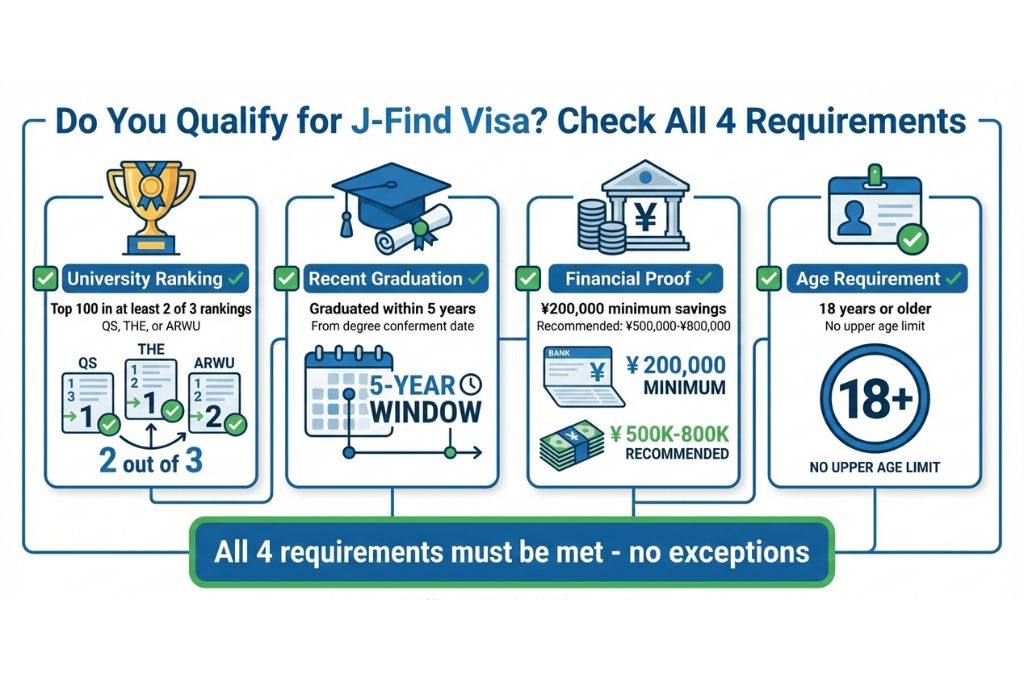
To qualify for the J-Find Visa, you need to meet all of the main requirements below. The Immigration Services Agency of Japan (ISA) created this visa to attract young, highly educated international talent who can contribute to Japan’s innovation economy. For entrepreneurs planning to establish a long-term business in Japan, the Business Manager Visa is the next step after the J-Find Visa.
| Requirement | What it means |
| Age | You must be 18 or older. |
| University | Your university MUST qualify under the designated global ranking rule. |
| Degree | You must have a bachelor’s degree, master’s degree, PhD, doctorate, or equivalent professional degree. |
| Graduation timing | You must have received the degree within the last 5 years. |
| Savings | You must show enough personal savings, with the official minimum around JPY 200,000. |
| Purpose | You must be coming to Japan for job hunting, startup preparation, or a related permitted activity. |
The university ranking rule
Your university must be ranked in the top 100 in at least 2 of the following 3 rankings:
- QS World University Rankings
- Times Higher Education World University Rankings
- Academic Ranking of World Universities
The Immigration Services Agency publishes a list of eligible universities, but rankings can change. Before you invest time in an application, check both the official list and the current ranking data.
For those who’re only looking for the full list of universities eligible, click here:
The 5-year graduation rule
The 5-year period runs from the date your degree was awarded. This is usually the date shown on your graduation certificate, degree certificate, or official school record.
This detail matters. If your transcript, diploma, and certificate show different dates, prepare an explanation before applying. Japan immigration processes often depend on documents matching cleanly, and mismatched dates can slow things down.
The savings rule
The official minimum is about JPY 200,000 in personal savings. This is a visa threshold, not a realistic living budget.
For most applicants, JPY 200,000 will not cover moving costs, temporary housing, deposits, daily expenses, and the slow start that often comes with job hunting in Japan. A more practical budget is usually several months of living costs, especially if you plan to live in Tokyo, bring family, or spend time on startup preparation before earning income.
Your bank documents should be easy to understand. Use an account in your own name where possible. If the balance recently increased, be ready to explain the source of funds. If the account is in foreign currency, include a clear conversion basis.
J-Find Visa In One Sentence
J-Find is a status of residence under Designated Activities. Its official English description is “Future creation individual.” In Japanese, it is connected to the term mirai sozo jinzai, meaning future creation talent.
For a broader overview of Japan’s work status categories, see our guide to types of working visas.
Which universities qualify?
The qualifying universities are based on the top-100 rule across QS, THE, and ARWU rankings. The full list is included near the end of this article.
Before applying, do not rely only on memory or brand reputation. Even a famous university needs to meet the ranking rule. Also, some universities qualify through a graduate school or main university name, so make sure your degree documents match the institution name you plan to use in the application.
If your university is not on the list, J-Find is usually not available. Personal achievement, work experience, startup experience, or a strong CV does not normally override the university requirement.
Not Sure If You Qualify For The J-Find?
- Eligibility check against your university and graduation timeline.
- Clear path planning for job hunting or startup preparation.
- Trusted by 100+ companies incorporated across Japan.
How Does J-Find Compare to Other Japan Visa Options?
Understanding how J-Find fits within Japan’s broader visa landscape helps you determine if it’s the best option for your situation. Here’s how J-Find compares to other common pathways for foreigners entering Japan:
| Visa Type | Job Offer Required? | Duration | Capital/Financial Required | Age Limit | Best For |
| J-Find | No | Up to 2 years | ¥200,000 savings | None (18+) | Job hunting & startup preparation |
| Working Holiday | No | 1-2 years (varies by country) | Varies (typically ¥300,000+) | Usually under 30 | Young adults from treaty countries |
| Student Visa | Yes (school admission) | Duration of study | Tuition + living costs | None | Full-time education in Japan |
| Engineer/ Specialist Visa | Yes (job offer required) | 1-5 years, renewable | None | None | Confirmed employment |
| Business Manager | No | 1-5 years, renewable | ¥30,000,000 + employee | None | Established business operations |
| Startup Visa | No | 6-24 months (varies by municipality) | None initially | None | Entrepreneurs with local government endorsement |
What activities are allowed on J-Find?
J-Find is meant for preparation. The main permitted activities are:
- Job hunting
- Interviews and career events
- Networking with employers, recruiters, founders, and investors
- Startup preparation
- Market research
- Business planning
- Looking for office space
- Preparing incorporation and licensing steps
- Limited paid work to support yourself, as long as the main purpose of your stay remains J-Find activity
For founders, this can be a useful period to test the Japanese market, meet partners, compare company types, and prepare a realistic business plan. If you are still deciding how to enter Japan, our Japan market entry guide is a useful next step.
What you should not do
Do not treat a J-Find as a normal full-time work visa. If your real purpose is to work full time, you should change to the proper work status first.
Also be careful with remote work. If you spend most of your time working remotely for overseas clients or an overseas employer, immigration may question whether your actual activity matches the J-Find purpose.
Work in adult entertainment and similar restricted businesses is not allowed. If you are unsure whether a job or business activity is safe under your status, check with the Immigration Services Agency or a qualified immigration professional before starting.
Keep records from day one
For renewals and future status changes, your activity record matters.
Keep simple records such as:
- Job applications sent
- Interviews and recruiter meetings
- Career events attended
- Business meetings
- Market research notes
- Office viewings
- Business plan revisions
- Incorporation preparation steps
- Licensing consultations
This does not need to be complicated. A spreadsheet, calendar, and folder of supporting documents can save you a lot of stress later.
How long can you stay on J-Find?
J-Find can be granted for 6 months or 1 year at a time. The maximum total stay is 2 years.
The 2-year cap is important. It may include time spent under similar designated activity programs, such as certain continued job hunting or startup preparation statuses. If you have already used another Japan job-hunting or startup-preparation status, confirm how much J-Find time you actually have left.
Renewal is not automatic. Immigration will want to see that you are genuinely using the status for job hunting or startup preparation. If your plan was vague at the start and your activity record is thin, renewal can become harder.
How to apply for the J-Find Visa
There are three practical routes to understand.
Route 1: Apply at a Japanese embassy or consulate
Some applicants can apply directly at a Japanese embassy or consulate outside Japan.
This route can be simpler if your local embassy accepts J-Find applications without a Certificate of Eligibility, often called a CoE. But embassy practices vary by country and can change, especially for newer visa categories.
Before preparing documents, contact the embassy or consulate that has jurisdiction over where you legally live. Ask:
- Do you accept J-Find applications without a CoE?
- What exact documents do you require?
- Do documents need Japanese translations?
- What is the current processing time?
- Do you accept electronic CoE copies if the applicant has one?
If you apply without a CoE, the MOFA J-Find page lists additional documents, including a description of intended activities, CV, and pledge related to joining health insurance.
Route 2: Apply for a CoE first
A Certificate of Eligibility is issued by Japan’s Immigration Services Agency. It is not the visa itself. It is more like pre-screening that helps the embassy issue the visa.
With a CoE, the embassy stage is usually smoother because immigration has already reviewed the core eligibility. But you need a way to apply for the CoE through Japan. Depending on your situation, this may involve a representative in Japan, a qualified immigration professional, or being in Japan when submitting the application.
Typical flow:
- Confirm eligibility.
- Prepare J-Find CoE documents.
- Submit the CoE application to immigration in Japan.
- Wait for review.
- Receive the CoE.
- Apply for the visa at the Japanese embassy or consulate.
- Enter Japan and receive your residence card.
Processing times vary. Do not book non-refundable flights based on a best-case estimate.
Route 3: Change status from inside Japan
If you are already in Japan under another medium- or long-term status, you may be able to apply for a change of status to J-Find. This is different from entering as a tourist and assuming you can simply switch in Japan.
Short-term stay and tourist status can be tricky. Some applicants use a short-term stay to prepare or submit a CoE application, then leave Japan and apply for the visa at an embassy. Do not rely on being allowed to change directly from tourist status unless you have confirmed the current handling with immigration or a qualified professional.
If your status in Japan is close to expiring, act early. Continuing activities outside your current status can create problems.
Required documents checklist
Document requirements vary by route, country, and case. Always check the current embassy and Immigration Services Agency guidance before applying.
Common documents include:
- Valid passport
- Visa application form or CoE application form, depending on route
- Photo that meets Japan’s application requirements
- Graduation certificate, completion certificate, or degree certificate
- Documents showing the degree level
- Documents showing your university qualifies
- CV or resume
- Description of intended activities in Japan
- Bank statement or balance certificate showing personal savings
- Japanese translation for documents not in Japanese, if required
- Health insurance pledge if applying without a CoE and required by the embassy
For family members, expect documents such as:
- Marriage certificate for spouse
- Birth certificate for children
- Proof of relationship to the J-Find holder
- Copy of the J-Find holder’s passport or residence card, depending on timing
- Additional financial explanation if dependents will rely on your support
Document preparation tips
Japan immigration applications are often delayed by small document issues. Before applying, check:
- Your name is written consistently across documents.
- The degree date is clear.
- Your university name matches the official ranking/list name.
- Bank documents are recent.
- Translations are complete and easy to match to the original.
- Your activity plan is specific, not just “I will job hunt in Japan.”
A good activity plan should explain what you will do, where, when, and why Japan is necessary for the plan.
For job seekers, include target industries, job types, recruiters, events, application schedule, and language study if relevant.
For founders, include the business concept, target customers, market research, office search, company setup steps, licensing needs, and timeline for the next visa.
What to do after arriving in Japan
Getting the visa is only the first step. After arrival, you need to set up your life properly.
Register your address
After you decide where you will live, register your address at your local city or ward office. This is tied to your residence card and is important for later procedures.
If you move, update your address. Do not treat address registration as optional.
Join National Health Insurance or the correct health plan
Many foreign residents need to enroll in Japan’s National Health Insurance system through their local municipal office. Your exact situation can vary, especially if you become employed and move into an employer health insurance plan, but you should handle health insurance early.
This matters because health insurance is not just a practical life issue. It can also affect how prepared and compliant you look in later immigration procedures.
Prepare for taxes if you earn income
If you do part-time work, freelance work, consulting, or other income-generating activity while in Japan, think about tax early. You may need to file, keep receipts, and understand whether your work creates Japanese tax obligations.
For business owners, our guide to Japanese taxes for new businesses gives a broader overview.
Open a bank account
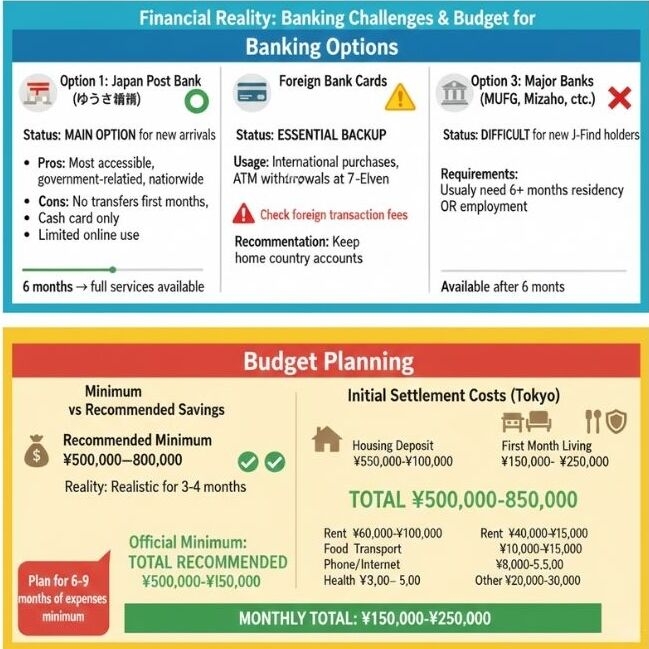
Banking can be harder than expected for new arrivals. Some banks want employment history, a longer residence record, or more predictable income. Japan Post Bank is often one of the more accessible options for new foreign residents, but policies and branch handling vary.
Do not assume a bank account will be available on day one. Bring backup payment methods, keep access to overseas cards, and plan for a period where some Japanese banking functions may be limited.
If you later incorporate, see our guide to opening a bank account for company banking considerations.
Practical challenges to expect
J-Find is flexible, but new arrivals still face normal Japan friction. It is better to plan for it than be surprised by it.
Housing
Many landlords prefer tenants with stable employment, Japanese language support, or a guarantor. If you arrive without a job, your first housing option may be a sharehouse, serviced apartment, monthly apartment, or foreigner-friendly rental.
Keep your first lease flexible if possible. Your job, business location, or immigration plan may change in the first year.
Employers may not know J-Find
J-Find is still newer than common work statuses. Some employers may not understand what you can and cannot do.
Prepare a simple explanation:
- Your status is Designated Activities for J-Find.
- You are in Japan legally for job hunting or startup preparation.
- You can apply to change status once you receive a full-time job offer.
- For any paid activity before that, the company should confirm the allowed scope.
For professional networking, our guide to business networking in Japan can help you avoid common first-meeting mistakes.
Your plan needs evidence
The biggest practical mistake is treating J-Find like two free years to decide later. Immigration may ask what you have actually done. Employers and business partners may also want to see progress.
Keep your plan current. If you shift from job hunting to entrepreneurship, or from entrepreneurship to job hunting, update your records and reasoning.
Japanese business culture matters
If you are using J-Find to meet employers, partners, customers, or investors, soft skills matter. In Japan, being prepared and respectful is often read as seriousness.
Learn the basics of Japanese business etiquette, prepare a simple Japanese introduction, and have business cards ready if you will attend business events.
What happens after J-Find?
J-Find is temporary. Before the 2-year cap arrives, you need another status, or you need to leave Japan.
The common next routes are:
- Work visa
- Highly Skilled Professional visa
- Business Manager Visa
- Family-based status, if your personal situation changes
Route 1: Work visa
If you receive a job offer from a Japanese company, the usual route is to change to a work visa such as Engineer/Specialist in Humanities/International Services.
Your job duties, degree background, employer, salary, and contract all matter. A job offer alone does not guarantee approval. The role needs to fit a recognized work status.
One common mistake for founders is assuming they can hold a normal work visa and freely act as a company director on the side. Work visa holders generally cannot use their status as a workaround to operate their own company. If you plan to be a director or run a business, confirm the visa strategy before incorporating.
Route 2: Highly Skilled Professional visa
The Highly Skilled Professional visa can be attractive if you qualify under Japan’s points system. It can offer advantages such as a longer period of stay and a faster path to permanent residence for high-point applicants.
But be careful if your goal is to run your own company. HSP Type-I is not a simple self-sponsorship route for operating a company in the way a Business Manager Visa is. Using HSP to self-sponsor a company is a known rejection risk.
If you are considering HSP, first confirm which HSP category applies, whether the activity matches your actual plan, and whether your points can be documented cleanly.
Route 3: Business Manager Visa
If you want to start and operate a business, the standard route is the Business Manager Visa.
This is where many J-Find applicants need a reality check. J-Find gives you time to prepare a business, but it does not reduce the Business Manager requirements.
Current Business Manager planning should include:
- Company incorporation, usually KK or GK
- JPY 30,000,000 capital
- At least one qualifying full-time employee
- Japanese ability requirement, usually JLPT N2 or CEFR B2 level, satisfied by the applicant or qualifying employee
- Business plan certified by a licensed SME Management Consultant
- Dedicated physical office
- Evidence that the business is real, viable, and properly prepared
If you are comparing company structures, start with our guides to Godo Kaisha in Japan and Kabushiki Kaisha in Japan.
If your business needs permits, do not leave them until the end. Our guide to business licenses in Japan explains how license requirements can affect setup timing.
J-Find for entrepreneurs: realistic Business Manager planning
J-Find can be very useful for founders, but only if you work backward from the Business Manager Visa.
Do market research before committing
Use your time in Japan to test assumptions. Meet potential customers, distributors, partners, accountants, lawyers, and city-level support organizations.
For broader research planning, see our guide to market research in Japan.
Plan your office carefully
A virtual office is generally not enough for Business Manager purposes. You need a dedicated physical office appropriate for the business.
As a practical risk guideline, office rent around JPY 100,000, or more is safer where possible. Rent below JPY 70,000 can be high-risk because immigration may question whether the office is substantial enough for the claimed business. This is not a magic rule, but it is a useful planning threshold.
The office should match the business. A consulting company, restaurant, travel agency, and import business do not need the same premises.
Secure office before proving capital
For Business Manager planning, the timing of capital proof matters. In our process, proof of capital should come after the office lease is secured.
This avoids a common sequencing problem: showing money without a credible business base, or signing documents in an order that does not support the application story.
Office and Capital Sequencing Matters
- Lease secured first, capital proof handled in the right order.
- Office sized correctly for your specific business type.
- Built from 100+ incorporations across Japan.
Do not ignore post-incorporation obligations
Incorporation is not the finish line. After company setup, you may need tax filings, social insurance procedures, payroll setup, accounting, permits, and ongoing compliance.
See our guide to post-incorporation requirements before you decide your timeline.
Consider Startup Visa carefully
Depending on your city and business stage, a municipal Startup Visa may also be relevant. It can be useful for some founders, but it is not a substitute for meeting the final Business Manager requirements.
See our guide to the Startup Visa in Japan for a fuller comparison.
Is J-Find worth it?
J-Find is worth considering if you are eligible and need time in Japan to build your next step.
It is strongest for:
- Recent top-university graduates without a job offer yet
- People over the Working Holiday age limit
- Applicants from countries without a Working Holiday arrangement
- Founders who need Japan-based preparation time
- Candidates who want to meet employers in person before committing
It is weaker for:
- People who already have a job offer
- People whose university does not qualify
- People who graduated more than 5 years ago
- Applicants with only the minimum savings and no backup plan
- Founders who cannot realistically meet Business Manager requirements later
- People mainly looking for a remote-work base in Japan
The best way to use J-Find is to treat it like a runway. You should know what you want to prove, who you need to meet, which documents you need to build, and when you need to change status.
FAQ
Do I need a job offer for the J-Find Visa?
No. That is one of the main benefits of J-Find. It is designed for people who want to job hunt or prepare a business in Japan before they have a job offer or a fully established company.
Can I work full time on J-Find?
Do not assume you can work full time on J-Find. The status is for job hunting and startup preparation, with limited paid activity to support those main activities. Once you have a full-time job offer, plan to change to the correct work visa before starting that role.
Can I freelance or work remotely on J-Find?
Possibly, but be careful. If freelance or remote work becomes the main reason you are in Japan, it may conflict with the purpose of J-Find. Keep records showing that your main activity is job hunting or startup preparation.
Can I bring my spouse or children?
Yes, J-Find can allow a spouse and dependent children to accompany the main applicant. They receive their own status. If your spouse wants to work, do not assume they can work freely. Confirm whether separate permission is required and what limits apply.
Can my parents come with me?
J-Find is generally for the main applicant’s spouse and dependent children, not parents. If you have a special family situation, confirm options with immigration or a qualified professional.
Does J-Find lead to permanent residence?
J-Find can count as residence time in Japan, but it is not usually the status that gets you to permanent residence by itself. In practice, most people need to transition to a work, HSP, spouse, or business-related status and build a longer record of income, tax payment, insurance, and residence compliance.
Can I start a company while on J-1?
You can prepare to start a business, and company setup may be part of that preparation. But operating the business long term requires the correct status. If your goal is to run the company, plan the Business Manager Visa route early.
Is J-1 Find easier than the Business Manager Visa?
It has a lower entry barrier because you do not need to already meet all Business Manager requirements when applying. But it is not a replacement for the Business Manager Visa. If your final goal is entrepreneurship, J-Find gives you preparation time, not an exemption.
What if my university is not listed?
If your university does not meet the ranking rule, J-Find is usually not available. You may need to consider other routes, such as direct employment, a Startup Visa, a student route, or Business Manager if you can meet the requirements.
When should I start planning my next visa?
Before you arrive, if possible. At the latest, start working backward from your next status during the first few months. Waiting until the final months of J-Find creates unnecessary risk.
Getting help with J-Find and business setup
If you are using J-Find mainly to job hunt, your most important task is building a credible activity record and finding a role that matches a work visa category.
If you are using J-Find to prepare a business, the bigger question is whether your company, office, capital, hiring plan, licenses, and documents can support the next visa. SmartStart Japan helps foreign founders think through these steps before they commit money in the wrong order.
For a broader setup roadmap, start with our guide on how to start a business in Japan, then compare your visa route with the Business Manager Visa requirements.
This article is for general information only and is not legal advice. Visa handling can change, and individual facts matter. Always confirm the current requirements with official sources or a qualified immigration professional before applying.
Plan Your J-Find to Business Manager Path
- Visa strategy mapped to your timeline and goals.
- Incorporation, office, and capital sequenced correctly.
- Trusted by 100+ companies incorporated across Japan.
Full List of Universities for J-Find Visa
Based on official MOJ list | Last updated: June 2026
This guide is for informational purposes only and does not constitute legal advice. Always verify current requirements with the Immigration Services Agency of Japan or a qualified immigration lawyer before making visa decisions
United States
| University Name | Country |
| Boston University | United States |
| Brown University | United States |
| California Institute of Technology | United States |
| Carnegie Mellon University | United States |
| Columbia University | United States |
| Cornell University | United States |
| Duke University | United States |
| Harvard University | United States |
| Johns Hopkins University | United States |
| Massachusetts Institute of Technology (MIT) | United States |
| New York University | United States |
| Northwestern University | United States |
| Princeton University | United States |
| Purdue University – West Lafayette | United States |
| Stanford University | United States |
| The University of Texas at Austin | United States |
| University of California, Berkeley | United States |
| University of California, Irvine | United States |
| University of California, Los Angeles | United States |
| University of California, San Diego | United States |
| University of Chicago | United States |
| University of Illinois at Urbana-Champaign | United States |
| University of Michigan-Ann Arbor | United States |
| University of Minnesota, Twin Cities | United States |
| University of North Carolina at Chapel Hill | United States |
| University of Pennsylvania | United States |
| University of Southern California | United States |
| University of Washington | United States |
| University of Wisconsin – Madison | United States |
| Vanderbilt University | United States |
| Washington University in St. Louis | United States |
| Yale University | United States |
United Kingdom
| University Name | Country |
| Imperial College London | United Kingdom |
| King’s College London | United Kingdom |
| London School of Economics and Political Science | United Kingdom |
| The University of Edinburgh | United Kingdom |
| The University of Glasgow | United Kingdom |
| The University of Manchester | United Kingdom |
| University College London (UCL) | United Kingdom |
| University of Birmingham | United Kingdom |
| University of Bristol | United Kingdom |
| University of Cambridge | United Kingdom |
| University of Oxford | United Kingdom |
Hong Kong
| University Name | Country |
| City University of Hong Kong | Hong Kong |
| The Chinese University of Hong Kong | Hong Kong |
| The Hong Kong Polytechnic University | Hong Kong |
| The Hong Kong University of Science and Technology | Hong Kong |
| The University of Hong Kong | Hong Kong |
China
| University Name | Country |
| Fudan University | China |
| Nanjing University | China |
| Peking University | China |
| Shanghai Jiao Tong University | China |
| Tsinghua University | China |
| University of Science and Technology of China | China |
| Zhejiang University | China |
Japan
| University Name | Country |
| Kyoto University | Japan |
| The University of Tokyo | Japan |
South Korea
| University Name | Country |
| Seoul National University | South Korea |
| Yonsei University | South Korea |
Australia
| University Name | Country |
| Monash University | Australia |
| The Australian National University | Australia |
| The University of Melbourne | Australia |
| The University of New South Wales (UNSW Sydney) | Australia |
| The University of Queensland | Australia |
| The University of Sydney | Australia |
Canada
| University Name | Country |
| McGill University | Canada |
| University of British Columbia | Canada |
| University of Toronto | Canada |
Netherlands
| University Name | Country |
| Delft University of Technology | Netherlands |
| University of Amsterdam | Netherlands |
| University of Groningen | Netherlands |
Germany
| University Name | Country |
| Heidelberg University | Germany |
| LMU Munich (University of Munich) | Germany |
| Technical University of Munich | Germany |
| University of Bonn | Germany |
France
| University Name | Country |
| Institut Polytechnique de Paris | France |
| Paris-Saclay University | France |
| PSL Research University Paris | France |
| Sorbonne University | France |
Switzerland
| University Name | Country |
| Swiss Federal Institute of Technology Lausanne (EPFL) | Switzerland |
| Swiss Federal Institute of Technology Zurich (ETH Zurich) | Switzerland |
| University of Zurich | Switzerland |
Sweden
| University Name | Country |
| Karolinska Institute | Sweden |
| KTH Royal Institute of Technology | Sweden |
| Lund University | Sweden |
| Uppsala University | Sweden |
Belgium
| University Name | Country |
| KU Leuven | Belgium |
Denmark
| University Name | Country |
| University of Copenhagen | Denmark |
Singapore
| University Name | Country |
| Nanyang Technological University | Singapore |
| National University of Singapore | Singapore |