Starting a daycare business in Japan presents a strong opportunity for foreign entrepreneurs as demand continues to rise among working families, dual-income households, and international communities. Setting up a company in Japan is one of the first steps before opening a childcare business. At the same time, childcare is one of the most heavily regulated service industries in Japan, with requirements that vary significantly by municipality, facility type, and operator profile.
You will learn how childcare licensing is structured, who is eligible to operate, what approvals are required, how long the process takes, and how to avoid the common mistakes that delay or derail foreign-led childcare businesses. If you plan to start a daycare in Japan, understanding the licensing structure, visa requirements, and municipal approval process is essential before investing in a location or hiring staff.
- What does "starting a daycare" mean in Japan?
- Who can legally open and operate a daycare in Japan?
- Checklist to Start a Daycare in Japan
- Step 1: Choose Your Facility Type When You Start a Daycare in Japan
- Step 2: Set up your company
- Step 3: Secure a location that can pass childcare and safety requirements
- Step 4: Pre-consult with the local authority
- Step 5: Obtain the required childcare approval
- Staffing, operations, and compliance
- How long does it take and how much does it cost?
- Common challenges for foreign founders, and how to avoid them
- Conclusion
Key Takeaways:
- Japan does not have a single nationwide daycare license; your facility category determines your approval route, staffing requirements, inspection standards, and access to public funding
- Foreign nationals can legally own and operate childcare facilities in Japan, but visa stability, company structure, and the October 2025 Business Manager Visa reforms (¥30 million capital threshold) directly influence your approval outcomes
- Licensed (ninka hoikujo) facilities receive government subsidies covering up to 95% of setup costs but require a lengthy municipal approval process; unlicensed (ninkagai hoiku shisetsu) facilities offer a faster, more flexible path with higher operating costs
- Staffing is your hardest ongoing constraint; certified childcare workers (保育士, hoikushi) must be hired at mandated ratios, municipal pre-consultation is not optional, and skipping either is one of the most expensive mistakes foreign founders make
What does “starting a daycare” mean in Japan?
Unlike many countries, Japan does not have a single nationwide daycare license. Daycare and preschool operations fall into multiple regulatory categories governed by municipal and prefectural authorities, each with different approval routes, inspection standards, staffing rules, and access to public funding.
At the highest level, childcare in Japan splits into two worlds: licensed facilities (認可保育所, ninka hoikujo) and unlicensed facilities (認可外保育施設, ninkagai hoiku shisetsu). Choosing the right category before doing anything else determines your approval timeline, your staffing obligations, how often you will face inspections, and whether public subsidies are available to you.
Understanding this distinction early is the single most important decision a foreign founder can make.
Who can legally open and operate a daycare in Japan?
Foreign founders can legally establish and operate childcare businesses in Japan; there are no nationality restrictions on ownership. What authorities focus on is who is responsible for operations. Every facility must have a clearly designated operator and a responsible manager who can interface with local authorities on compliance, staffing, and safety. Foreign entrepreneurs planning to start a daycare in Japan must demonstrate long-term operational stability through their company structure, immigration status, and staffing plan.
Visa status is where it gets complicated. While licensing and immigration are technically separate, visa stability heavily influences how local governments view your application. The main pathways:
- Business Manager Visa — the strongest signal of long-term operational intent. Running a childcare facility qualifies fully as eligible business activity. Following the October 2025 reforms, requirements include ¥30 million in capital, a full-time employee with unrestricted work authorization, JLPT N2 or equivalent, and a verified business plan.
- Startup Visa — a preparation pathway available in select municipalities. However, note that Startup Visa will not work for a daycare business. Check the article linked above for additional information.
Visa requirements are overseen by the Immigration Services Agency of Japan, which manages Business Manager Visa approvals. Before finalizing your strategy, review the most common reasons Business Manager Visa applications are rejected. For childcare entrepreneurs, a credible staffing plan with certified hoikushi employees significantly strengthens your case.
Interested in Starting a
Daycare in Japan?
We help foreign founders navigate every step. From company incorporation and Business Manager Visa to childcare licensing, tax registration, and municipal approval.
- 100+ Companies Incorporated
- Japan Business Experts
Checklist to Start a Daycare in Japan
Step 1: Choose Your Facility Type When You Start a Daycare in Japan
You must select your childcare category before leasing property, hiring staff, or designing your facility. The choice shapes every subsequent decision.
Option A: Licensed daycare (認可保育所 / ninka hoikujo)
Licensed facilities operate under municipal childcare schemes and receive substantial government operational subsidies. Fees to families are income-based rather than market-rate, which keeps enrollment competitive but removes your pricing flexibility. The trade-off is strict national compliance; facility standards, staffing ratios, inspection schedules, and approval timelines are all tightly prescribed.
Entry into the ninka hoikujo system typically requires participating in a formal municipal operator recruitment process (公募), holding advance consultations with the local government, and aligning your opening timeline with the municipality’s childcare capacity planning, which often means targeting an April opening. The approval process runs 12 to 24 months in most cases.
Option B: Unlicensed childcare facility (認可外保育施設 / ninkagai hoiku shisetsu)
Unlicensed facilities operate under a notification and supervision framework rather than full licensing. You submit a notification to the prefectural governor within one month of opening, then enter the ongoing supervision system, annual inspections, operational reports, and a compliance certificate that unlocks eligibility for national subsidy programs. According to the Ministry of Health, Labour and Welfare, childcare facilities in Japan operate under both national and municipal supervision.
This route offers more flexibility in curriculum design, fee structures, enrollment criteria, and operating hours. It is particularly well-suited to international preschools, bilingual daycares, and niche childcare concepts. Most foreign founders seeking speed start here and later pursue licensed pathways once they have demonstrated operational credibility.
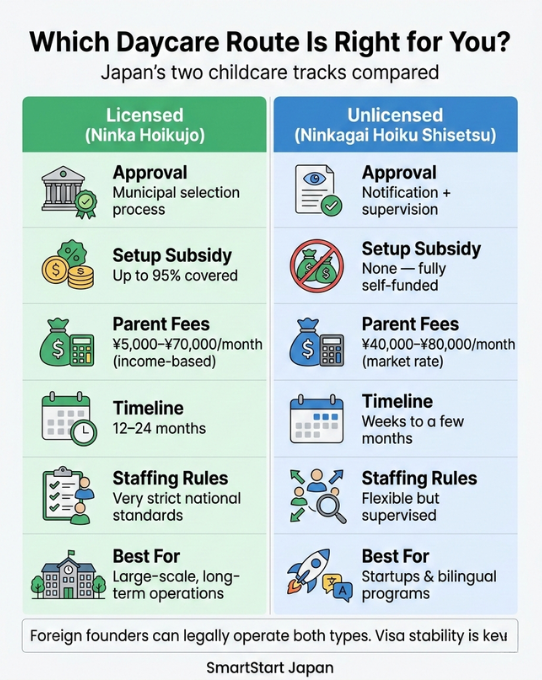
Start a Daycare in Japan: Ninka vs Ninkagai Options
The financial picture between the two routes is significant, and understanding it before you commit is critical.
| Licensed (Ninka hoikujo) | Unlicensed (Ninkagai hoiku shisetsu) | |
| Approval route | Municipal operator selection | Notification + supervision |
| Setup subsidy | Up to 95% of establishing costs | None |
| Operational funding | Government covers operating costs | Self-funded |
| Parent fees | Income-based (¥5,000–¥70,000/month) | Market rate (¥40,000–¥80,000/month avg.) |
| Timeline | 12–24 months | Weeks to a few months |
| Staffing rules | Very strict | Flexible but supervised |
| Best for | Long-term, large-scale operations | Startups, niche/bilingual programs |
Licensed facilities benefit enormously from government support; setup costs can be nearly fully covered, operational expenses are subsidized per child, and for children aged 3–5, fees have been fully covered by the national government since October 2019. The catch is that you cannot simply open a ninka hoikujo facility; you must be selected through a competitive municipal process, which takes time and requires a proven track record.
Ninkagai hoiku shisetsu operators bear the full cost of setup and operations themselves. Monthly fees are higher and unregulated, which creates pricing flexibility but also places your facility in direct competition with lower-cost licensed options. Families who cannot secure a ninka hoikujo spot often turn to ninkagai hoiku shisetsu as a fallback, but the most sought-after ninkagai hoiku shisetsu facilities, particularly bilingual and international programs, maintain strong enrollment at premium price points.
Step 2: Set up your company
Both a Kabushiki Kaisha (KK) and a Godo Kaisha (GK) are fully valid structures for operating a childcare facility. The 2000 deregulation opened licensed daycare operations to for-profit corporations, ending the previous dominance of social welfare corporations (社会福祉法人). Choosing the right company structure is an important early decision for founders planning to start a daycare in Japan.
| GK (Godo Kaisha) | KK (Kabushiki Kaisha) | Social Welfare Corp. | |
| Registration fee | ~¥60,000 | ~¥200,000+ | Substantial initial assets required |
| Annual meetings | Not required | Required | Required |
| Financial disclosure | Not required | Public | Public |
| Credibility | Moderate | High | Highest |
| Best for | Lean startups, early-stage entry | Scaling, investors, municipal selection | Traditional licensed operators |
| Foreign founder path | Practical | Practical | Complex, requires prefectural governor approval |
Step 3: Secure a location that can pass childcare and safety requirements
Location selection is where many childcare startups stall. Your facility must satisfy three overlapping regulatory frameworks simultaneously: childcare standards, building codes, and fire safety law. Before signing a long-term lease, you need to confirm the space is realistically compliant, or budget for the cost of making it so.
What authorities will assess
When inspectors evaluate your facility, their review covers several interconnected areas.
- Child-safe layout and evacuation flow are assessed comprehensively. Inspectors examine whether rooms are appropriately separated by function; nursery rooms, activity rooms, medical rooms, and outdoor access must all be present and logically arranged. Evacuation routes must be clearly defined and unobstructed, with multiple exit paths for upper-floor facilities. Second-floor facilities require fireproof construction and at least two direct stairways to the ground. Fourth-floor facilities and above require dedicated evacuation stairways and a waiting area equal to at least one-eighth of the childcare floor area. Maximum walking distance from any childcare room to a stairway is 30 meters. Inspectors will walk your facility with an eye to how quickly children could be moved outside in an emergency.
- Fire safety equipment and exits are governed by the Fire Service Act, which classifies childcare facilities as 特定防火対象物, specified fire prevention objects requiring the highest level of compliance. Required equipment includes fire extinguishers, automatic fire alarm systems, emergency exit lighting, and, depending on facility size, sprinkler systems. Fire equipment is inspected every six months, with comprehensive safety inspections annually. Monthly evacuation drills, covering fire, earthquake, and other disaster scenarios, are mandatory by law and must be documented. A fire safety management officer must be designated once the facility reaches a certain scale.
- Outdoor space or proximity to parks is evaluated with flexibility, but it matters. Licensed facilities for children aged two and above must provide either a dedicated outdoor play area on the premises or documented access to a park or open space within walking distance. Tokyo and other major cities have relaxed this standard modestly given urban land constraints, but do not assume a waiver will be granted; confirm the municipality’s current policy in your pre-consultation.
If meals are provided
Most daycare facilities in Japan serve meals, and doing so triggers a separate layer of regulatory requirements that must be addressed before opening.
If you operate an in-house kitchen serving 20 or more meals per session, you must submit a business notification to your local public health center (保健所) and designate a food sanitation officer (食品衛生責任者), a qualification obtained through a half-day training course. HACCP-based sanitation management is mandatory for all food operations regardless of size, which means documented procedures for temperature control, hygiene checks, and incident logging.
If you serve fewer than 20 meals or outsource meal preparation to an external contractor, the contractor must hold a food service establishment permit (飲食店営業許可). You cannot simply accept deliveries from an uncertified provider. Annual inspections by the public health center cover kitchen layout, food storage conditions, equipment hygiene, and staff sanitation records. If your kitchen layout does not meet local standards during pre-consultation, redesigning after the fact is expensive; get this confirmed early.
For a full overview of the legal requirements that apply to your company from day one, including food service and safety obligations, review SmartStart Japan’s compliance guide before finalizing your location.
A note on virtual offices: a virtual office may work for your company registration address, but it creates serious problems for childcare licensing, facility inspections, and visa applications. A dedicated physical space is non-negotiable for operating a childcare business.
Step 4: Pre-consult with the local authority
Pre-consultation is not optional in practice, even where it is not legally required. Most childcare founders who skip this step pay for it later through costly redesigns, failed inspections, or outright rejection.
Before submitting any application or notification, arrange a consultation with the childcare division of your target municipality. Bring:
- Floor plans and proposed facility layout
- Staffing model and operational concept
- Proof of corporate registration
The local government will flag facility-specific issues before you commit to a buildout, clarify municipality-specific requirements that differ from national minimums, and, for unlicensed facilities, walk you through notification paperwork and local inspection standards.
Engaging early also builds goodwill. Japanese regulatory culture rewards founders who appear organized and cooperative. Those who arrive with completed plans that need renegotiating fare significantly worse.
Step 5: Obtain the required childcare approval
Licensed facilities (Route A)
For ninka hoikujo facilities, your formal approval comes through the municipal operator selection process. The city or ward announces a 公募 (operator recruitment), accepts detailed proposals including a facility plan, staffing plan, operating philosophy, safety protocols, and financial projections, then selects an operator through a committee review. Once selected, you complete your facility buildout and compliance work before the final opening approval, typically timed to an April opening.
Municipal selection committees look closely at your organizational credibility: financial stability, prior childcare operating experience, the strength of your staffing plan, and your facility’s safety design. Operators with at least two years of licensed daycare experience have access to recruitment rounds that are closed to newcomers. For how business licensing works across regulated industries in Japan, see SmartStart Japan’s overview.
Unlicensed facilities (Route B)
For ninkagai hoiku shisetsu facilities, you submit your establishment notification to the prefectural governor, or the mayor in designated cities, within one month of commencing operations. Required documents include qualification certificates for childcare staff, liability insurance contracts, facility floor plans, and fee schedules. After notification, your facility enters the prefectural supervision system, with annual operational status reports and on-site inspections against national supervision standards.
Staffing, operations, and compliance
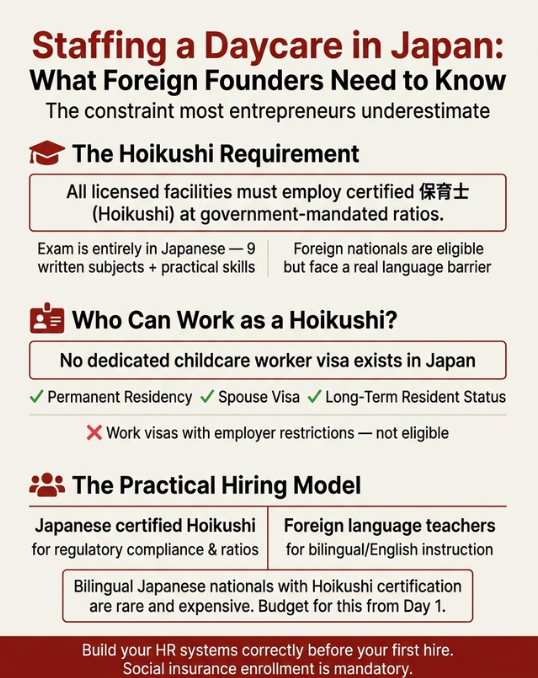
Staffing is the constraint that surprises most foreign founders. Every licensed facility must employ certified 保育士 (hoikushi) at mandated ratios. Key things to know:
- The national hoikushi exam is conducted entirely in Japanese across nine written subjects plus a practical skills assessment; foreign nationals are eligible, but the language barrier is real
- There is no dedicated visa for childcare workers; foreign nationals can only work as hoikushi if they hold unrestricted work authorization (permanent residency, spouse visa, or long-term resident status)
- The practical model for most foreign-owned daycares combines certified Japanese hoikushi for compliance with foreign language teachers for English instruction
- Bilingual Japanese nationals with hoikushi certification are difficult to recruit and command a premium; budget for this from day one
For ongoing compliance, Japan’s business regulations impose strict obligations: employment contracts must be in writing, social insurance enrollment is mandatory from your first hire, and wrongful termination carries legal consequences. Build your HR systems correctly from the start.
On the community side, parent communication in Japan follows a norm of regular, transparent updates; LINE is the standard platform. Small compliance lapses escalate quickly through parent networks and local channels. Proactive disclosure and consistent quality controls are brand protection, not just good practice.
How long does it take and how much does it cost?
For entrepreneurs planning to start a daycare in Japan, understanding the difference between licensed and unlicensed timelines is critical for budgeting and planning.
Unlicensed (ninkagai hoiku shisetsu): Several weeks to a few months for the notification process itself. Facility setup costs are entirely self-funded; renovation and fit-out typically run ¥3–15 million depending on size and condition of the space, plus rent from signing to opening. Government fees are minimal; the real costs are buildout, staffing, and carrying costs during the setup period.
Licensed (ninka hoikujo): 12 to 24 months from opening application is a realistic range. The government covers up to 95% of establishing costs for selected operators, which dramatically changes the unit economics. The challenge is the time cost; paying rent on a space while navigating a multi-stage approval process requires well-managed cash flow and conservative planning.
Foreign founders should budget for the longer end of these ranges. Translation support, consulting fees, redesigns after inspections, and buffers for municipal process delays all add up. Plan conservatively.
Common challenges for foreign founders, and how to avoid them
- Language barriers are pervasive. Municipal consultations, application documents, inspection reports, and ongoing communications with local authorities are conducted in Japanese. Address formats must match exactly between your corporate registration and all submissions. Having bilingual advisors is not a luxury; it is operationally necessary.
- Documentation standards are strict. Japanese regulatory filings must be complete, correctly formatted, and internally consistent. Minor discrepancies between documents, name spellings, address formats, and organization charts trigger delays. Prepare all filings carefully and verify consistency across every document before submission.
- Visa instability signals risk to municipalities. Immigration status that appears temporary or uncertain undermines your credibility during operator selection processes. Planning your immigration strategy in parallel with your business setup, not as an afterthought, is essential.
- Community sensitivity shapes outcomes. Childcare decisions involve parents, neighbors, and local officials. Noise, operating hours, drop-off traffic, and neighborhood relationships all influence how your facility is perceived. Founders who engage with the community early, attend local meetings, and respond to concerns proactively fare significantly better during licensing than those who arrive with completed plans and expect approval by default.
Planning a Different Business in Japan?
Browse our step-by-step guides for foreign founders, or book a free consultation to discuss your specific business idea.
Conclusion
Starting a daycare in Japan is not a quick startup but a regulated, community-focused business that requires careful planning, licensing approval, and operational credibility. The regulatory framework is demanding but transparent, and for founders who plan holistically, before leasing, hiring, or renovating, the path to approval is clear and achievable.
The financial case is also real. Government subsidies for licensed operators are among the most generous in any service industry in Japan, and demand for quality childcare, particularly bilingual and international programs, continues to outpace supply in major cities. Starting a daycare in Japan is achievable with the right structure and the right support. For foreign entrepreneurs prepared to navigate these requirements, it is entirely possible to start a daycare in Japan and build a sustainable childcare business. Reach out to SmartStart Japan for a free consultation tailored to childcare entrepreneurs, whether you need help with incorporation, visa strategy, or navigating municipal approval.