Key Takeaways
- A Certificate of Incorporation is your company’s proof of legal existence in Japan: without it, you cannot open a corporate bank account, apply for a Business Manager Visa, etc.
- Incorporation and credibility are not the same thing: A professional website, local office presence, or solid business plans are all critical factors that determine whether your applications are approved.
- The Legal Affairs Bureau (法務局) is the sole issuing authority: all company registrations in Japan flow through this government body.
- Foreign entrepreneurs can incorporate remotely: Being remote requires professional representation, power of attorney arrangements, and a valid Japanese registered address.
- Receiving your certificate is the beginning, not the finish line: post incorporation obligations, including tax registrations and social insurance enrollments, all begin the moment your company is registered.
- Key Takeaways
- What is a Certificate of Incorporation in Japan?
- Is a Certificate of Incorporation the same as a Company Registry Certificate?
- How do I obtain a Certificate of Incorporation in Japan?
- What can I do with a Certificate of Incorporation?
- Can I use a virtual office address on my Certificate of Incorporation?
- What are the most common mistakes foreign entrepreneurs make?
What is a Certificate of Incorporation in Japan?
A certificate of incorporation is one of the most important legal documents you receive when registering a company in Japan. It serves as official proof that your business has been legally registered with the Japanese government and exists as a recognized corporate entity. For foreign entrepreneurs entering the Japanese market, understanding what this document contains, who issues it, and why it matters is an essential first step in building a credible business presence.
The Certificate of Incorporation contains the core identifying information of your registered company. Specifically, it includes this information:
- Company name
- Corporate number
- Registered address
- Directors and representatives
- Capital amount
- Registered business activities
- Date of incorporation
All of this information becomes part of the company’s official public registration record, meaning it is accessible to banks, government agencies, clients, and any third party conducting due diligence on your business.
Who issues the Certificate of Incorporation?
The Certificate of Incorporation is issued by the Legal Affairs Bureau (Homukyoku), a government authority operating under Japan’s Ministry of Justice. The Legal Affairs Bureau is responsible for maintaining all corporate registration records in Japan and serves as the official body through which companies are incorporated and verified. When you register your company, the Bureau reviews your submitted documentation, processes your application, and upon approval, issues your certificate as confirmation that your company has been entered into the national corporate registry.
Why is it important?
The Certificate of Incorporation is important for a wide range of practical and legal reasons. First and foremost, it serves as proof of legal existence. Without it, your company cannot be verified as a legitimate entity by any institution or counterparty. Beyond that, it is a required document in many critical business processes, including opening a corporate bank account, applying for a visa, etc.

Is a Certificate of Incorporation the same as a Company Registry Certificate?
These terms are sometimes used interchangeably, but they refer to distinct documents. Understanding the differences will help you know exactly what is being requested when banks, government agencies, or business partners ask for documentation.
Comparison Table
| Document | Purpose | When It Is Requested |
| Certificate of Incorporation (登記事項証明書) | Confirms initial legal registration | Upon first establishing the company |
| Copy of Corporate Registration (登記簿謄本) | Shows current registration details | Banking, government filings, due diligence |
| Articles of Incorporation (定款) | Governs internal company structure | Legal reviews, dispute resolution |
| Seal Registration Certificate (印鑑登録証明書) | Verifies corporate seal on record | Contracts, banking, legal transactions |
How do I obtain a Certificate of Incorporation in Japan?
Before filing anything, you must decide which type of company you are registering. The two most common structures for foreign entrepreneurs in Japan are Kabushiki Kaisha (Japan’s equivalent of a joint-stock corporation)and Godo Kaisha (a more flexible and cost-effective structure). When choosing between the two, consider your investor expectations, the corporate image you want to project, your budget for setup costs, and your appetite for ongoing administrative obligations.
The complete cost breakdown for setting up a company in Japan covers registration fees, notarization, seals, and professional services.
Prepare incorporation documents
Once you have selected a structure, prepare a set of foundational documents — the full incorporation documents checklist covers everything required. including articles of incorporation, shareholder information, and a registered address. It is worth noting that the wording of your company purpose is one of the most common sources of errors and delays. Vague or incorrectly phrased descriptions are frequently flagged during the review process.
Register with the Legal Affairs Bureau
With your documents prepared, you will submit a registration application to the Legal Affairs Bureau that has jurisdiction over your company’s registered address. The filing requires a complete set of incorporation documents along with payment of the registration tax, which varies depending on your company structure and stated capital. The minimum registration tax for a KK is ¥150,000, while a GK carries a minimum of ¥60,000.
Receive your Certificate of Incorporation
Once the Legal Affairs Bureau reviews and approves your application, your company will be officially entered into the corporate registry and your Certificate of Incorporation will be issued. At this stage, you should also order certified copies of your registration documents — most banks and government agencies will require multiple copies, and having them prepared in advance will save significant time as you move through the next steps of establishing your business.
Certificate of Incorporation Information
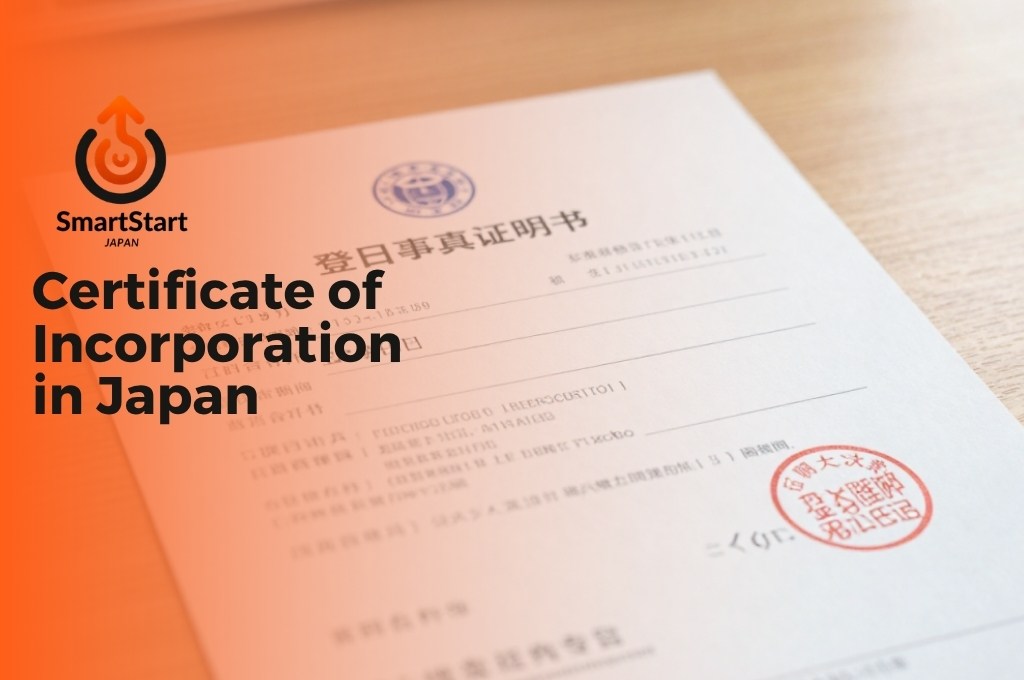
This is a Certificate of Current Matters translation from Japanese to English. The document displays basic information about a company, including the corporate number, name of the company, and location of the office. This information serves as the basis for how a company is categorized and labeled when evaluated by banking officials. This document also holds other crucial info like the finances and contacts for the company.
Breaking down a Certificate of Incorporation
| Corporate Number | 会社法人等番号 | The number that is assigned to the company for identification purposes |
| Trade Name | 商号 | The official name that the company is listed under |
| Head Office | 本店 | The location or address of the office under which the company operates |
| Method of Public Notice | 公告をする方法 | The method by which the company publicly announces official notices |
| Date of Incorporation | 会社成立の年月日 | The official date on which the company was legally registered |
| Purpose | 目的 | The list of officially registered business activities the company is authorized to conduct |
| Number of Issuable Shares | 発行可能株式総数 | The maximum total number of shares the company is authorized to issue to shareholders |
| Number of Issued Shares | 発行済株式の総数 | The actual number of shares that have currently been issued and distributed to shareholders |
| Amount of Capital | 資本金の額 | The total stated capital of the company in Japanese yen |
| Regulations Regarding Transfer of Shares | 株式の譲渡制限に関する規定 | The rules governing how shares may be transferred between parties |
| Officers | 役員に関する事項 | The names, titles, and appointment/registration dates of all directors, representative directors, and auditors of the company |

How long does it take to receive a Certificate of Incorporation?
The timeline for incorporation in Japan is generally predictable — the incorporation timeline in Japan breaks it down stage by stage.
Typical incorporation timeline
| Stage | Estimated Duration |
| Document preparation | 1–3 weeks |
| Filing with Legal Affairs Bureau | 1 day |
| Registration review | 7–10 business days |
| Certificate issuance | Upon approval |
In total, foreign entrepreneurs should anticipate approximately 2–4 weeks from the start of document preparation to receipt of the Certificate of Incorporation, assuming all materials are submitted correctly.
Factors that can delay registration
Several issues commonly extend the timeline:
- Incomplete documentation: missing signatures, missing attachments, or improperly notarized documents
- Translation issues: documents involving foreign nationals often require certified Japanese translations, and errors in these can trigger rejections
- Incorrect company purpose wording: overly broad, vague, or improperly phrased business activity descriptions are a frequent cause of review delays
- Errors in submitted materials: typos, mismatched information, or inconsistencies between documents can result in the entire application being returned for correction
Working with a professional service provider experienced in Japanese corporate registration can significantly reduce the risk of these issues.
What can I do with a Certificate of Incorporation?
Once you have your Certificate of Incorporation in hand, it unlocks a range of critical business functions that form the operational backbone of your company in Japan.
- Open a corporate bank account
- Apply for a business manager Visa
- Sign contracts with Japanese clients and suppliers
- Lease office space
- Register for taxes and compliance requirements
Why do Japanese banks ask for a Certificate of Incorporation?
Banking is one of the most challenging hurdles for foreign entrepreneurs in Japan, and understanding why banks request the Certificate of Incorporation can make a significant difference in the outcome of your application.
When a company applies for a corporate bank account, the bank uses the Certificate of Incorporation to confirm several key facts. These checks are part of a broader compliance framework that banks are legally required to follow under Japanese financial regulations. Incorporation by itself does not guarantee approval. This is a critical point that many foreign entrepreneurs misunderstand. A company can be legally incorporated and still fail a banking review. Incorporation confirms that your company exists on paper, it does not confirm that your company is a credible, low-risk business partner in the eyes of a Japanese bank.
Can foreigners obtain a Certificate of Incorporation without living in Japan?
It is possible for foreign nationals residing outside of Japan to incorporate a company in the country, though the process involves additional considerations and logistical arrangements. Overseas founders typically work with professional service providers such as registered agents, incorporation specialists, or business setup firms. All of which can manage the registration process on their behalf. This often involves the use of a power of attorney arrangement, through which the founder authorizes a local representative to sign and submit documents in their name. Foreign founders also tend to have a harder time obtaining a certificate if remote. Foreign founders incorporating remotely frequently encounter challenges like banking restrictions, address requirements, and communication barriers
How does a Certificate of Incorporation affect a Business Manager Visa application?
For foreign entrepreneurs who plan to live in Japan and operate their business in person, the Business Manager Visa is the required immigration status. The Certificate of Incorporation plays an important but misunderstood role in this process. Immigration authorities require evidence that a legitimate company has been established in Japan before they will consider a Business Manager Visa application. Your Certificate of Incorporation serves as that evidence. It is also important to avoid application mistakes like submitting weak business plans, insufficient preparation, etc.

Can I use a virtual office address on my Certificate of Incorporation?
Virtual offices are a popular option among foreign entrepreneurs who want to establish a registered presence in Japan without the cost of a dedicated physical office. However, their use comes with important caveats. Under Japanese corporate registration rules, a virtual office address can generally be used as the registered address on your Certificate of Incorporation.
Japanese banks are increasingly cautious about companies registered at virtual office addresses. Some banks will decline account applications from companies that cannot demonstrate a genuine physical presence, while others may accept virtual office registrations but require additional documentation to compensate for the lack of a dedicated office. It is important to research a bank’s specific policies before choosing your registration address.
Immigration considerations
For Business Manager Visa applications, immigration authorities apply additional scrutiny to virtual office addresses. A virtual office alone is generally not sufficient to satisfy the office requirement. Applicants are typically expected to demonstrate access to a dedicated workspace where business is actually conducted.
Pros and cons for startups
| Pros | Cons | |
| Virtual Office | Low cost, fast setup, prestigious address | Banking limitations, visa scrutiny, perceived lack of presence |
| Physical Office | Stronger credibility, banking and visa advantages | Higher cost, longer setup time |
For early-stage startups with limited capital, a virtual office can be a practical starting point — but founders should plan to transition to a dedicated workspace as their operations grow, particularly if banking and immigration approvals are priorities.
What are the most common mistakes foreign entrepreneurs make?
Japan’s corporate and regulatory environment has a learning curve, and foreign founders frequently make the same avoidable mistakes. Knowing them in advance can save you significant time, money, and frustration. Some of the most common mistakes made are:
- Applying for banking services too early
- Assuming incorporation creates business credibility
- Failing to establish a local presence
- Not preparing supporting documentation
- Misunderstanding Japanese compliance requirements
Certificate of Incorporation Checklist for Foreign Founders
Use this checklist to stay organized and avoid the most common pitfalls at each stage of the process.
Before incorporation
| Have you chosen your company structure? | YES/NO |
| Have you defined your business activities clearly and precisely? | YES/NO |
| Have you secured a valid registered address in Japan? | YES/NO |
| Have you prepared all founder and shareholder documentation? | YES/NO |
Immediately after incorporation
| Have you obtained your certificate of Incorporation from the Legal Affairs Bureau? | YES/NO |
| Have you ordered multiple certified copies for use with banks and agencies? | YES/NO |
| Have you initiated tax office and compliance registrations? | YES/NO |
Before opening a bank account
| Have you launched a professional operational business website? | YES/NO |
| Have you prepared a detailed business plan? | YES/NO |
| Have you gathered client contracts | YES/NO |
| Have you established a verifiable local presence in Japan? | YES/NO |
Before applying for a business manager Visa
| Have you secured a dedicated office address? | YES/NO |
| Have you confirmed your stated capital meets immigration thresholds? | YES/NO |
| Have you prepared comprehensive supporting evidence including business plans and financial projections? | YES/NO |