What happens the day your first Japanese hire signs a contract? Japanese employment law is stricter and more detailed than most founders expect, especially on dismissal and overtime, and it applies from that first day to every worker, whatever their nationality or visa. This guide is written for foreign founders making their first hires, foreign-company executives setting up a subsidiary, and founders growing past ten employees, and it covers contracts, working hours, dismissal, work rules and paid leave.
This guide is general information, not legal advice. For decisions about a specific employee, speak to a sharoushi* (社労士, short for 社会保険労務士, shakai hoken romushi), a labor and social security attorney, or to a lawyer. Last reviewed: October 2026.*
- How does Japanese employment law work?
- What must a Japanese employment contract include?
- What are the working hour rules and how does Japan overtime pay work?
- Why is dismissal so difficult in Japan?
- When do I need work rules (shugyo kisoku) in Japan?
- How much paid leave must employers give in Japan?
- What other employer obligations should I know about?
- What changed recently in labor laws in Japan?
- Do I need a Japanese entity to hire employees?
- Frequently asked questions about employment law in Japan
- Conclusion
How does Japanese employment law work?
Japanese employment law is built on a handful of statutes. The two that matter most are the Labor Standards Act (労働基準法, rodo kijun ho), which governs hours, wages, leave, dismissal notice and work rules, and the Labor Contracts Act (労働契約法, rodo keiyaku ho), which governs contracts, fixed-term renewals and dismissal. Around them sit the Minimum Wages Act, the Industrial Safety and Health Act, the Equal Employment Opportunity Act, the Childcare and Family Care Leave Act, and the Part-Time and Fixed-Term Workers Act.
Three principles frame everything else in this guide.
- The laws apply to every worker in Japan, regardless of nationality, visa type, or where your head office sits.
- The law sets a floor. Your contract and work rules may give employees more than the statutory minimum, but never less.
- A term below the legal standard is void, and the statutory rule replaces it automatically. A clause copied from a head-office template is not merely unenforceable; the Japanese standard takes its place.
The Labor Standards Act
The Labor Standards Act sets the minimum conditions of work: maximum hours, breaks and days off, overtime premiums, paid leave, notice before dismissal, and the work rules a company must adopt once it reaches ten employees. Most of the practical obligations in this guide come from it.
Enforcement sits with the Labor Standards Inspection Offices (労働基準監督署, rodo kijun kantokusho), which report to the Ministry of Health, Labour and Welfare. An inspection usually opens with a request for documents, covering contracts, time records, wage ledgers, the 36 Agreement and your work rules, and it may be followed by interviews and a site visit. Inspections are often triggered by a single employee complaint, so a dispute with one former hire can lead to a review of your whole payroll. Where an inspector finds a breach, you receive a correction recommendation and are expected to pay any unpaid wages.
The exposure goes beyond fines, because many provisions carry criminal penalties. Breaching the overtime caps, for example, can mean up to six months’ imprisonment or a fine of up to ¥300,000. Prosecutions are rare, but the liability is real, and it attaches to the company and in some cases to the responsible individuals.
Struggling to work out which of these rules apply to your company? SmartStart Japan helps foreign founders set up in Japan and get their first-hire paperwork right from day one. Book a free consultation.
What must a Japanese employment contract include?
Many foreign founders arrive with a short, at-will contract that works perfectly well in their home country. In Japan, the law decides much of what an employment relationship contains, and it requires you to put the key terms in writing.
The notice of working conditions
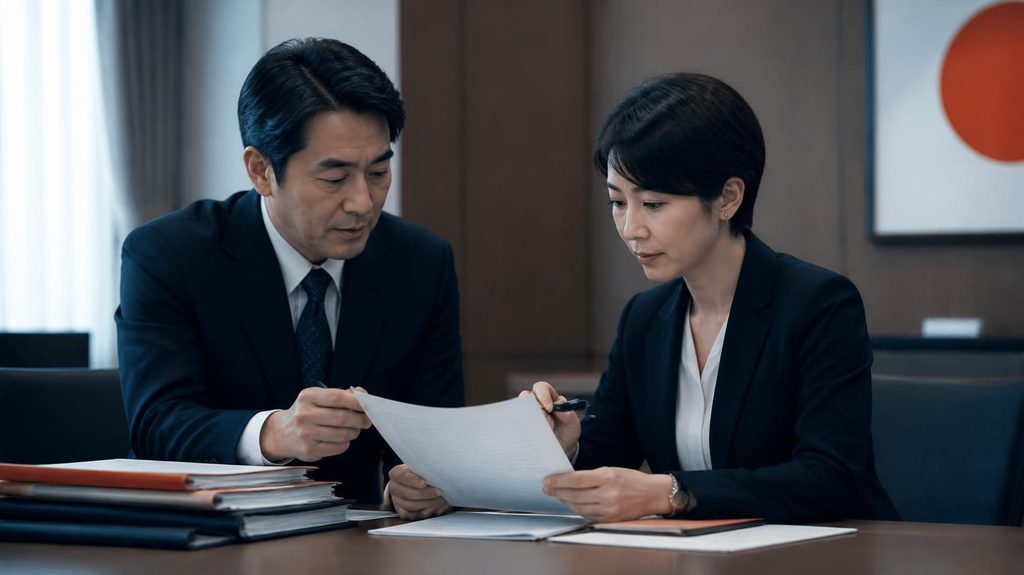
At the time of hiring, you must give every employee a written notice of working conditions (労働条件通知書, rodo joken tsuchisho). It must cover:
- The contract term, and for fixed-term staff, whether and how the contract may be renewed.
- The workplace and the duties.
- Working hours, breaks, days off and leave.
- Wages, how they are calculated and paid, and the pay dates.
- The grounds for termination, including dismissal.
Since April 2024, the notice must also state the full scope of possible future changes to the employee’s workplace and duties, for all employees. For fixed-term employees, it must state any cap on the number of renewals or on the total contract period. When an employee becomes eligible to convert to an indefinite contract, you must tell them about that right and about the conditions that will apply after conversion. The Ministry of Health, Labour and Welfare publishes model notice forms and model work rules for the 2024 changes that your sharoushi can adapt.
The notice may be delivered electronically, but only if the employee asks for it.
Probation and fixed-term contracts
A probation period does not switch off dismissal protection. The only practical difference is that a worker dismissed within the first 14 days is not entitled to the 30-day notice, and the grounds for dismissal must still be reasonable.
Fixed-term contracts carry their own limits:
- Maximum length. A single fixed-term contract can run for up to three years, rising to five years for certain specialists and for workers aged 60 or over.
- Conversion after five years. Once renewed contracts total more than five years, the employee can request conversion to an indefinite contract, and you must accept (Labor Contracts Act, Article 18).
- Expectation of renewal. Repeated renewals can create a reasonable expectation of continued employment, and refusing to renew is then as hard to justify as a dismissal (Labor Contracts Act, Article 19).
A fixed-term contract is not a way around Japan’s dismissal rules. Treat every renewal as a decision that needs a written record.
Contract clauses that don’t work in Japan
Penalty clauses and pre-agreed damages for breach of contract are banned (Labor Standards Act, Article 16), as is offsetting a loan or advance against wages (Article 17). Employment-at-will language and head-office templates built on another country’s law are ignored in the best case, and in the worst case they are read as evidence that you did not understand your obligations. If you start from a template, have it adapted for Japan rather than translated.
English contracts and foreign employees
No law requires a contract in Japanese, though the employee must clearly understand the written conditions. In a dispute, a Japanese-language version is what an inspector, a labor tribunal or a court will read, so an English-only contract leaves you exposed to a reading you did not intend. We recommend a bilingual contract that states which version prevails.
With foreign hires, also confirm that the residence status allows the role, which depends on which of the working visas in Japan the person holds. Employers who let someone work outside their permitted status face criminal penalties under Article 73-2 of the Immigration Control Act. The 2024 amendment raises the maximum to five years’ imprisonment or a fine of up to ¥5 million, and that increase takes effect on 1 April 2027; until then the earlier maximums of three years and ¥3 million apply.
What are the working hour rules and how does Japan overtime pay work?
Working hours are where small companies most often go wrong, usually because nobody told them that overtime without paperwork is illegal even when it is paid in full.
Legal hours, breaks and days off
The baseline is 8 hours a day and 40 hours a week. Employees must receive a break of at least 45 minutes when they work more than 6 hours, and at least 60 minutes when they work more than 8 hours. They must also get at least one day off a week, or four days off in any four-week period.
One exception applies: workplaces with fewer than 10 employees in retail, entertainment, healthcare and hospitality may use a 44-hour week. This exception is on the list for possible abolition in the proposed Labor Standards Act overhaul, which had not been submitted to the Diet as of September 2026.
You must record working hours objectively, for example by time card, PC log or entry system, and this applies to managers as well as to hourly staff. Self-reported hours are not sufficient where they do not match reality. Flextime lets employees choose their own start and finish times within a settlement period, and discretionary work systems treat an employee as having worked a fixed number of hours whatever the actual time. Both need a written agreement, and discretionary work carries further conditions, so use them only with advice.
The 36 Agreement and overtime caps
No overtime and no work on a statutory day off is lawful until you have signed a 36 Agreement (三六協定, saburoku kyotei) with a majority union or a majority employee representative and filed it with the Labor Standards Inspection Office. The name comes from Article 36 of the Labor Standards Act. Paying the overtime premium does not cure the lack of an agreement.

The standard caps are 45 hours of overtime a month and 360 hours a year. Where your business has a genuine need for more, a special clause allows:
- Up to 720 hours of overtime a year.
- Under 100 hours in any single month, including holiday work.
- An average of 80 hours or less over any period of 2 to 6 months.
- More than 45 hours a month in no more than 6 months of the year.
The Ministry of Health, Labour and Welfare publishes a plain-language guide to the overtime caps and a 36 Agreement preparation tool on its Work Style Reform site. The employee representative must be properly chosen, or the agreement can be invalid, and we cover how in the section on employee representatives below.
Overtime premium rates
These are the minimum premiums on top of the base hourly wage.
| Type of work | Minimum premium |
| Overtime beyond 8 hours a day or 40 a week | 25% |
| Overtime beyond 60 hours a month (all company sizes since April 2023) | 50% |
| Late-night work (10pm to 5am) | 25% |
| Work on the statutory day off | 35% |
| Overtime that is also late-night | 50% (75% beyond 60 hours) |
| Statutory day off work that is also late-night | 60% |
For a salaried employee, start by converting the monthly salary into an hourly rate. Divide the base monthly salary by the average number of scheduled working hours in a month, excluding allowances that are not part of base pay, such as commuting, family and housing allowances.
Suppose an employee earns a base salary of ¥300,000 a month and is scheduled for an average of 160 hours a month. The hourly rate is ¥300,000 ÷ 160 = ¥1,875, and 20 hours of overtime at 125% comes to 20 × ¥1,875 × 1.25 = ¥46,875. Check that hourly rate against the minimum wage for your prefecture, because a salary that looks generous can fall short once long scheduled hours are factored in.
Hiring your first employee? Use our employee cost calculator to see the full monthly cost, including overtime and social insurance.
Managers and fixed overtime allowances
A job title does not create an exemption from overtime. A genuine manager (管理監督者, kanri kantokusha) must have real authority over the business, pay that matches the role, and control over their own hours, and even then they still receive the late-night premium and paid leave. Calling an employee a manager to avoid overtime is one of the most common causes of back-pay claims in Japan.
Fixed overtime allowances (みなし残業, minashi zangyo) are lawful, though only when set up correctly. The clause must separate the overtime amount from base pay, state how many overtime hours it covers, and provide that any overtime beyond that number is paid on top. A flat statement that salary includes overtime, with no figures attached, is likely to be treated as base pay. Unpaid wage claims can reach back three years, so a small monthly shortfall across several employees adds up quickly.
Why is dismissal so difficult in Japan?
Dismissal is the biggest legal and cultural shock for foreign employers, and the consequence of getting it wrong is severe. Where a court rules a dismissal invalid, the employment is treated as never having ended, so you may have to reinstate the employee and pay back wages for the entire period of the dispute, which can run to a year or more.

The objectively reasonable grounds test
Under Article 16 of the Labor Contracts Act, a dismissal is invalid if it lacks objectively reasonable grounds and is not socially appropriate. There is no at-will employment in Japan, and you cannot dismiss someone simply because the role did not work out or because you lost confidence in them.
Poor performance alone rarely qualifies. Courts expect a documented process: clear targets, written warnings, training or coaching, a genuine chance to improve, and often a reassignment to a different role before dismissal is considered. A dismissal that skips these steps is likely to be ruled invalid, however poor the performance was.
Notice, payment in lieu and protected periods
You must give 30 days’ notice of dismissal, or pay 30 days’ average wages instead, or combine the two, for example 10 days’ notice plus 20 days’ pay. This requirement sits in Article 20 of the Labor Standards Act. Notice does not make an unreasonable dismissal valid, because it is only a procedural step.
Some periods are protected outright. You cannot dismiss an employee during leave for a work injury or illness, during maternity leave, or for 30 days after either ends (Article 19). Dismissals because of pregnancy, childcare leave, union activity, whistleblowing or nationality are prohibited.
Three kinds of dismissal
Japanese law and practice treat three kinds of dismissal differently, and what you must show differs for each.
| Type | What the employer must show |
| Disciplinary dismissal (懲戒解雇, chokai kaiko) | A serious breach of the work rules, with the rule and the penalty set out in advance in those rules. The penalty must be proportionate, the employee must have had a chance to explain, and the facts must be documented. |
| Ordinary dismissal (普通解雇, futsu kaiko) | A genuine inability to do the job or a loss of trust, backed by documented warnings, training and a chance to improve, and consideration of other roles. |
| Redundancy (整理解雇, seiri kaiko) | Four factors, taken together: business necessity, efforts to avoid dismissal, fair selection of who goes, and proper consultation with employees. |
For redundancy, courts weigh all four factors together. Business necessity means a real need to reduce staff rather than one weak quarter. Efforts to avoid dismissal means you have tried other options first, such as cutting costs, freezing hiring, redeployment or calling for voluntary resignation. Selection must use fair and objective criteria. And you must explain the situation to employees and listen to what they say.
Negotiated exits
Because forced dismissals carry so much risk, most employers in Japan end the relationship by mutual agreement. In practice that means an offer to resign, often with a severance package, recorded in a signed agreement that settles all claims. There is no statutory severance amount, and what you offer depends on the employee’s tenure, the strength of your grounds and what a tribunal would be likely to award. Many companies pay several months’ salary.
The agreement must be genuinely voluntary. Pressure on an employee to resign can itself be unlawful, and a resignation obtained under pressure can be undone. If a dispute does reach a tribunal, the labor tribunal (労働審判, rodo shinpan) is the faster route, designed to resolve cases within three hearings, and most cases end in a settlement. Where either side objects to the outcome, the case moves to a regular court.
We recommend documenting performance from the first month of employment. Written objectives, regular reviews and records of warnings are what turn a difficult dismissal into a defensible one. For the protections that apply around pregnancy and leave, see our article on Japan maternity leave.
When do I need work rules (shugyo kisoku) in Japan?
For a growing startup, the tenth employee is a legal milestone, because this is the point at which written work rules (就業規則, shugyo kisoku) become mandatory.
The ten-employee threshold
You must draw up work rules and file them with the Labor Standards Inspection Office once you regularly employ ten or more people. The count is per workplace rather than per company, and it includes regularly employed part-time and fixed-term staff, not only full-time employees.
Failing to create and file them can bring a fine of up to ¥300,000. There is a second and more practical problem: without written rules, the company has no basis for discipline. If you want to be able to suspend, reprimand or dismiss someone for misconduct, the offence and the penalty need to be in the rules first.
What work rules must contain
The rules must include:
- Hours, breaks, days off and leave.
- Wages, including how they are calculated and paid.
- Termination, including the grounds for dismissal.
Where your company offers them, the rules must also cover severance, bonuses, discipline, and any other benefits or conditions that apply to all employees. The Ministry of Health, Labour and Welfare publishes a model set of work rules in Japanese that most sharoushi work from.
The rules must be made known to employees, for example by posting them in the workplace or putting them on a shared drive that everyone can reach. Rules that staff cannot see may not bind them.
Employee representatives and consultation
Before you file work rules, you must obtain the opinion of the majority union or, where there is none, of a majority employee representative, and attach their written opinion to the filing. The same type of representative signs the 36 Agreement.
The representative must be chosen by the employees in a fair process, such as a vote or a show of hands, and cannot be a manager. A representative you appoint yourself is invalid, and that can void the 36 Agreement as well, leaving your overtime without legal basis.
In a team of ten, a simple selection works well. Tell everyone in writing that a representative is needed, hold a vote or call for volunteers, then record the result and the date and keep it with your files. The representative should not be someone who supervises the others.
Filing with the Labor Standards Inspection Office
You file the work rules with the Labor Standards Inspection Office for your area, together with a notification form and the representative’s written opinion. Any later change to the rules must be consulted on and filed in the same way. The process is procedural, though the paperwork is checked, so we recommend asking your sharoushi to prepare it.
How much paid leave must employers give in Japan?
Paid leave (年次有給休暇, nenji yukyu kyuka) is governed by numerical rules, and the penalties for missing them are real.
How paid leave accrues
Employees earn paid leave after 6 months of employment, provided they attended at least 80% of working days. Days of maternity and childcare leave count as attended.
| Years of service | Days of paid leave |
| 0.5 | 10 |
| 1.5 | 11 |
| 2.5 | 12 |
| 3.5 | 14 |
| 4.5 | 16 |
| 5.5 | 18 |
| 6.5 or more | 20 |
Part-timers who work four days a week or fewer and under 30 hours a week receive a proportional amount.
The mandatory five days
For any employee who is granted 10 or more days, you must make sure at least five days are actually taken each year, and fines apply for each employee who does not receive them. Employees may choose their own dates, but where they do not, you must set the timing after asking for their wishes. You may also use a scheduled leave system for part of the entitlement. The MHLW guide to the five-day requirement sets out how to run the annual cycle.
You can change the timing an employee has chosen only where the leave would seriously disrupt normal business operations, and an ordinary busy period does not count. Unused leave expires after two years, and you must keep a paid leave register (年次有給休暇管理簿, nenji yukyu kyuka kanribo) and retain it for the legally required period.
Other statutory leave
Parental and family leave are separate rights. Maternity leave, childcare leave and family care leave each have their own rules, and employees can claim them whatever their length of service. For details, see our article on Japan maternity leave.
What other employer obligations should I know about?
Six further duties round out the picture, and each one deserves an article of its own.
- Minimum wage. Rates are set by prefecture and revised each autumn. The FY2026 national weighted average is ¥1,177, a rise of ¥56, and the new rates take effect between 1 October and 2 December 2026. See our article on Japan minimum wage.
- Social and labor insurance, withholding tax and payroll. These add materially to the cost of a hire, and our accounting support for startups in Japan covers the monthly cycle. See also Social insurance, withholding and payroll and our employee cost calculator.
- Harassment prevention. Every employer must take measures against power harassment, sexual harassment and maternity-related harassment. From 1 October 2026, those duties extend to customer harassment and to sexual harassment of job seekers.
- Foreign staff. Check residence cards at hiring, and file the foreign employment status notification with Hello Work when a foreign employee joins and when they leave.
- Retirement and older workers. The minimum retirement age is 60, and you must offer employment to age 65 to everyone who wants it.
- Health. Annual health checks are required for regular staff. Stress checks are mandatory now only at workplaces with 50 or more regular workers. An amendment passed in May 2025 extends them to smaller workplaces, and a June 2026 cabinet order fixed the start date at 1 April 2028. Reporting results to the Labor Standards Inspection Office stays limited to workplaces with 50 or more workers.
What changed recently in labor laws in Japan?
Labor laws in Japan change in small steps every year, so here is the recent timeline and what is still to come. Last reviewed: October 2026.
- April 2023. The 50% premium for overtime beyond 60 hours a month was extended to small and medium-sized companies.
- April 2024. New items were added to the notice of working conditions, and the overtime caps were applied to construction, drivers and doctors.
- April 2025. The transitional measure ended, so employment to age 65 now applies to everyone who wants it, and the first stage of the childcare and family care leave amendments took effect.
- 1 October 2026. Customer harassment and job-seeker sexual harassment measures became mandatory.
- October to December 2026. New prefectural minimum wages take effect.
- 1 April 2027. The higher penalties for employing people outside their permitted status take effect.
- 1 April 2028. Stress checks extend to workplaces with fewer than 50 workers.
- Still pending. A major Labor Standards Act overhaul is under discussion, covering limits on consecutive working days, rest intervals between shifts, guidance on a right to disconnect, and an end to the 44-hour exception. No bill has been submitted, so the timing is open.
Do I need a Japanese entity to hire employees?
There are two routes to hiring in Japan, and the real question is who the legal employer is. That answer determines who signs the contract, files the 36 Agreement, pays social insurance and carries the liability if something goes wrong.
Hiring through your own Japanese entity
Where you hire through your own company, the company is the employer. It must register for social and labor insurance, record working hours, file a 36 Agreement before anyone works overtime, and file work rules once it reaches ten employees. Our checklist of requirements after incorporation covers the registrations in order.
Directors are not employees under labor law, which affects how founders are paid and covered. A founder who is also a director sits outside the Labor Standards Act in general, while any non-director staff are fully covered, and we explain the pay side in director salary in Japan. Directors also carry duties to the company under corporate law, so decisions about the board and governance should be taken with advice. To set the company up in the first place, see our guide to company formation in Japan.
Hiring through an employer of record
An employer of record in Japan becomes the legal employer on paper, while you direct the daily work. It can make sense when you are testing the market, need to hire quickly, or have only one or two people in the country. It stops working well as headcount grows, because the fees add up and you have less control over contracts, work rules and exits. For a fuller comparison, see EOR vs PEO in Japan.
Not sure which route fits your plans? SmartStart Japan helps foreign founders incorporate, register for social insurance and set up compliant employment from the start. Book a consultation.
Frequently asked questions about employment law in Japan
Can I dismiss an employee at will in Japan?
No. A dismissal needs objectively reasonable grounds and must be socially appropriate (Labor Contracts Act, Article 16), plus 30 days’ notice or pay in lieu. See Why is dismissal so difficult in Japan?
Is overtime pay mandatory in Japan?
Yes. Work beyond 8 hours a day or 40 a week is paid at a premium of at least 25%, rising to 50% beyond 60 hours a month, and it needs a filed 36 Agreement. A manager title does not remove the obligation unless the role is genuinely managerial. See Overtime premium rates.
How many hours can employees legally work in Japan?
Eight hours a day and 40 a week before overtime. With a 36 Agreement, overtime is capped at 45 hours a month and 360 a year, or up to 720 a year with a special clause. See The 36 Agreement and overtime caps.
Does an employment contract in Japan have to be in Japanese?
No law requires Japanese, though the employee must clearly understand the written conditions, and a Japanese version matters if there is ever a dispute. See English contracts and foreign employees.
Do I need work rules if I have fewer than ten employees?
Not legally, but without written rules the company has no basis for disciplinary action, so many small companies draft them early. See When do I need work rules?
Are part-time employees entitled to paid leave in Japan?
Yes. After 6 months with 80% attendance they receive paid leave, in proportion to their working days if they work four days a week or fewer and under 30 hours. See How much paid leave must employers give?
Do foreign employees have the same rights under Japanese labor law?
Yes. Labor laws apply to every worker in Japan regardless of nationality, and the employer must also check that the residence status allows the role. See English contracts and foreign employees.
Can I hire employees in Japan without a Japanese company?
Yes, through an employer of record, which acts as the legal employer. For more than a few hires, your own entity is usually more practical and cheaper over time. See Do I need a Japanese entity?
What happens if a company breaks labor laws in Japan?
A Labor Standards Inspection Office can investigate and issue correction orders, some breaches carry criminal penalties, and employees can claim unpaid wages going back three years. See The Labor Standards Act.
Conclusion
To sum it all up, employment law in Japan rewards employers who plan early. Put the key conditions in writing in a notice of working conditions, pay overtime within the caps of a filed 36 Agreement, treat dismissal as a last resort that needs documentation, adopt work rules when you reach ten employees, and make sure your staff take their five mandatory days of paid leave.
Bring in a sharoushi for the jobs where mistakes are expensive: drafting work rules and the 36 Agreement, any dismissal or redundancy, labor inspections, disputes and unpaid-wage claims. Rates, thresholds and start dates change every year, so check current figures against the official sources below before you act. Get these foundations right and hiring in Japan becomes one of the more predictable parts of building your business here.