Originally By Reid Schickner | 2026/01/27
Starting a sole proprietorship is one route to starting a business in Japan, and it involves a series of legal, financial, and administrative steps.. For many freelancers, consultants, teachers, creators, online sellers, and solo service providers, the first practical step is registering as a sole proprietor.
In Japanese, this is called 個人事業, or kojin jigyo. The person running the business is called a 個人事業主, or kojin jigyo nushi.
A sole proprietorship in Japan is simpler than setting up a KK or GK. You do not create a separate company, issue shares, or register a corporate entity at the Legal Affairs Bureau. You notify the tax office that you are operating a business as an individual.
That simplicity is useful, but it comes with a trade-off. The business is legally tied to you. If the business has debt, a contract issue, unpaid tax, a claim from a customer, or a dispute with a supplier, you are personally responsible.
This guide explains how sole proprietorships work in Japan, who they are useful for, what forms you need, what taxes to understand, how visa issues work for foreign founders, and when it may be time to change to a company.
If you want the short answer, a sole proprietorship is often a good first step for a small, low-risk business. If you need limited liability, investment, a stronger visa strategy, employees, a licensed office, or stronger credibility with larger clients, compare it with a GK or KK before filing.
Key takeaways
- A sole proprietorship in Japan is simple to start, but it is not a company and does not give you limited liability.
- Foreign residents must check visa permission before operating. Tax registration and immigration permission are separate.
- A sole proprietor can apply for a Business Manager Visa, but the practical burden is higher than using a KK or GK.
- Taxes, Blue Return filing, invoice registration, licenses, and banking should be checked before the business gets busy.
- Key takeaways
- What is a sole proprietorship in Japan?
- Who should use a sole proprietorship?
- Sole proprietorship vs GK or KK
- Before you register for a Sole Proprietorship
- Confirm your visa and work eligibility
- Steps to start a sole proprietorship in Japan
- Taxes for sole proprietors in Japan
- Hiring employees as a sole proprietor
- When to change from sole proprietor to a corporation
- FAQ
- Final thoughts
What is a sole proprietorship in Japan?
A sole proprietorship is a business run by an individual. It is not a company.
This is the most important point to understand. A sole proprietor may use a trade name, issue invoices, have a website, serve clients, and open a bank account for business use. But legally, the business and the owner are not separated.
That is different from a Kabushiki Kaisha, KK, or Godo Kaisha, GK. A KK or GK is a separate legal entity. The company can sign contracts, own assets, open a corporate bank account, and continue separately from the individual founder.
With a sole proprietorship, you are the business. This affects:
- Liability
- Taxes
- Banking
- Contracts
- Business transfer or sale
- Visa planning
- Credibility with some Japanese clients
For a small freelance business, that may be fine. For a business with employees, a physical location, high-value contracts, regulated activities, or meaningful legal risk, a company is often safer.
Who should use a sole proprietorship?
A sole proprietorship works best when the business is simple, small, and mainly operated by the owner.
It is commonly used by:
- Freelancers
- Consultants
- Designers
- Writers and editors
- Translators and interpreters
- Teachers and tutors
- Coaches and trainers
- Small online sellers
- Solo service providers
- People testing a business before forming a company
For example, a freelance web designer, marketing consultant, English teacher, content creator, or small online seller may start as a sole proprietor while testing the market.
If you are still exploring whether Japan is the right market, a sole proprietorship can be a light way to begin. If your business is connected to overseas sales or expansion, this guide to Japan market entry can help you think beyond the registration step.
A sole proprietorship is usually not the best fit if you need:
- Limited liability
- Several employees
- Large B2B contracts
- Equity investment
- A corporate bank account
- A business that can be sold or transferred easily
- A regulated office or licensed premises
- A clearer structure for visa or immigration review
This does not mean sole proprietors cannot do serious business. Many do. It means the structure has limits. It is useful for starting small, but it may become restrictive as the business grows.
If you are operating as a freelancer in Japan, the key is to understand where freelance work ends and business setup begins.
Sole proprietorship vs GK or KK
Before registering as a sole proprietor, compare it with Japan’s two common company structures: Godo Kaisha, GK, and Kabushiki Kaisha, KK.
Before registering as a sole proprietor, compare it with Japan’s two common company structures: Godo Kaisha, GK, and Kabushiki Kaisha, KK.
| Category | Sole proprietorship | GK | KK |
| Legal entity | No separate legal entity | Separate legal entity | Separate legal entity |
| Liability | Personal liability | Limited liability in general | Limited liability in general |
| Setup burden | Light | Medium | Higher |
| Public credibility | Lower than a company | Moderate | Higher |
| Best for | Freelancers and solo operators | Small companies and owner-managed businesses | Companies needing stronger credibility or investment readiness |
| Bank account | Personal account or bank-specific trade name treatment | Corporate bank account | Corporate bank account |
| Equity investment | Not suitable | Limited compared with KK | More suitable |
| Administration | Simple | More formal than sole proprietorship | More formal than GK |
A sole proprietorship is usually the lightest structure. A Godo Kaisha in Japan is often used for owner-managed companies, subsidiaries, and smaller businesses that still want a separate legal entity. A Kabushiki Kaisha is often used when the business needs stronger public credibility, outside investors, or a more traditional corporate image in Japan.
If your goal is to test a business idea, a sole proprietorship may be enough.
If your goal is to hire staff, raise money, apply for financing, work with large Japanese companies, or build a long-term visa strategy, compare the sole proprietorship route with GK and KK before deciding.
SmartStart Japan helps foreign founders compare sole proprietorships, GKs, and KKs before filing. This is especially useful if your choice affects visas, banking, licenses, or future incorporation.
Before you register for a Sole Proprietorship
Filing as a sole proprietor can be quick. The thinking before the filing matters more.
Before you submit anything to the tax office, check these five areas.
Confirm your visa and work eligibility
If you are not a Japanese citizen or permanent resident, your visa status matters.
Filing tax paperwork does not automatically give you permission to work or run a business in Japan. The tax office and immigration are separate systems. The tax office can accept a business filing, but that does not mean your residence status allows the business activity.
This is especially important if you are on:
- A work visa tied to an employer or job category
- A student visa
- A dependent visa
- A designated activities status
- Any status with limits on work activity
Before operating, confirm whether your visa allows the business activity you plan to do. If you are unsure, check the relevant working visas in Japan and speak with an immigration professional.
Can a sole proprietor apply for a Business Manager Visa?
Yes, a sole proprietor can apply for a Business Manager Visa, but this point needs careful explanation.
Legally, the Business Manager Visa rules are not limited only to KK or GK companies. Japan’s Immigration Services Agency materials discuss both corporate businesses and individual business operators. In the 2025 revisions, the agency explains that when the business operator is an individual, the business scale is checked by looking at the total amount invested into things needed to operate the business, such as securing an office, employee salaries for one year, and equipment costs.
The current standard also refers to a business scale of 30 million yen or more, along with other requirements such as office substance, business plan review, employment, Japanese-language capacity, permits where needed, and tax/social insurance compliance. You can review the official Immigration Services Agency explanation on the Business Manager Visa status and the 2025 rule revisions.
In practice, a corporation is still the more common and straightforward route. A KK or GK usually makes it easier to show capital, office setup, business documents, organizational structure, and long-term business substance.
So the practical guidance is:
- A sole proprietor route may be legally possible.
- It is likely to receive careful scrutiny.
- You need strong evidence of business substance and sustainability.
- A corporation is often easier to explain to immigration.
- Do not assume that filing a sole proprietorship is enough for visa purposes.
If your business setup is connected to a visa, get advice before choosing the structure. The wrong order can create expensive delays.
Decide on your business activity
Your business activity affects licenses, tax treatment, bank explanations, loan applications, client trust, and sometimes visa questions.
A clear activity is better than a vague one.
For example:
- “Web design for small businesses” is clearer than “online services.”
- “English coaching for adults” is clearer than “education business.”
- “Shopify store selling imported home goods” is clearer than “e-commerce.”
You do not need to describe every possible future activity. But you should be able to explain what the business actually does, who it serves, and how it earns money.
If the business involves online sales, also think through platform rules, returns, customer support, labeling, and tax. For a broader view, see this guide to selling online in Japan.
Decide whether to use a trade name, 屋号
A sole proprietor can use a trade name called 屋号, yagō.
This is not a company name. You are still operating as an individual. But a trade name can help you present the business more clearly on a website, invoice, proposal, business card, or bank explanation.
A trade name can help if:
- You want a brand name separate from your personal name
- You sell services to companies
- You want invoices to look more professional
- You may turn the business into a company later
Be careful with names that make the business look like a corporation when it is not. Avoid using terms that imply a registered company structure. You should also avoid names that are too close to existing brands or trademarks.
Check your address and virtual office situation
Many freelancers and solo business owners work from home. That may be practical, but it can create privacy and compliance questions.
A virtual office in Japan can be useful if you mainly need a public-facing business address for a website, invoice, or mail handling.
A virtual office may work if:
- You work remotely
- You do not meet clients at the address
- Your business does not need inspected premises
- Your industry does not require a licensed office
- You mainly need an address for public materials
But a virtual office is not always enough. Some licenses, banks, immigration situations, and company setup plans may require a physical office or stronger address arrangement. If you plan to apply for a Business Manager Visa, open a corporate bank account later, or enter a regulated industry, check before relying on a virtual office.
Check whether you need a license
The tax office filing does not give you permission to operate every type of business.
Some industries require a permit, license, registration, inspection, or approved office before you advertise, accept payment, or open to customers.
Common areas to check include:
- Food and restaurants
- Bars and alcohol sales
- Recruitment and staffing
- Real estate
- Travel and tourism
- Used goods and secondhand sales
- Construction
- Childcare
- Medical, beauty, and wellness services
- Financial or professional services
Depending on the business, you may need to check with a public health center, police station, labor bureau, prefectural office, city office, or industry regulator.
If your business touches a regulated area, review business license requirements before you start. This is one of the most common mistakes foreign founders make in Japan: they file tax paperwork and assume the business is fully legal. For regulated businesses, the tax filing is only one piece.
Steps to start a sole proprietorship in Japan
The basic process is simple. The main work is filing the right forms, setting up records, and checking whether your business needs any extra approval.
Step 1. Prepare your information
Before filing, prepare the information you will need for the tax office.
This usually includes:
- Your name
- Your address
- Your business start date
- Your business activity
- Your business address, if different from your home address
- Your trade name, 屋号, if you use one
- Your My Number information
- Whether you plan to apply for Blue Return filing
If you are not comfortable reading Japanese forms, get help before filing. The form itself is not difficult, but mistakes in dates, address, activity, or tax choices can create confusion later.
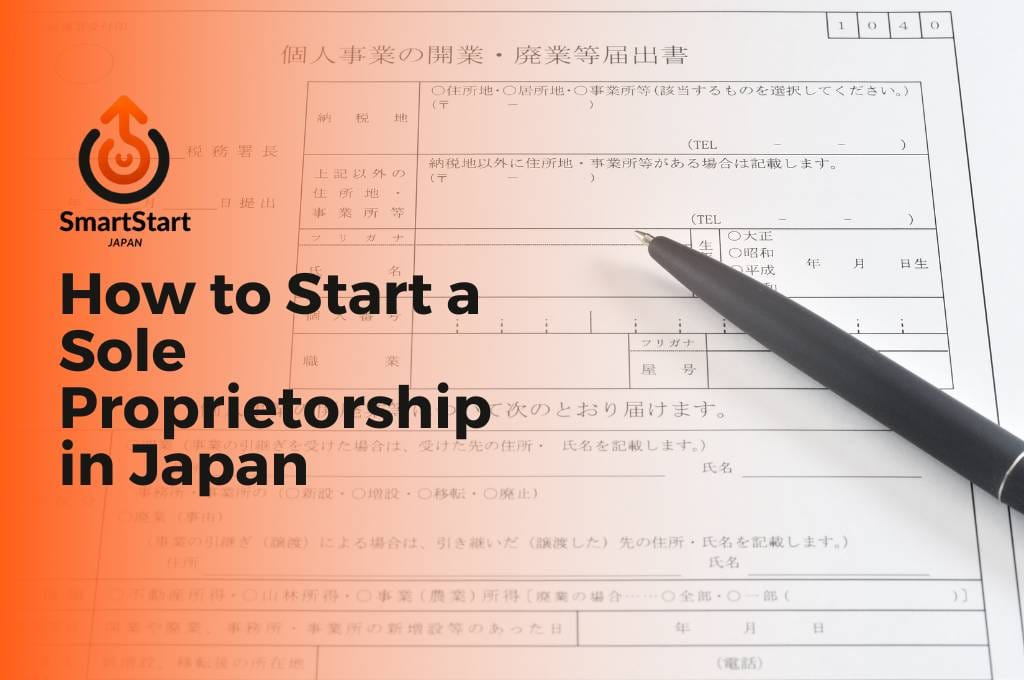
Step 2. File the opening notification, 開業届
The main form is the 個人事業の開業・廃業等届出書, kojin jigyo no kaigyo haigyo-to todokede-sho.
In English, this is often called the Notification of Business Start or Closure. Many people simply call it the 開業届, kaigyo todoke.
You submit this to the tax office that has jurisdiction over your tax address. The filing tells the tax office that you have started operating a business as an individual.
This filing does not create a company. It only registers your business activity for tax purposes.
The National Tax Agency’s current guidance says the opening notification should be submitted by the income tax return filing deadline for the year in which the business started. You can check the official NTA page for the opening notification procedure.
Even if the deadline is not immediate, do not treat this as something to leave until the last minute. Filing early can make other steps easier, such as Blue Return planning, bookkeeping setup, bank explanations, and subsidy applications.
Step 3. File the Blue Return application, 青色申告承認申請書
The next form to consider is the 所得税の青色申告承認申請書, shotokuzei no aoiro shinkoku shonin shinsei-sho.
This is the Application for Approval of Blue Return Filing.
Blue Return filing is optional, but many sole proprietors should consider it. It can reduce taxable income if you apply on time, keep proper books, and file correctly.
The timing matters. The NTA says the application is generally due by March 15 of the year for which you want to use Blue Return filing. If you start a new business on or after January 16, the deadline is generally within two months from the business start date. See the NTA page for the Blue Return application.
Do not confuse this with the opening notification. The 開業届 tells the tax office you started the business. The Blue Return application asks for approval to use Blue Return filing.

Step 4. Set up bookkeeping from the beginning
Do not wait until tax season to organize your records.
Track these from the start:
- Sales
- Expenses
- Receipts
- Invoices
- Bank transfers
- Cash payments
- Equipment purchases
- Client payments
- Consumption tax status, if relevant
Good records help you file taxes, claim expenses, apply for loans, explain the business to a bank, and understand whether the business is actually making money.
If you want the larger Blue Return deductions, bookkeeping matters even more.
Step 5. Separate your business banking
A sole proprietor does not have a corporate bank account because there is no corporation.
Most sole proprietors use a dedicated personal bank account for business income and expenses. This makes bookkeeping cleaner and keeps business transactions separate from daily spending.
Some banks may allow a trade name, 屋号, to appear in connection with the account. Depending on the bank, the account may appear under your personal name only, or under a format that includes both the trade name and your personal name.
Even then, it is not the same as a corporate bank account. The account remains tied to the individual owner. Bank policies vary, so confirm directly before assuming how the account name will appear.
If you later incorporate, banking changes. A corporation can apply for a corporate bank account, but the bank will review the company, business activity, address, owners, and documents.
Step 6. Prepare for annual tax filing
Sole proprietors generally file an annual tax return for the previous calendar year.
This is where you report business income, expenses, deductions, and tax owed.
Tax filing is much easier if you organize records throughout the year instead of trying to reconstruct everything later. If you have clients overseas, mixed personal and business expenses, inventory, digital sales, subcontractors, or consumption tax questions, consider speaking with an accountant early.
Taxes for sole proprietors in Japan
A sole proprietor is taxed as an individual.
Business profit is generally reported as part of the owner’s personal income tax filing. The main taxes to understand are income tax, resident tax, consumption tax, and individual enterprise tax.
This section gives a practical overview. For a broader beginner explanation, see SmartStart Japan’s guide to Japanese business taxes.
Income tax
Income tax is based on taxable income.
For a sole proprietor, this generally means business revenue minus business expenses and deductions. Japan uses progressive tax rates, so the rate rises as taxable income increases.
This is one reason profitable sole proprietors sometimes compare staying as an individual with forming a company. A company is taxed differently, and the owner may receive director compensation, which creates a different tax calculation.
There is no single profit number where everyone should incorporate. Some accountants discuss incorporation when annual net profit reaches around 8 million to 9 million yen, but this is only a rule of thumb. The right timing depends on income, expenses, social insurance, family situation, accounting costs, liability risk, visa plans, and growth goals.
Resident tax
Resident tax is paid to the local government.
It is generally based on the previous year’s income. This means the bill can arrive later, after the income has already been earned.
Plan for this. New sole proprietors sometimes spend the money they need for later tax payments because the bill does not arrive immediately.
Consumption tax and the qualified invoice system
Consumption tax becomes more important as sales grow.
Under the basic rule, a business may be exempt from consumption tax if taxable sales during the base period are 10 million yen or less. For an individual business, the base period is generally the year two years before the current year. The NTA explains the 10 million yen rule on its page about consumption tax exemption.
This area has exceptions. Even if sales are 10 million yen or less, exemption may not apply in some situations. One major example is qualified invoice registration.
Japan’s qualified invoice system, also called the invoice system or 適格請求書等保存方式, affects whether business customers can claim input tax credits. If a sole proprietor registers as a qualified invoice issuer, they generally become a taxable business for consumption tax regardless of the 10 million yen threshold. The NTA explains this on its qualified invoice system page.
This is a business decision, not just a tax form. Some B2B clients may prefer or require qualified invoices. But registration can create consumption tax filing and payment obligations.
For a practical business-facing explanation, see this guide to Japan’s qualified invoice system.
If your taxable sales are approaching 10 million yen, or if clients ask for qualified invoices, speak with a tax professional before deciding what to do.
Individual enterprise tax, 個人事業税
Individual enterprise tax is called 個人事業税, kojin jigyozei.
This is a local tax that may apply to certain types of self-employed business income. It does not apply to every activity in the same way.
Tokyo Metropolitan Tax Bureau explains that individual enterprise tax has a business proprietor deduction of 2.9 million yen per year. If the business operates for only part of the year, the deduction may be prorated. Tax rates depend on the business category and are commonly 3%, 4%, or 5%. You can check Tokyo’s official page on individual enterprise tax.
Many small sole proprietors may not pay this tax at the beginning. Once profit rises above the deduction amount, include it in tax planning.
One important detail: the Blue Return special deduction is an income tax concept. Do not assume it reduces individual enterprise tax in the same way. This is a good example of why a tax accountant can be useful once the business becomes profitable.
Blue Return filing and the special deduction
Blue Return filing is called 青色申告, aoiro shinkoku.
It can reduce taxable income if you apply on time, keep proper books, and file correctly.
Depending on your bookkeeping and filing method, the Blue Return special deduction can be:
- 100,000 yen
- 550,000 yen
- 650,000 yen
The NTA explains these deduction tiers on its page about the Blue Return special deduction.
In simple terms:
- The 100,000 yen deduction is for Blue Return filers who do not meet the higher-tier requirements.
- The 550,000 yen deduction generally requires proper bookkeeping, financial statements, and timely filing.
- The 650,000 yen deduction generally requires meeting the 550,000 yen requirements plus e-Tax filing or qualifying electronic bookkeeping.
The larger deduction is not automatic. You need to apply, keep records correctly, and file properly by the deadline.

Banking & GビズID
After filing, there are a few practical items that can make the business easier to run.
Banking
Use one account for business activity if you can.
This helps with:
- Separating personal and business spending
- Tracking sales
- Tracking expenses
- Preparing tax returns
- Showing clean records for a loan application
- Reducing confusion when working with an accountant
Even if the account is legally a personal account, separating business activity makes your records much easier to understand.
Invoices, receipts, and document storage
Set up a simple system before the business gets busy.
You should be able to find:
- Customer invoices
- Supplier invoices
- Receipts
- Bank records
- Contracts
- Quotes and purchase orders
- Tax filings
- License documents, if any
Japan is paperwork-heavy compared with many countries. If you build the habit early, tax season becomes far less painful.
GビズID
GビズID is an account used for Japanese government online administrative services.
For sole proprietors, it may be useful for subsidy or grant applications, JGrants, employment-related procedures, and other online filings. The official GビズID site describes it as an authentication system for multiple administrative services.
It is not always mandatory on day one. For many sole proprietors, it becomes useful later when applying for subsidies, handling digital procedures, or dealing with employment-related filings.
Do not confuse GビズID with registering a company. It is an online government ID system, not a business structure.
Funding options
A sole proprietor can apply for funding, but options are different from a company.
Common funding sources include:
- Personal savings
- Revenue from early customers
- Japan Finance Corporation loans
- Bank loans
- Subsidies and grants
- Product-based crowdfunding
Sole proprietors may be able to apply for business loans from Japan Finance Corporation or banks. Approval depends on the business plan, use of funds, industry, owner background, financial situation, and repayment ability.
Some subsidies and grants may also be available to sole proprietors. Eligibility depends on the program, timing, business size, industry, and required documents.
Crowdfunding can work if you are selling a product or pre-selling a service. Equity investment is different because a sole proprietorship has no shares. If you want investors to own part of the business, you usually need a company structure.
Hiring employees as a sole proprietor
A sole proprietor can hire employees, but the paperwork becomes more complicated.
Depending on the situation, obligations may arise for:
- Labor insurance
- Employment insurance
- Social insurance
- Payroll withholding
- Employment contracts
- Working hours
- Paid leave
- Payroll records
- Tax filings connected to salaries
Hiring is often the point where a simple sole proprietorship becomes less simple.
If you plan to hire, speak with a labor and payroll specialist before the first employee starts. It is much easier to set up correctly from the beginning than to repair missing filings later.
Hiring can also affect visa strategy. For Business Manager Visa planning, employees, payroll, office setup, and business scale may become part of the overall immigration picture.
When to change from sole proprietor to a corporation
A sole proprietorship is often a good starting point. It may not be the best structure forever.
Many business owners start thinking about incorporation when one or more of these become important:
- Tax planning
- Liability protection
- Employees
- Larger contracts
- B2B credibility
- Bank financing
- Business Manager Visa planning
- Business sale or succession
- Equity investment
If you are already operating and wondering about the next step, SmartStart Japan has a separate guide on going from sole proprietor to company.
Tax planning
As a sole proprietor, business profit is taxed as individual income. As profit rises, the progressive tax rate can become heavier.
A corporation is taxed differently. The owner may also receive director compensation, which changes the calculation.
This does not mean incorporation always saves tax. Accounting fees, social insurance, director compensation planning, consumption tax timing, and administrative work all matter.
Consumption tax timing
Consumption tax can affect incorporation timing.
If annual taxable sales are approaching 10 million yen, or if you are deciding whether to register as a qualified invoice issuer, review the structure with a tax professional.
Incorporation may affect consumption tax planning, but the result depends on timing, capital amount, invoice registration status, customer type, taxable sales, and current rules.
Do not assume that incorporation automatically creates a consumption tax exemption period. The treatment depends on the facts.
Liability and risk
As a sole proprietor, you are personally responsible for the business.
If you sign a large lease, borrow money, hire staff, or take on projects where mistakes could cause large losses, a company structure may be safer.
A corporation can separate the business from the owner, although directors may still have responsibilities, and personal guarantees may still apply in some cases.
Credibility with larger clients
Some Japanese companies prefer working with corporations.
This does not mean sole proprietors cannot do B2B work. Many do. But larger companies, government-related organizations, and conservative clients may feel more comfortable with a KK or GK.
For some businesses, incorporation is a sales decision as much as a tax decision.
Financing and investment
A sole proprietor may be able to apply for loans, but equity investment is different.
A sole proprietorship has no shares. If you want investors to own part of the business, you usually need a company structure. A KK is usually the more suitable structure for share-based fundraising.
FAQ
Is a sole proprietorship the same as a company in Japan?
No. A sole proprietorship is not a company. It is a way for an individual to operate and report business activity. A KK or GK is a separate legal entity.
Can a foreigner register as a sole proprietor in Japan?
Yes, a foreign resident may be able to register as a sole proprietor, but visa status matters. Tax registration and immigration permission are separate. Confirm whether your residence status allows the business activity before operating.
Can a sole proprietor apply for a Business Manager Visa?
Yes, it is possible. The Business Manager Visa rules can apply to individual business operators, not only corporations.
In practice, a corporation is usually the more common and easier structure to explain. A sole proprietor applicant must be ready to prove business substance, scale, office setup, financial capacity, operational sustainability, and other requirements. Under current guidance, the business scale requirement includes the 30 million yen standard, and for individual operators, this is assessed through the amount invested into things needed to run the business.
How long does it take to start a sole proprietorship in Japan?
The tax office filing itself can usually be done quickly if you have the information ready. The more important timing issues are checking your visa, checking licenses, preparing records, and filing the Blue Return application on time if you want to use it.
Does it cost money to register as a sole proprietor?
In general, filing the opening notification directly with the tax office is free.
There may be optional or related costs, such as accounting software, tax accountant fees, professional help, seals, licenses or permits, virtual office fees, and translation support.
Do I need a trade name, 屋号?
No. A trade name is optional.
It can help with branding, invoices, websites, proposals, and customer trust. But it does not create a company or separate legal entity.
Do I need Blue Return filing?
Blue Return filing is optional, but many sole proprietors should consider it.
It can provide tax benefits if you apply on time, keep proper records, and file correctly. The larger deductions require stronger bookkeeping and filing requirements.
Can a sole proprietor open a corporate bank account?
No. A sole proprietor does not have a corporation, so it is not the same as opening a corporate bank account for a KK or GK.
Most sole proprietors use a dedicated personal account for business activity. Some banks may allow trade name treatment, depending on the bank.
Can a sole proprietor get a business loan?
Yes, sole proprietors may be able to apply for business loans, including Japan Finance Corporation loans and bank loans.
Approval depends on the lender’s review, business plan, use of funds, industry, financial situation, owner background, and repayment ability.
Can a sole proprietor receive subsidies or grants?
Sometimes. Some subsidies and grants are available to sole proprietors, but eligibility depends on the program and application requirements.
GビズID may be useful for certain online subsidy or administrative procedures, but it is not the same as registering a business.
Do sole proprietors need business licenses?
Some do, and some do not.
The tax office filing only covers tax registration. It does not replace industry-specific permits or approvals. If your business involves food, alcohol, real estate, recruitment, travel, used goods, childcare, construction, or another regulated area, check before operating.
When should I change from a sole proprietor to a corporation?
Consider incorporation when profit, liability risk, hiring, financing, B2B credibility, visa planning, or investment needs become more serious.
There is no perfect timing that applies to every business. The right decision depends on your income, risk, clients, tax position, visa situation, and growth plan.
Final thoughts
A sole proprietorship is one of the simplest ways to start doing business in Japan.
It works best for freelancers, consultants, and small owner-operated businesses that do not need a company structure from day one.
The main risk is personal responsibility. The business is tied to you, so debts, contracts, disputes, and tax obligations are also tied to you.
For a small and low-risk business, that tradeoff may be acceptable. Once the business needs employees, larger contracts, financing, limited liability, visa planning, or stronger credibility, it may be time to compare GK and KK options.
Choose the structure based on the business you are building, not only the easiest form to file.
SmartStart Japan helps foreign entrepreneurs compare sole proprietorships, GKs, and KKs, then plan the setup around visas, banking, licenses, tax registration, and launch needs.