Do you want to hire your first employee in Japan before setting up a Japanese company? EOR Japan solves this by employing the person for you and becoming their legal employer. Many founders also ask whether a professional employer organization (PEO) would work instead, or whether they should set up their own company from the start.
A PEO is a US co-employment model in which the provider shares employer duties with a client that already has its own company, and Japan has no legal equivalent. Below, we compare employer of record (EOR) services with the Japanese alternatives to a PEO and with your own KK or GK, including the overhead cost at 1, 3 and 10 employees and the headcount at which incorporating becomes cheaper.
Updated on November 4, 2026. This article is general information, not legal advice.
- Quick answer: EOR vs PEO vs your own KK or GK
- What is a PEO?
- Is there a PEO in Japan?
- Alternatives to a PEO in Japan
- What is an EOR in Japan?
- EOR vs PEO vs your own KK or GK: cost at 1, 3 and 10 employees
- What else to check before choosing a Japan EOR
- Which option fits your stage?
- Moving from an EOR to your own Japanese entity
- FAQ
- Choosing between an EOR and your own entity
Quick answer: EOR vs PEO vs your own KK or GK
We recommend an EOR when you want to start fast and are testing the market. Japan has no PEO, so the nearest equivalent is outsourced HR on top of your own company. Your own KK or GK has a higher fixed cost but a low cost per extra head, so our illustrative overhead model makes it cheaper from the second employee. A single hire is close to a tie under these assumptions; obtain quotes before deciding.
- Japan EOR: The EOR is the legal employer, no entity is required, and your first hire can start within weeks. The cost is a fee per employee that grows with headcount, which makes it best for testing the market with one to a few hires.
- “PEO” in Japan (outsourced HR on your own entity): Your company is the legal employer, so you need an entity and can only hire after incorporation. The cost is fixed retainers plus your entity costs, which suits teams that already have an entity.
- Your own KK or GK: Your company is the legal employer, and your first hire comes after incorporation, a bank account and registrations. The cost shape is a higher fixed cost with a low cost per extra head, which suits long-term teams past break-even.

What is a PEO?
A professional employer organization (PEO) is a US model in which the PEO and your company become co-employers of your staff. The PEO runs payroll, payroll tax, benefits and HR compliance, while your company directs the work and must already have its own legal entity. A PEO supports an employer that already exists.
- Co-employment: The PEO reports wages and payroll tax for your staff, while your company directs the work and remains an employer. An IRS-certified PEO (CPEO) is generally solely liable for federal employment taxes on the wages it pays to worksite employees, but with a non-certified PEO your business can remain liable.
- Reasons to use one: Companies often use a PEO to access group benefits and insurance rates, and to outsource their HR administration.
- Difference from an EOR: A PEO needs your own entity and shares employer duties with you, whereas an EOR is the sole legal employer, so no entity is needed.
Sources: IRS, CPEO customers: what you need to know; NAPEO (US industry body).
Is there a PEO in Japan?
Japan has no co-employment model, so a US-style PEO does not exist in Japan. Japanese labor law places employer duties on the company that signs the employment contract, and the only arrangement that splits duties with a client is licensed worker dispatch. Providers that appear in a search for “PEO Japan” are, in practice, EORs, dispatch agencies or payroll outsourcers, so check which one you are buying.
Alternatives to a PEO in Japan
Instead of a PEO, you can buy the services below, all of which sit on top of your own entity.
- Sharoushi (社会保険労務士, shakai hoken romushi): A licensed labor and social insurance consultant handles social insurance and labor filings, work rules and labor advice. This suits any company with its own entity.
- Payroll outsourcing (給与計算代行, kyuyo keisan daiko): A provider runs monthly payroll, withholding and the year-end adjustment, which suits small teams without an HR person.
- HR BPO: A provider covers payroll plus attendance, onboarding and benefits, which suits growing teams.
- Worker dispatch (派遣, haken): A licensed agency employs staff who work under your direction, which suits short-term or flexible roles.
- Outsourced contracting (業務委託, gyomu itaku): A contractor delivers a result and directs its own staff, which suits defined projects but never daily direction.
This difference matters for pricing. EOR payroll services bundle employment and payroll into one fee, while payroll outsourcing in Japan covers payroll only and assumes you already employ the person through your own company. A Japan EOR takes the place of the employer, while every PEO alternative assumes that you are the employer.
Struggling to hire your first employee in Japan? SmartStart Japan helps foreign companies decide between an EOR and their own KK or GK. Book a free consultation
What is an EOR in Japan?
An EOR is the sole legal employer of your worker, so unlike with a PEO you need no Japanese entity. The EOR signs the employment contract, runs payroll and withholding tax, enrolls the employee in social and labor insurance, and handles leave and benefit filings. You still direct the daily work, set goals and give feedback. Recruitment and assignment must follow the rules for the provider’s actual arrangement, including the dispatch restrictions explained below.
. Our Japan EOR guide covers how an EOR in Japan works in full.
Legal basis for an EOR in Japan
Japan has no EOR category in law. When the EOR employs the worker and your company directs the daily work, the arrangement matches worker dispatch (労働者派遣, rodosha haken) under the Worker Dispatching Act (労働者派遣法, Rodosha Haken Ho). Running dispatch as a business requires a license from the Minister of Health, Labour and Welfare under Article 5 of the Act.
Vendors disagree on how this applies to them. Some say no license is needed because the EOR is the “real employer,” while others say the arrangement is dispatch and must be licensed. Ask a labor lawyer to confirm which applies to your setup, and ask every provider for its dispatch license number. Some global EORs also use a local partner entity, so ask which entity signs the employment contract.
Source: Worker Dispatching Act, current Japanese text (e-Gov).
Client rules under worker dispatch
If your Japan EOR operates as a dispatch provider, four rules matter most for you as the client.
- Selecting the worker: Selecting the worker: In a worker-dispatch arrangement, the client should not conduct pre-dispatch interviews, request résumés or otherwise seek to identify a particular worker, except where an applicable exception such as temp-to-perm dispatch permits it. The dispatch agency should not cooperate with prohibited selection practices. Ask the provider to explain its lawful recruitment and assignment process; selecting the person before signing the dispatch contract is not an established workaround.
- Office-level limit: A client site can take dispatched staff for 3 years. You can extend this by up to 3 more years each time by hearing the views of the majority union or majority representative at least one month before the limit date.
- Individual limit: One worker can stay in the same organizational unit (課, ka) for at most 3 years, with no extension. The limit does not apply to indefinite-term workers (無期雇用, muki koyo), workers aged 60 or over, fixed-end projects, limited-day work, or workers covering maternity, childcare or family-care leave, and a gap of more than 3 months resets the count.
- Deemed offer (Article 40-6): The client is deemed to have offered direct employment if it uses prohibited work, uses an unlicensed provider, breaches either period limit or uses disguised contracting, unless it acted in good faith without negligence. The worker can accept this offer within one year.
Sources: MHLW, ban on identifying dispatched workers, Art. 26(6) (PDF); Tokyo Labour Bureau, client guideline text (PDF); MHLW and labor bureaus, period limits for clients (PDF).
Division of responsibilities
Using a Japan EOR does not remove every employer task from your side. The EOR handles the formal employment, while you remain responsible for the work itself and for conditions at your site.
- Handled by the EOR: The employment contract and notice of working conditions; payroll, withholding tax and the year-end adjustment; social insurance (社会保険, shakai hoken) and labor insurance enrollment; and leave administration and benefit filings, including maternity and childcare leave.
- Managed by you: Daily work direction and goals; performance and feedback;specifying the role and required skills, subject to the dispatch rules above; and working hours, breaks, holidays, safety and health at your site.
For more on your own obligations, see Employment law in Japan: a guide for employers.
EOR vs PEO vs your own KK or GK: cost at 1, 3 and 10 employees
Salary and statutory employer contributions are owed under every option, so this section compares only the overhead layer on top. All yen figures use ¥158 per US dollar, the market rate in the week of October 19, 2026.

Shared statutory costs (FY2026, Tokyo)
The following contributions apply whichever option you choose, as they are set by law rather than by your provider.
- Health insurance: 9.85% under Kyokai Kenpo Tokyo, split equally between employer and employee, from the March 2026 insurance month. Long-term care insurance (介護保険, kaigo hoken) adds 1.62% for staff aged 40 to 64.
- Child and childcare support levy (子ども・子育て支援金, kodomo kosodate shienkin): 0.23%, split equally, from the April 2026 insurance month and paid in May. The national total collected is scheduled to rise from ¥600 billion in FY2026 to ¥1 trillion in FY2028, so expect the rate to climb.
- Employees’ pension: 18.3%, split equally, a rate that has been fixed since September 2017.
- Employment insurance: 1.35% for general businesses, of which the employer pays 0.85%.
- Workers’ accident insurance: Paid by the employer only at a rate set by industry, with most office businesses paying 0.25% to 0.3% of wages in FY2026.
- Child-rearing contribution (子ども・子育て拠出金, kodomo kosodate kyoshutsukin): Paid by the employer only, at 0.36% in FY2026.
- Part-timers: At employers with at least 51 insured staff, the short-hours coverage rules generally include staff scheduled for at least 20 hours a week, expected to remain employed for more than two months, and not excluded as students. Exceptions apply to the student exclusion. The employer-size threshold falls to 36 in October 2027, 21 in October 2029 and 11 in October 2032, and is removed in October 2035. The ¥88,000 monthly wage condition was removed in October 2026. Separately, eligible employees working at least three-quarters of a regular employee’s weekly hours and monthly working days are already covered, including at smaller covered employers. A small entity does not automatically avoid social-insurance obligations.
Source: MHLW coverage guidance.
For the full cost of one hire, use our employee cost calculator.
Sources: Kyokai Kenpo FY2026 rates; Children and Families Agency, support levy; Japan Pension Service, employer notices; Japan Pension Service, wage condition abolished; MHLW, FY2026 employment insurance rates (PDF); MHLW, part-timer coverage schedule; MHLW, workers’ accident rate table (PDF).
Cost components
Beyond statutory contributions, each option carries its own setup, running and exit costs.
- Setup (one-off): A Japan EOR may charge an onboarding fee and require a deposit. The table below excludes both. Add any non-refundable onboarding fee to the expense comparison and show any refundable deposit separately as an upfront cash requirement. Outsourced HR requires incorporation plus service setup. For your own KK, registration tax is 0.7% of capital with a minimum of ¥150,000, the notary fee is ¥15,000 to ¥50,000, and a ¥40,000 stamp applies to paper articles of incorporation but not to electronic ones. For a GK, registration tax is 0.7% of capital with a minimum of ¥60,000, and no notary is needed.
- Fixed monthly costs: A Japan EOR has none, while outsourced HR involves sharoushi and payroll retainers plus accounting. Your own KK or GK also pays the per-capita levy (均等割, kintowari), which in Tokyo’s 23 wards is ¥70,000 a year at capital of ¥10M or less and ¥180,000 above that for companies with 50 staff or fewer. The levy test uses capital plus capital reserve, not registered capital alone. Your own entity also needs a tax accountant, a registered address and a bank account.
- Per-employee monthly costs: A Japan EOR charges a fee per head, outsourced HR charges a small per-head payroll fee, and your own entity carries a small per-head admin cost.
- Exit (one-off): A Japan EOR may charge a termination or transfer fee, outsourced HR involves closure costs, and your own entity involves liquidation costs.
- Hidden costs: EOR costs can include FX margins and benefit markups, outsourced HR can include translation of work rules, and your own entity can involve bank account delays, visa support and translation.
Notary fees for a KK follow four tiers: ¥15,000 where capital is under ¥1M and the founders are three or fewer individuals taking all shares with no board; ¥30,000 for other companies with capital under ¥1M; ¥40,000 for capital of ¥1M to under ¥3M; and ¥50,000 for capital of ¥3M or more.
Sources: Japan Notary Federation; NTA, registration tax rates; Tokyo Metropolitan Tax Bureau, corporate inhabitant tax. For a line-by-line view, see our full company setup cost breakdown or the incorporation cost calculator.
Overhead by headcount
Outsourced HR on your own entity is a layer inside the own-entity cost stack rather than a separate path, so the figures below combine both. They show overhead only, in thousands of yen (¥000), rounded, and exclude salary and statutory contributions. Our model uses these inputs, each shown as low / mid / high where it varies.
- EOR fee: This model uses $399 / $599 / $699 per employee per month, or approximately ¥63k / ¥95k / ¥110k at the assumed exchange rate. These are illustrative fee scenarios based on advertised starting prices, not Japan-specific quotes. Examples include Pebl at $399, Deel from $599, Remote from $599 with an annual contract, and Oyster at $699 per employee per month. Confirm the applicable billing terms, included services and Japan-specific fees with each provider.
- Sharoushi retainer: ¥20k a month for 1 to 4 staff, ¥30k for 5 to 9 staff and ¥40k for 10 to 19 staff.
- Payroll outsourcing: ¥10k / ¥20k / ¥30k a month for 1 to 4 staff, ¥20k / ¥25k / ¥40k for 5 to 9 staff, and ¥30k / ¥40k / ¥50k for 10 to 19 staff.
- Other entity costs: The Tokyo per-capita levy of ¥70,000 a year (¥5.8k a month), a tax accountant at ¥20k / ¥30k / ¥50k a month, and a registered address and admin at ¥0 / ¥10k / ¥20k a month.
- Per-head admin on your own entity: Treated as ¥0 in this model, because the sharoushi and payroll tiers above already rise with headcount.
- Setup, own entity only: ¥60k for a GK filed yourself (registration tax only), ¥225k for a GK using SmartStart’s service from ¥165,000, or ¥475k for a KK with ¥3M or more capital, covering registration tax, the notary fee and SmartStart’s service from ¥275,000.
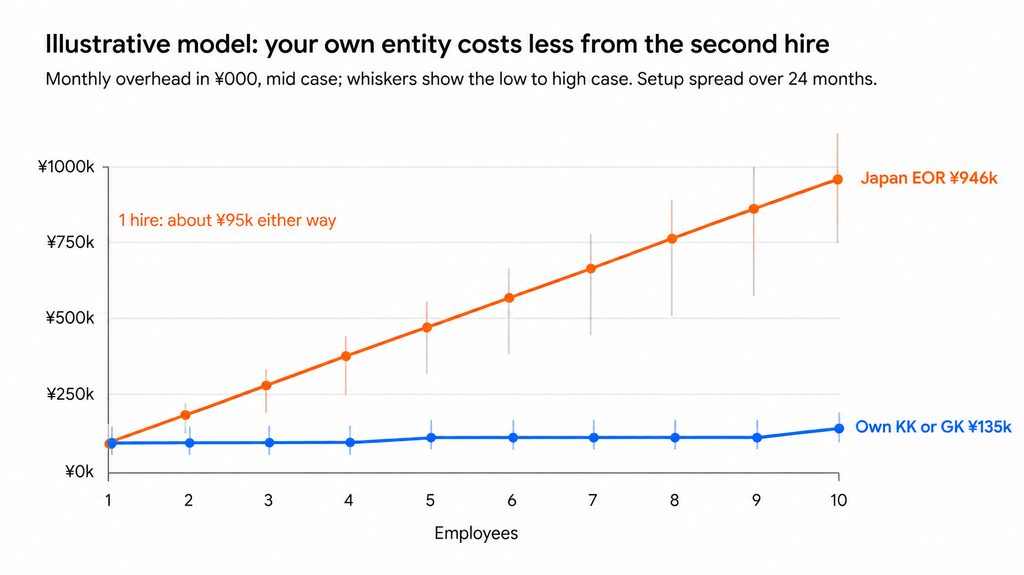
The EOR fee grows with every hire, while your own entity’s monthly overhead stays flat until the sharoushi and payroll tiers step up at 10 staff. The totals over 12 and 24 months are as follows, with setup included for your own entity.
| Headcount | Option | 12 months (¥000, low / mid / high) | 24 months (¥000, low / mid / high) |
| 1 employee | Japan EOR | 757 / 1,136 / 1,325 | 1,513 / 2,271 / 2,651 |
| 1 employee | Your own entity | 730 / 1,255 / 1,985 | 1,400 / 2,285 / 3,495 |
| 3 employees | Japan EOR | 2,270 / 3,407 / 3,976 | 4,539 / 6,814 / 7,952 |
| 3 employees | Your own entity | 730 / 1,255 / 1,985 | 1,400 / 2,285 / 3,495 |
| 10 employees | Japan EOR | 7,565 / 11,357 / 13,253 | 15,130 / 22,714 / 26,506 |
| 10 employees | Your own entity | 1,210 / 1,735 / 2,465 | 2,360 / 3,245 / 4,45 |
EOR figures exclude the onboarding fee and any deposit (some providers hold about a month of employment cost), as well as FX margins, reported at 0.5% to 2% of payroll, and benefit markups. Own-entity figures exclude bank, visa and translation costs, and your own time. EOR prices are list prices as reported on October 23, 2026, so confirm them on each provider’s pricing page. The sharoushi, payroll, accountant and address figures are market ranges rather than quotes.
Break-even headcount
To find the point at which your own company becomes cheaper than a Japan EOR, take your fixed monthly entity cost and add your one-off setup cost divided by the number of months in your planning horizon. Then divide that total by the EOR fee per head minus your own entity’s admin cost per head.
On the inputs above, the break-even over a 24-month horizon lands at about 0.9 employees in the low case, 1.0 in the mid case and 1.3 in the high case, and over 12 months it is about 1.0, 1.1 and 1.5. Your own entity is therefore cheaper from the second employee in every case, while a single hire is close to a tie. The exact answer moves mostly with accounting and setup costs, so rerun it with your own quotes. Non-refundable onboarding fees can move expense break-even earlier. A refundable deposit affects upfront cash requirements and should be shown separately; it is not automatically an additional expense.
At three employees, the mid case is ¥284k a month through an EOR against ¥86k for your own entity, and the gap keeps widening with each hire.
If the founder needs a Business Manager Visa (経営・管理, keiei kanri), the entity needs ¥30M of capital and at least one full-time employee, a rule in place since October 16, 2025. That employee must be a Japanese national, a special permanent resident, or hold a status in Appended Table 2 of the Immigration Act. Capital is not a cost, but it ties up cash, lifts KK registration tax to ¥210,000 and moves Tokyo’s per-capita levy to ¥180,000 a year. A foreign parent hiring locally without relocating a founder can still incorporate without residency and with low capital.
See our KK vs GK selector and Business Manager Visa requirements for more detail. Source: Immigration Services Agency, Business Manager criteria from October 2025.
Factors beyond cost
The figures above do not capture everything that matters when choosing between a Japan EOR and your own entity. Speed to first hire, bank account and visa hurdles for a new entity, and the ease of exiting a market all differ between the options. Permanent establishment and dispatch risk, as well as how candidates see a third-party employer, could shape your decision as much as the monthly fee.
What else to check before choosing a Japan EOR
Before you sign with a provider, review the points below. Our Japan EOR guide covers each of them in depth.
Work visa sponsorship
An EOR can sponsor the Engineer/Specialist in Humanities/International Services status (技人国, gijinkoku) for qualifying roles. Compare the other types of working visas before you commit, as two recent changes affect how EOR-based applications work.
- Dispatch-basis applications (from March 9, 2026): The client must be fixed before filing, and the period of stay follows the dispatch contract. The provider and the client both sign pledges, and immigration may check the client directly. The July 2026 revision adds one exception: where a new hire’s client can only be set after initial training, the provider files the training details instead and submits the client’s pledge at the next renewal.
- Language proof (from April 15, 2026): Applicants hired by Category 3 or 4 employers for roles that mainly involve using language with people must submit proof of CEFR B2-level ability in the language used on the job. This is a documentation requirement rather than a new eligibility rule, and the proof is not limited to Japanese, so ask which category your EOR is in.
- Founders: A founder cannot obtain a Business Manager Visa through an EOR.
Sources: ISA, gijinkoku on a dispatch basis, revised July 2026 (PDF); ISA, gijinkoku status page. See also our Business Manager Visa service and visa eligibility check.
Legal and tax risks
Disguised contracting (偽装請負, giso ukeoi) can trigger the deemed-offer rule, so keep direction of work inside a compliant dispatch structure. Permanent establishment (恒久的施設, kokyuteki shisetsu) could also arise if staff you manage conclude contracts for your foreign company. A dismissal is void without objectively reasonable grounds under Article 16 of the Labor Contracts Act, and an ordinary dismissal needs 30 days’ notice or pay in lieu under Article 20 of the Labor Standards Act. Take advice from a lawyer or tax advisor, and see Employment law in Japan: a guide for employers for the wider rules.
Questions for Japan EOR providers
Ask every Japan EOR provider these questions before you sign a contract.
- Legal employer: Which entity is the legal employer, its own Japanese company or a partner?
- Dispatch license: What is its worker dispatch license number (format 派13-xxxxxx), and does it match the MHLW 人材サービス総合サイト (jinzai service sogo site)?
- Contract type: Does it employ staff on indefinite or fixed-term contracts, and how does it handle the 3-year limit?
- Full fee: What does it charge for setup, monthly fees, FX margins and benefit markups, and is there a transfer fee if staff move to your own entity?
Which option fits your stage?
The right choice depends mostly on how many people you plan to hire and how long you expect to stay in Japan. Based on our cost model, we recommend the following approach for each stage.
- Overseas business making its first Japan-based hire : Compare an EOR with incorporation when you need to hire quickly and are testing the market. If the founder will move to Japan to manage the business, assess their residence route separately. An EOR does not provide a founder’s Business Manager route.
- First 1 to 3 hires: Compare quotes now, as your own entity is cheaper from the second hire in every case we modeled, and the gap widens with each addition.
- 10 or more employees: Compare incorporation seriously. At 10 employees in our mid-case overhead model, the EOR fee is about seven times the own-entity overhead before setup costs are spread across the planning period. The decision still depends on your actual quotes, operating plans and compliance needs.
Moving from an EOR to your own Japanese entity
Many companies start with an EOR in Japan and move their staff to their own entity once they pass break-even. The process involves four main steps.
- Check the transfer fee: Ask your EOR whether it charges a transfer or buyout fee, and budget for it before you give notice.
- Set up and register: Set up your KK or GK, register for social and labor insurance, sign new employment contracts and end the EOR contract.
- Agree on paid leave: Paid leave builds on continuous service with the same employer, so it restarts unless the new contract recognizes prior service. Agree this in writing.
- Notify immigration: The employee must file a change-of-employer notification with immigration within 14 days, and you should check the new entity’s category before the next renewal.
See what to register after incorporation for the full post-setup checklist. Source: ISA, notification on contracting organizations.
FAQ
At how many employees does my own company become cheaper than an EOR?
From the second employee, in the low, mid and high cases we modeled, while a single hire is close to a tie over 12 to 24 months. The result depends mostly on your accountant fee and setup cost, so get two or three quotes and rerun the formula above with your own numbers before deciding.
Does a Japan EOR need a worker dispatch license?
Providers disagree on this point. The Worker Dispatching Act requires a license to run dispatch as a business under Article 5, and while some EORs say their model is not dispatch because they are the real employer, others hold a license to be safe. As the law does not define an EOR, ask for the license number and confirm with a labor lawyer.
Can I interview candidates hired through an EOR?
If the arrangement is worker dispatch, the client should not conduct pre-dispatch interviews or request résumés to select a particular worker. Temp-to-perm dispatch has a specific exception. Ask the provider to explain the process and applicable rules; do not assume that confirming the hire before signing the contract avoids the restriction.
What happens when an EOR hire reaches 3 years?
If the worker is on a fixed-term dispatch arrangement, the same person cannot stay in the same organizational unit beyond 3 years, and this limit cannot be extended. Workers on indefinite-term contracts with the provider, workers aged 60 or over and a few other cases are exempt. Moving the person to a different unit or converting them to direct employment are the usual options.
Can I move an EOR employee to my own company later?
Yes, and many companies do so once they pass break-even. You incorporate, register for insurance, sign new contracts and end the EOR contract, but check the transfer or buyout fee first, because some providers charge one. Paid leave may restart unless you recognize prior service, and the employee must notify immigration of the new employer within 14 days.
Choosing between an EOR and your own entity
An EOR in Japan suits fast, low-commitment hiring, and your own KK or GK becomes cheaper once headcount passes break-even, which on our assumptions is the second hire. Japan has no PEO, so what you buy instead is outsourced payroll and labor filings on top of your own entity. Whichever route you take, ask the provider for its dispatch license number and talk to a sharoushi or labor lawyer before you sign.
Ready to compare an EOR with your own KK or GK? Book a free consultation with SmartStart Japan.