Setting up a United States company in Japan can mean a few different things.
You might be a US company opening a Japan subsidiary. You might be a solo founder in the US who wants to expand into Japan. Or you might be planning to move to Japan yourself and manage the business locally.
Those are very different situations.
Japan allows foreign founders and foreign companies to own Japanese companies, but the practical setup is not always simple. The company structure, bank account, office address, visa plan, tax setup, and US parent structure all affect each other.
This guide explains the main options for US founders and US companies entering Japan, what structure usually makes sense, what documents you need, what mistakes to avoid, and when you should get professional help before making the wrong filing.
- Key Takeaways
- Can a US Company Set Up a Company in Japan?
- Why Are US Founders Looking at Japan Right Now?
- What Is the Default Structure We Recommend?
- Option 1: Representative Office
- Option 2: Branch Office
- Option 3: Godo Kaisha (GK)
- Option 4: Kabushiki Kaisha (KK)
- KK vs GK vs Branch vs Representative Office
- Which Structure Should a US Founder Choose?
- What Documents Does a US Founder Need?
- Capital Deposit Rules US Founders Should Not Miss
- Can a US LLC or C-Corp Own a Japan Company?
- Do You Need to Live in Japan to Own the Company?
- Business Manager Visa Requirements for US Founders
- Business Manager Visa Renewal Planning
- What If You Already Have a Japan Work Visa?
- Is the Startup Visa an Alternative to the Business Manager Visa?
- Bank Account Reality Check for US-Owned Japan Companies
- How Much Does It Cost to Set Up a US-Owned Company in Japan?
- How Long Does It Take?
- What Taxes Should US Founders Understand?
- Japan Fiscal Year vs US Fiscal Year
- What Happens If the Japan Company Runs at a Loss?
- Post-Incorporation Compliance Checklist
- Should You Set Up First or Test the Market First?
- How SmartStart Japan Can Help
- FAQ: Setting Up a United States Company in Japan
Key Takeaways
- Most US small businesses and solo founders should start by comparing a Godo Kaisha (GK) and a Kabushiki Kaisha (KK).
- A GK is usually the simpler default for lean market entry, consulting, agencies, software, and many owner-managed businesses.
- A KK is usually better when you need stronger enterprise credibility, outside investors, stock options, or a more familiar corporate structure for Japanese partners.
- A branch office is not a separate Japanese company. It is tied directly to the US parent company, cannot generate revenue independently, is generally ineligible for government subsidies, and is usually harder to bank.
- A representative office can be useful for market research, but it cannot conduct sales activities in Japan.
- Incorporating a company does not automatically give you a Japanese visa or a Japanese bank account.
- If you want to live in Japan and manage the company, you will usually need to plan around the Business Manager Visa requirements.
- Business Manager Visa cases now require much more planning because of the ¥30 million paid-up capital requirement, full-time employee requirement, Japanese language requirement, and business plan certification requirement.
- If the Japan entity is owned by a US LLC, C-Corp, or individual founder, you should speak with a US CPA who understands international tax before finalizing the structure.
If you already know you want a Japanese company and need help choosing the right structure, SmartStart Japan offers incorporation services in Japan and a free 30-minute consultation.
Can a US Company Set Up a Company in Japan?
Yes. A US company or US founder can set up a business presence in Japan.
The main question is not whether it is possible. The question is what kind of presence you actually need.
US founders usually have four options:
- Open a representative office
- Register a branch office
- Incorporate a Godo Kaisha (GK)
- Incorporate a Kabushiki Kaisha (KK)
For most US companies and solo founders expanding into Japan, the default option is usually a Japanese subsidiary, either a GK or KK.
A representative office is too limited for sales. A branch office can work for certain larger multinational companies, but it creates direct parent-company liability, is not a separate Japanese company, cannot generate revenue independently, and is usually more difficult for banking and subsidy eligibility.
A Japanese subsidiary gives you a separate legal entity, a clearer structure for Japanese customers, and a more standard path for hiring, banking, contracts, and local growth.
That does not mean everyone should choose the same entity. A US SaaS company, a solo consultant, a venture-backed startup, and a US manufacturer opening a Japan sales base may all need different structures.
Why Are US Founders Looking at Japan Right Now?
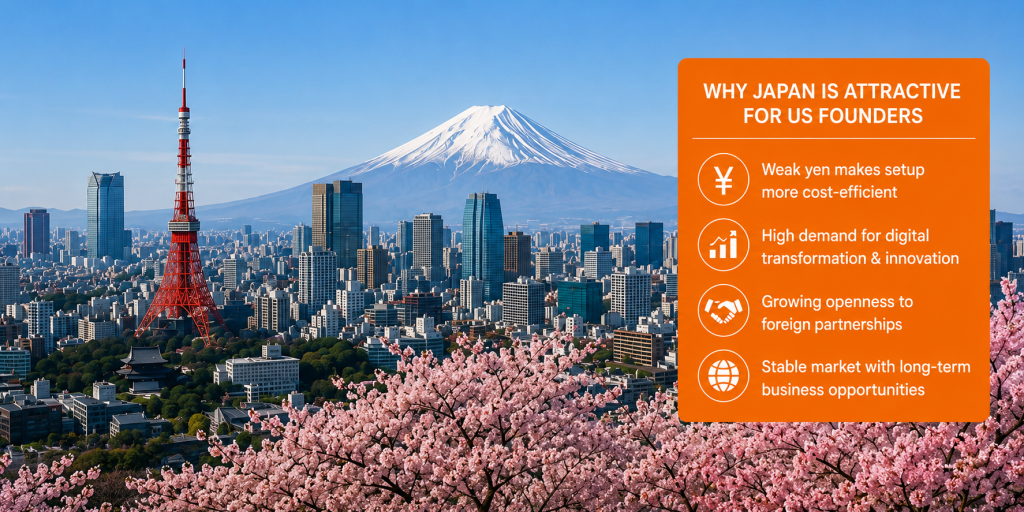
Japan has become more attractive for many US founders because of a few overlapping trends.
The weak yen has made some Japan setup costs feel lower from a US dollar perspective. Japanese companies are also investing more seriously in digital transformation, AI, automation, overseas sales, and foreign partnerships. For US businesses with strong products, systems, or technical expertise, Japan can be a serious expansion opportunity.
But Japan is not a market where you can simply register a company and expect things to move by themselves.
Japanese customers, banks, landlords, suppliers, and government offices care about documentation, consistency, local presence, and trust. Even when the legal setup is possible, the practical setup can take longer than expected.
For US founders, the biggest mistake is usually assuming that Japan works like Delaware, California, or New York.
It does not.
Japan has its own corporate registry system, seal and signature practices, bank screening process, visa rules, tax filings, office address expectations, and compliance deadlines. The earlier you plan for those, the fewer problems you will have after incorporation.
What Is the Default Structure We Recommend?
For most US small businesses, startups, and solo founders expanding into Japan, the default recommendation is:
Start by comparing a GK and a KK. Choose a GK if you want a lean, practical Japan subsidiary. Choose a KK if credibility, fundraising, stock options, or larger Japanese corporate clients matter more.
A branch office should usually be a secondary option, not the default. It may be appropriate for large multinational companies that have a clear tax, legal, or corporate reason to operate as an extension of the US parent. For many SMEs, it adds complexity without enough benefit.
A representative office is useful only when you are not ready to sell in Japan yet. It can support research, information collection, vendor meetings, and early market exploration, but it is not a sales entity.
Here is the simple way to think about it:
- Testing the market without sales: Representative office
- Large multinational with parent-level control needs: Branch office
- Lean Japan subsidiary for most small businesses: GK
- Credibility-focused subsidiary for enterprise, investors, or long-term scale: KK
If you are unsure which entity fits your situation, start with your real business goal. Are you trying to invoice Japanese customers, hire staff, open a bank account, apply for a Business Manager Visa, sign enterprise contracts, or simply explore the market?
The right answer depends on those details.
Option 1: Representative Office
A representative office is the lightest form of Japan presence.
It is usually used before a company is ready to fully enter the Japanese market. A representative office can conduct preparatory and support activities, such as:
- Market research
- Information gathering
- Publicity
- Purchasing goods
- Meeting potential partners
- Exploring whether Japan is worth entering
The major limitation is that a representative office cannot conduct sales activities in Japan.
This means it is not suitable if you want to invoice customers, hire a local sales team, sign Japanese contracts as a local business, or operate as a normal Japanese company.
For a US company, a representative office can make sense as a first step if Japan is still in the research stage. But once you want to start selling locally, you should usually move to a branch or subsidiary structure.
Option 2: Branch Office
A branch office is a registered business location of the US parent company in Japan.
It is not a separate Japanese corporation. This is the most important point.
The branch is legally tied to the overseas parent company. If the branch has obligations, disputes, contracts, debts, or liabilities in Japan, those issues can connect directly back to the US head office.
A branch office also has several practical limitations:
- It cannot generate revenue independently from the overseas head office.
- It operates on financial support from the overseas head office.
- It is generally ineligible for Japanese government subsidies.
- Corporate banking is significantly more difficult than for a Japanese subsidiary.
- It is rarely the best default structure for small and mid-sized US businesses.
A branch office may be appropriate when:
- A large multinational company wants direct Japan registration
- The US parent has a clear legal or tax reason to avoid a subsidiary
- The company is comfortable with parent-level liability
- The parent company has advisors who understand branch taxation and compliance
- The Japan operation is part of a larger global structure
For most US SMEs, a branch office is not the recommended first choice. A GK or KK subsidiary is usually cleaner.
If you are considering a branch, review SmartStart Japan’s guide to opening a Japan branch office before making the decision.
Option 3: Godo Kaisha (GK)
A Godo Kaisha, often called a GK, is Japan’s limited liability company-style entity.
For many US small businesses and solo founders, this is the most practical starting point. It is flexible, relatively simple to manage, and cheaper to incorporate than a KK.
A GK is commonly used by:
- Consultants
- Agencies
- Software companies
- Small import/export businesses
- Holding companies
- Owner-managed businesses
- Foreign founders testing Japan
- US companies that want a lean Japan subsidiary
The main advantages of a GK are:
- Lower government registration tax than a KK in many cases
- No notarization of Articles of Incorporation
- Flexible internal governance
- Separate legal entity from the US owner or parent company
- Usually faster and simpler than a KK
The government registration tax for a GK is generally:
- ¥60,000 when capital is under ¥10 million
- ¥210,000 when capital is ¥30 million or above, which is the common Business Manager Visa capital level
This matters because many US founders only see the lower ¥60,000 figure and then under-budget for a visa-path setup.
The main drawback of a GK is credibility. Many Japanese people know what a Kabushiki Kaisha is, but some may be less familiar with a Godo Kaisha. This does not usually matter for smaller B2B, consulting, online, or owner-managed businesses. It may matter more if you are selling to conservative enterprise clients, raising capital, or recruiting senior local employees.
For a deeper breakdown, see SmartStart Japan’s guide to Godo Kaisha in Japan.
Option 4: Kabushiki Kaisha (KK)
A Kabushiki Kaisha, usually called a KK, is Japan’s traditional joint-stock corporation.
It is the most recognized corporate structure in Japan. If a Japanese customer, bank, landlord, or enterprise partner sees “Kabushiki Kaisha,” they immediately understand that it is a standard Japanese corporation.
An KK is usually better when:
- You want stronger local credibility
- You sell to larger Japanese companies
- You may raise outside investment
- You want to issue shares or stock options
- You want a more familiar subsidiary structure for corporate governance
- Your US parent company wants a more traditional corporate-to-corporate ownership structure
The tradeoff is cost and administration.
A KK usually has higher registration costs than a GK. The government registration tax is generally at least ¥150,000, or 0.7% of capital, whichever is higher.
A KK also requires notarization of the Articles of Incorporation. In addition, a ¥50,000 revenue stamp must be physically affixed to the Articles of Incorporation during the notarization process as a separate mandatory government fee.
A KK does not always need to be complicated. A small KK can be set up with relatively simple governance. However, it is still more formal than a GK, especially around shares, shareholder decisions, and corporate records.
For a more detailed explanation, see SmartStart Japan’s guide to Kabushiki Kaisha in Japan.
KK vs GK vs Branch vs Representative Office
| Feature | Representative Office | Branch Office | Godo Kaisha (GK) | Kabushiki Kaisha (KK) |
| Can conduct sales in Japan? | No | Limited and tied to parent structure | Yes | Yes |
| Separate legal entity? | No | No | Yes | Yes |
| Parent company liability | Direct parent exposure | Direct parent exposure | Generally limited to Japan entity | Generally limited to Japan entity |
| Registration required? | Usually no | Yes | Yes | Yes |
| Typical government registration tax | None | ¥90,000 | ¥60,000 under ¥10M capital, ¥210,000 at ¥30M+ capital | Minimum ¥150,000 or 0.7% of capital |
| Articles notarization | Not applicable | Not required | Not required | Required |
| Additional KK notarization stamp | Not applicable | Not applicable | Not applicable | ¥50,000 revenue stamp |
| Local credibility | Low | Medium | Medium | High |
| Setup complexity | Low | Medium to high | Low to medium | Medium |
| Corporate banking difficulty | Not suitable for normal company banking | High | Medium | Medium |
| Subsidy eligibility | No | Generally not eligible | Yes, depending on program | Yes, depending on program |
| Good for Business Manager Visa? | No | Rarely the best route | Common | Common |
| Best use case | Research only | Large multinational structure | Lean subsidiary | Credibility-focused subsidiary |
For most US founders, the real choice is usually GK vs KK. SmartStart Japan has a separate article on the types of companies in Japan if you want a deeper comparison.
Which Structure Should a US Founder Choose?
Here are practical scenarios.
If you are a solo founder expanding from the US
A GK is often the best starting point if you want a simple Japanese company, lower setup cost, and flexible management.
This is common for consultants, software founders, creative agencies, online businesses, and service providers.
However, if your goal is to apply for a Business Manager Visa and move to Japan, the structure should be planned together with your visa, office, capital, bank account, employee plan, and business plan. Do not incorporate first and think about the visa later.
If you are a US company creating a Japan subsidiary
A GK is usually the leaner option. A KK may be better if your Japanese customers expect a traditional corporation or if the US parent wants a more standard corporate subsidiary structure.
For US companies selling to Japanese enterprise clients, a KK can sometimes help with first impressions. It does not replace trust, references, local communication, or product-market fit, but it can reduce friction.
If you are a venture-backed startup
A KK is often easier to explain to investors, employees, and corporate partners. If you expect Japanese fundraising, stock options, or complex equity arrangements, discuss this with legal and tax advisors before choosing a GK.
If you are only researching Japan
Start with a representative office or no entity at all. You may not need to incorporate until you are ready to hire, invoice, lease office space, or sign local contracts.
If you are a large US company
A branch office may be worth considering, but only with proper legal and tax advice. It can work for some multinational companies, but it is rarely the cleanest default for small businesses.
What Documents Does a US Founder Need?
The documents depend on whether the Japan company is owned by an individual founder or by a US parent company.
Japan’s Legal Affairs Bureau needs to confirm identity, authority, company details, and the legal basis for the incorporation. Because US documents are issued in English and under US state law, they usually need authentication and Japanese translation before they can be used in Japan.
If an individual US founder will own the Japanese company
You may need documents such as:
- Passport copy
- Proof of address
- Signature certificate or notarized affidavit
- Japanese translation of foreign-language documents
- Articles of Incorporation for the Japanese company
- Capital deposit evidence
- Registered company address in Japan
A Japanese founder would normally use a registered personal seal certificate. A US founder usually does not have this, so a notarized signature certificate or affidavit is commonly used instead.
If a US company will own the Japan company
You may need documents such as:
- Certificate of Incorporation, Certificate of Formation, or equivalent state-issued document
- Certificate of Good Standing, if needed
- Articles of Incorporation, Articles of Organization, operating agreement, bylaws, or equivalent governing documents
- Corporate resolution approving the Japan setup
- Affidavit confirming the parent company’s existence, address, officers, and authority
- Signature certificate for the person signing on behalf of the US parent
- Japanese translations of foreign-language documents
- Articles of Incorporation for the Japanese company
- Capital deposit evidence
- Japan registered address
The exact documents depend on the US state, the parent company type, the Japanese entity type, and how the ownership is structured.
Apostille and notarization
A common US-founder mistake is sending documents to the wrong place for authentication.
If the document is a state-issued corporate document, the apostille usually comes from the relevant Secretary of State or state-level authority. If the document is a federally issued document, a different authentication route may apply.
If you are physically in Japan, certain documents may be notarized through the US Embassy or a US consulate in Japan. This can sometimes reduce the need to handle notarization from the US side, depending on the document.
All foreign-language documents submitted to Japanese authorities generally need Japanese translations. The translator does not always need to be a Japanese notary, but the translation must be accurate and usable for the relevant filing.
This is an area where small mistakes create long delays. Names, addresses, officer titles, entity names, and dates must match across documents.
Overwhelmed by the document and capital sequencing?
- Document prep support for US parent and founder filings.
- Capital timing guidance so your 2-week window never slips.
- 100+ companies incorporated with documents structured correctly.
Capital Deposit Rules US Founders Should Not Miss
The capital deposit step is easy to misunderstand because it is simple in theory but strict in timing.
For ordinary incorporation, the capital deposit evidence needs to show that the capital has actually been paid in through an acceptable route.
For Business Manager Visa cases, the sequencing matters even more:
- Secure the appropriate office lease first.
- Then make the capital deposit.
- Then prepare the capital deposit certificate or evidence.
- Then submit the incorporation documents within the eligible window.
For visa-path cases, proof of capital must come after the office lease, not before. Reversing the order can create problems with both incorporation timing and immigration review.
Capital deposit certificates also have a strict 2-week window of eligibility. Incorporation documents need to be submitted within that window, or a new certificate may be required.
This is one of the most common ways overseas founders lose time. The founder has the money ready, but the office, bank evidence, translation, and filing package are not synchronized.
Can a US LLC or C-Corp Own a Japan Company?
Yes, but the tax consequences can be very different.
From the Japan registration side, the Legal Affairs Bureau mainly wants to confirm that the US entity exists and that the person signing has authority to act for it. A US LLC, C-Corp, or other company can potentially be used as the parent company if the documents are prepared correctly.
The more complicated issue is US tax.
C-Corp as the US parent
A US C-Corp parent is usually the cleaner corporate-to-corporate structure.
The Japan company becomes a foreign subsidiary of the US corporation. This is easier to understand from a corporate structure perspective and may fit better if the US parent already has investors, shares, employees, and formal governance.
However, it can trigger US international tax reporting. A US-owned Japanese subsidiary may be treated as a Controlled Foreign Corporation, depending on ownership. This can create reporting obligations such as Form 5471 and related disclosures.
A C-Corp parent can be suitable when:
- The US company already operates as a corporation
- You want a standard parent-subsidiary structure
- The Japan company will sign enterprise contracts
- You may create intercompany licensing or service agreements
- You already have a US CPA handling international reporting
The main point is that the Japan structure should not be planned separately from the US tax structure.
LLC as the US parent
A US LLC can also own a Japan company, but it needs more careful review.
Many US LLCs are pass-through entities for US tax purposes. Depending on ownership and tax elections, income, losses, foreign tax credits, and reporting obligations may flow differently than they would through a C-Corp.
This becomes especially important if a US LLC owns a Japanese GK.
For US tax purposes, a Japanese KK is generally treated as a corporation. A Japanese GK may allow more flexibility in classification, depending on the structure and elections. This can be useful in some cases, but it can also create reporting complexity.
Possible US filings may include Form 5471, Form 8858, Form 8832, or other international tax forms depending on the ownership and classification.
Do not choose a GK just because it looks cheaper on the Japan side. If the US owner is an LLC, ask a US CPA who understands cross-border structures how the Japan entity should be classified for US tax purposes.
Individual US founder as owner
An individual US founder can also own a Japan company directly.
This may be simple from a Japan incorporation perspective, but it can create personal US tax reporting requirements. US citizens and green card holders are generally taxed by the US on worldwide income, so the Japan company may still need to be reported in the US.
If you are a US citizen moving to Japan, you need both Japan-side advice and US-side advice. The same company can look simple in Japan but complicated on your US tax return.
Could your Japan entity trigger US tax reporting?
- Structure review before CFC and Form 5471 issues appear.
- US parent coordination aligned with your CPA's tax plan.
- 100+ companies incorporated for US founders and companies.
Do You Need to Live in Japan to Own the Company?
No. A US founder can own a Japanese company while living in the United States. A US company can also own a Japanese subsidiary without relocating anyone to Japan.
This is important because incorporation and immigration are separate systems.
Setting up a company in Japan does not automatically give you the right to live in Japan. It also does not automatically give you a Japanese corporate bank account.
If you are managing the company from the US, you may not need a Japanese visa. This can work for market testing, holding structures, online businesses, or companies using local service providers.
However, if you personally want to live in Japan and run the company day to day, you will usually need to apply for the Business Manager Visa or another appropriate status of residence.
For founders who are not planning to relocate immediately, SmartStart Japan has a guide on how to start a company without residency.
Business Manager Visa Requirements for US Founders
If you want to move to Japan to run your company, incorporation is only the first step.
The Business Manager Visa is the visa category commonly used by foreign founders who want to live in Japan and manage a business. It is not automatically granted just because you register a company.
The requirements became stricter in 2025, so older articles online may be outdated.
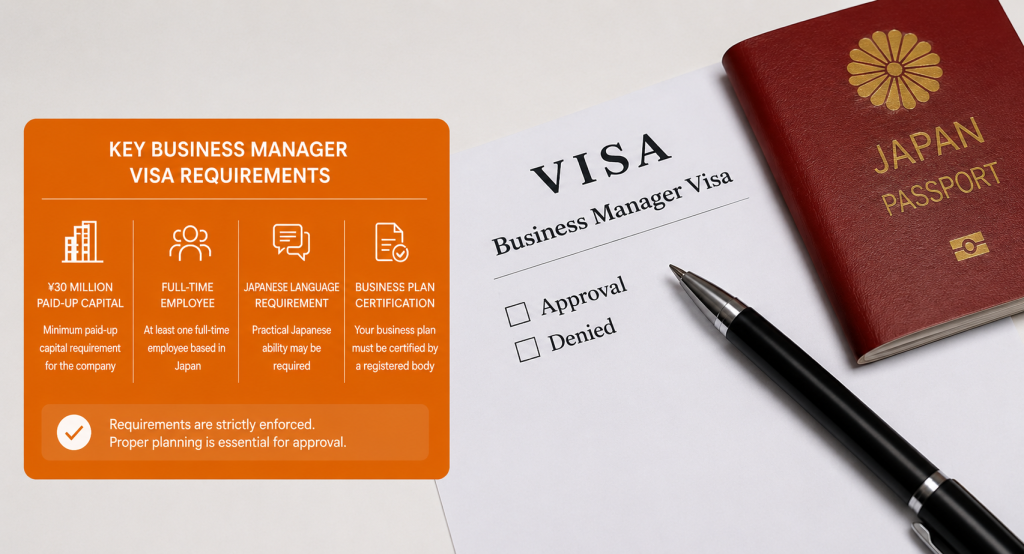
For a new Business Manager Visa application, you should expect to prepare around the following requirements:
- A real business office in Japan
- Paid-up cash capital of at least ¥30 million
- The full ¥30 million must remain after wire transfer fees are deducted
- At least one qualifying full-time employee
- Japanese language ability at JLPT N2 / CEFR B2 level by either the applicant or an eligible full-time employee
- A business plan certified by a licensed SME Management Consultant (中小企業診断士)
- Evidence of management experience or a relevant advanced degree
- Proper tax, labor, and social insurance compliance where applicable
Do not describe the ¥30 million requirement as “capital or business assets” when preparing a visa-path plan. For current practical purposes, treat this as paid-up cash capital that needs to be deposited properly.
The full-time employee requirement
The full-time employee requirement is not satisfied by just hiring any person casually.
The employee generally needs to be a qualifying full-time employee, such as a Japanese national, special permanent resident, permanent resident, spouse of a Japanese national, spouse of a permanent resident, or long-term resident.
The employee also needs to be properly employed and enrolled in the relevant Japanese social and labor insurance systems.
This requirement is one reason Business Manager Visa setup is now much more expensive and operationally serious than before.
The Japanese language requirement
The Japanese language requirement should not be treated as a soft preference.
For current planning, assume that either the applicant or an eligible full-time employee needs Japanese ability at around JLPT N2 or CEFR B2 level.
If the founder does not have this level of Japanese, then the hiring plan becomes even more important.
The business plan certification requirement
The business plan needs to be certified by a licensed SME Management Consultant, known in Japanese as 中小企業診断士.
This is not the same as asking a CPA, tax accountant, or general consultant to review the plan. Under the current pre-2028 standard, the SME Management Consultant requirement should be treated as the relevant certification route.
The business plan should show that the business is real, financially viable, operationally prepared, and capable of supporting the founder’s activities in Japan.
The office requirement
The office requirement is especially important.
A virtual office is generally not accepted for Business Manager Visa purposes. Immigration wants to see a real business office that can support continuous business activity.
That does not always mean the founder must rent a traditional long-term private office from a local landlord. Based on SmartStart Japan’s experience, offices provided by providers such as Regus or WeWork are generally acceptable under the newer standards when the office arrangement properly supports business operations.
The key point is that the office must be real, usable, and suitable for the business. A mailing address alone is not enough.
For more detail, see SmartStart Japan’s guide to the Business Manager Visa in Japan.
Business Manager Visa Renewal Planning
Getting the Business Manager Visa is not the end of the process.
You also need to plan for renewal.
For renewal purposes, a minimum monthly director salary of ¥250,000 is strongly recommended. This matters because immigration will look at whether the business can support the founder’s life in Japan and whether the company is operating in a stable, compliant way.
The company should also stay current on:
- Corporate tax filings
- Payroll withholding
- Social insurance
- Labor insurance, if applicable
- Local tax payments
- Office lease continuity
- Business activity evidence
- Employee status and enrollment
- Proper bookkeeping
This is why the visa plan should not be separated from the company setup plan. A company that is technically incorporated but undercapitalized, inactive, poorly documented, or non-compliant may create problems at renewal.
What If You Already Have a Japan Work Visa?
Some US founders are already in Japan on another visa status and want to start or join a company.
This needs careful handling.
A person on a work visa may be able to hold a director title under company law in some situations. But if their main day-to-day role becomes business management, company administration, or founder-level business operation, they may generally need to change status.
Highly Skilled Professional visa holders in certain categories may have more flexibility, but this should not be assumed without checking the exact status and activity.
The practical rule is simple: do not rely only on the job title. Look at what you are actually doing every day.
If your actual activity changes from employee work to business management, ask an immigration professional before acting as the operating founder.
Is the Startup Visa an Alternative to the Business Manager Visa?
The Startup Visa should not be viewed as a simple replacement for the Business Manager Visa.
It is better understood as a preparation track toward the Business Manager Visa.
Startup Visa programs are limited, location-specific, and generally focused on businesses that match startup-style criteria such as innovation, scalability, and growth potential. They are not usually the right route for ordinary local service businesses, small retail, restaurants, hospitality, or simple consulting setups.
For US founders, the Startup Visa may be relevant if the business is genuinely startup-oriented and fits a participating municipality’s program. But for many founders who want to build a normal operating company in Japan, the Business Manager Visa remains the main route.
Bank Account Reality Check for US-Owned Japan Companies
The corporate bank account is often harder than the incorporation itself.
Many US founders assume that once the company is registered, the bank account will be automatic. That is not how Japan works.
Japanese banks usually review:
- The company’s business purpose
- The background of the founder or parent company
- The source of funds
- The office address
- The website or business materials
- Expected customers and suppliers
- Contracts, invoices, or proof of actual business activity
- Whether a responsible person can communicate with the bank
- Whether the company appears to have real operations in Japan
Remote-only companies can face additional friction. If the representative director is not in Japan, the company uses a virtual office, and there is no local operating history, some banks may reject the application or request more evidence.
Branch offices are also significantly more difficult for corporate banking than Japanese subsidiaries.
This does not mean banking is impossible. It means it should be planned early.
A stronger bank application usually has:
- A clear business purpose in the Articles of Incorporation
- A realistic company address
- A website or business profile
- Evidence of real customers or planned transactions
- Enough capital to make the business look serious
- A director or responsible contact who can respond quickly
- Consistent documentation across all filings
If banking is important for your Japan setup, do not choose your entity type, office address, capital amount, and business purpose separately. Banks look at the full picture.
SmartStart Japan can help with corporate bank account setup and can review whether your incorporation plan may create problems later.
How Much Does It Cost to Set Up a US-Owned Company in Japan?
The cost depends on the entity type, capital amount, document complexity, translation needs, and whether you need visa, bank account, tax, FEFTA, or licensing support.
Here are the common government-side costs to understand:
| Item | Typical government or official cost |
| GK registration tax, capital under ¥10M | ¥60,000 |
| GK registration tax, capital ¥30M or more | ¥210,000 |
| KK registration tax | Minimum ¥150,000, or 0.7% of capital if higher |
| KK Articles of Incorporation notarization | Notary fee applies |
| KK notarization revenue stamp | ¥50,000 |
| Branch office registration tax | ¥90,000 |
| Japanese translations | Depends on volume and complexity |
| Apostille and notarization in the US | Depends on state and document type |
| Tax office registrations through SmartStart | Confirm current fee, often quoted separately |
| FEFTA filing support through SmartStart | Confirm current fee, often quoted separately |
The key point is that “from ¥60,000” can be misleading for Business Manager Visa cases. A GK with ¥30 million capital has a higher registration tax than a small-capital GK.
Professional service fees vary depending on whether you only need registration or need a full setup package including document drafting, translation, tax notifications, visa planning, bank account support, FEFTA review, and post-incorporation compliance.
For a more detailed cost breakdown, see SmartStart Japan’s guide to the cost of setting up a company in Japan.
How Long Does It Take?
For overseas US founders, a practical estimate is usually 4 to 8 weeks for incorporation if the documents are prepared smoothly.
For many overseas GK cases, 4 to 6 weeks may be realistic when documents are well-prepared. US-parent structures can take longer because of document authentication, apostilles, translations, and coordination across time zones.
A realistic timeline may look like this:
Phase 1: Structure and document planning
Choose GK, KK, branch, or representative office. Confirm ownership, directors, business purpose, capital amount, fiscal year, office address, and whether a visa will be needed.
For US parent structures, this is also the stage to confirm who has authority to sign.
Phase 2: US-side documents
Collect US corporate documents, prepare affidavits or resolutions, complete notarization, and obtain apostilles if required.
This is often the slowest part for US companies because each state has different processing times.
Phase 3: Japanese drafting and translation
Prepare the Japanese Articles of Incorporation, translations of foreign documents, seal or signature documents, and registration forms.
If you are setting up a KK, the Articles of Incorporation must be notarized, and the ¥50,000 revenue stamp should be budgeted.
Phase 4: Office and capital sequencing
For Business Manager Visa cases, the office lease must come before the proof of capital.
After the office is secured, the capital deposit can be made. The capital evidence or certificate has a 2-week eligibility window, so the incorporation documents need to be ready for submission within that period.
This phase needs coordination. Do not treat office, capital, and filing as separate tasks.
Phase 5: Registration
The registration package is submitted to the Legal Affairs Bureau.
After registration is complete, the company can obtain its certificate of registered matters and company seal certificate.
Phase 6: Post-incorporation setup
This includes tax office registrations, local tax notifications, Blue Return application, bank account application, payroll setup, social insurance, labor insurance, and any required licenses.
Tax office registration with the national, prefectural, and municipal tax offices must be handled within 2 weeks of the incorporation date.
Phase 7: Visa application, if needed
If the founder is applying for a Business Manager Visa, the visa timeline comes after the company, office, capital, employee, business plan certification, and supporting documents are ready.
This can add several months, and timing depends heavily on the immigration bureau, document quality, and case complexity.
What Taxes Should US Founders Understand?
Japan corporate tax is not one single tax.
A Japanese company may be subject to:
- National corporate tax
- Local corporate tax
- Corporate inhabitant tax
- Enterprise tax
- Special corporate enterprise tax
- Consumption tax, if applicable
- Withholding tax, if paying salaries, director compensation, royalties, or certain fees
For small and medium-sized companies, Japan has reduced rates on the first levels of taxable income. At higher profit levels, the total effective corporate tax burden can be around 30% or more depending on location, company size, capital, and taxable income.
One Japan-specific issue is the per-capita portion of corporate inhabitant tax, sometimes called kinto-wari.
Even if your company has no profit, it may still owe a minimum local inhabitant tax. For a small company, this is commonly around ¥70,000 to ¥80,000 per year.
This surprises many US founders.
In the US, a loss-making company may owe some state franchise taxes depending on the state. In Japan, you should assume the company will still have some annual local tax cost even if it has no revenue.
Japan Fiscal Year vs US Fiscal Year
Japanese companies can choose their fiscal year-end when they incorporate.
Many Japanese companies use a March 31 fiscal year-end because Japan’s government, school, and corporate calendar often runs April to March.
However, a US-owned Japan company should think carefully before choosing March 31.
If the US parent company uses a calendar year, choosing December 31 for the Japan company may make US reporting and consolidation easier. A mismatch can create extra work for US tax reporting, management accounts, and intercompany reconciliation.
This is especially important if the Japan company is treated as a Controlled Foreign Corporation for US tax purposes.
A short first fiscal year is usually acceptable. For example, if you incorporate in September and choose December 31 as your year-end, the first fiscal year will simply be shorter.
Before choosing the fiscal year, ask:
- What is the US parent company’s fiscal year?
- Will the Japan company be included in US reporting?
- Will the founder file US tax returns personally?
- Will the company need a Business Manager Visa?
- Will the company need consumption tax planning?
- Will the first year have losses that should be carried forward?
The fiscal year is easy to overlook during incorporation, but annoying to fix later.
What Happens If the Japan Company Runs at a Loss?
A loss-making Japan company still needs to file taxes and may still owe local per-capita inhabitant tax.
However, losses can become valuable if you file the right tax election on time.
Japan has a Blue Return system, called Aoiro Shinkoku. For corporations, Blue Return status can allow net operating losses to be carried forward and offset against future taxable income, subject to requirements.
The deadline matters.
For a newly established corporation, the Blue Return application generally needs to be filed by the earlier of:
- The day before three months have passed from incorporation, or
- The last day of the first fiscal year
If you miss this deadline, the company may lose the ability to use early losses in the most favorable way.
This is one of the easiest filings to forget because it happens after incorporation, when founders are busy with banking, sales, hiring, and visas.
It is also one of the reasons SmartStart Japan recommends handling incorporation and post-incorporation tax filings together, not as separate projects.
Post-Incorporation Compliance Checklist
After the company is registered, the work is not finished.
You should plan for the following items.
National, prefectural, and municipal tax office registrations
A newly incorporated Japanese company must register with the relevant national, prefectural, and municipal tax offices within 2 weeks of the incorporation date.
This is a strict deadline and should not be confused with the annual tax filing deadline after fiscal year-end.
Blue Return application
If you want Blue Return status, file the application by the relevant deadline. This is usually important for startups and new market entry companies because the first year may involve setup losses.
Salary-paying office notification
If the company will pay director compensation or employee salaries, it needs to handle payroll-related tax notifications.
Social insurance
If the company pays director compensation or hires employees, social insurance obligations may apply. This is especially important for Business Manager Visa cases because immigration will review whether the business is complying with tax, labor, and social insurance rules.
Labor insurance
If the company hires employees, labor insurance filings may be required.
Bank account
The bank account application usually starts after incorporation because banks want to see the company registration documents.
Licenses
Some businesses need licenses before they can legally operate.
Examples include:
- Recruitment and staffing
- Real estate
- Restaurants and food businesses
- Alcohol import or sales
- Medical, cosmetic, or supplement-related imports
- Travel-related services
- Financial services
- Childcare and daycare
- Certain education-related businesses
If your business is regulated, do not assume incorporation is enough. Check licensing before you register the company purpose.
SmartStart Japan has a separate guide to business licenses in Japan.
FEFTA and Bank of Japan reporting
Some foreign investment into Japan may require prior notification or post-transaction reporting under Japan’s foreign exchange and foreign trade rules.
This is especially important in sensitive industries, regulated sectors, or cases involving foreign ownership of certain Japanese businesses.
Do not ignore this just because you are a small company. The filing requirement depends on the activity and structure, not only company size.
FEFTA support is usually a separate compliance service from basic incorporation support, so raise this early if your business touches regulated or sensitive sectors.
Staying compliant after incorporation is not automatic.
- Compliance calendar built for tax, insurance, and filing deadlines.
- Post-incorporation support covering tax, labor, and social insurance.
- 30+ subsidies done for companies across Japan.
Should You Set Up First or Test the Market First?
Not every US company needs to incorporate immediately.
If you are still validating demand, you may be able to start with market research, distributor conversations, Japanese landing pages, or direct sales from the US. This can help you understand whether Japan is worth the setup cost.
However, incorporation becomes more important when you need to:
- Hire local employees
- Open a Japan bank account
- Sign local contracts
- Apply for a Business Manager Visa
- Lease a real office
- Build long-term local trust
- Apply for certain licenses
- Invoice as a Japanese company
- Work with Japanese enterprise clients that prefer domestic vendors
If you are still at the market validation stage, Scaling Your Company has guides on Japan market entry, B2B sales in Japan, and digital marketing in Japan.
If you already know you need a company, then the next step is choosing the right structure and planning the setup correctly.
How SmartStart Japan Can Help
SmartStart Japan helps foreign founders, small businesses, and overseas companies set up and support businesses in Japan.
For US founders, the most important part is not just submitting the registration. It is making sure the company is structured correctly for what happens after registration.
That includes:
- Choosing between GK, KK, branch, or another route
- Preparing foreign founder or US parent documents
- Coordinating notarization, apostille, and Japanese translation
- Drafting company purposes that fit the business
- Planning capital, address, banking, and tax filings
- Supporting post-incorporation notifications
- Helping with bank account preparation
- Coordinating Business Manager Visa planning where needed
If you want help setting up the right way, you can review SmartStart Japan’s incorporation services in Japan or book a free 30-minute consultation.
FAQ: Setting Up a United States Company in Japan
Can a US citizen own 100% of a Japanese company?
Yes, in many industries a US citizen can own 100% of a Japanese company. However, regulated industries and foreign investment reporting rules may apply depending on the business activity.
Does a US company need a Japanese partner?
Usually no. A Japanese partner is not generally required just to incorporate a company. However, having local support can help with banking, office setup, hiring, licenses, and customer development.
Do I need a Japanese resident director?
A Japanese resident director is not generally required just to incorporate a Japanese company. However, not having someone in Japan can make banking and operations much harder.
Legal possibility and practical execution are different.
Can I open a Japanese corporate bank account from the US?
It is difficult. Some banks may require in-person steps, local documentation, a real office, or a responsible person in Japan. Remote-only setups can face more screening.
Plan the bank account before incorporation, not after.
Can I use a virtual office?
A virtual office may be usable for some company setups, but it can create problems for banking and is generally not accepted for Business Manager Visa purposes.
If your goal is only basic incorporation, a virtual office may be possible. If your goal is visa, banking, or enterprise credibility, be careful.
Do I need ¥30 million to set up a company in Japan?
Not for ordinary incorporation.
Japan allows companies to be incorporated with very low capital. However, if you are applying for a Business Manager Visa, you should plan for at least ¥30 million in paid-up cash capital.
The practical capital amount also matters for banking and credibility.
Is a GK or KK better for a US company?
For many US SMEs, a GK is the practical default because it is cheaper and simpler.
A KK may be better if you need enterprise credibility, investors, stock options, or a more traditional corporate structure.
Can a US LLC own a Japanese GK?
Yes, it may be possible, but US tax treatment needs careful review. A US LLC owning a Japanese GK can create classification and reporting issues that should be checked with a US CPA before incorporation.
Can a US C-Corp own a Japanese KK?
Yes, this is a common parent-subsidiary style structure. However, it may create US international tax reporting obligations, especially if the Japan company is a Controlled Foreign Corporation.
Can a branch office invoice Japanese customers?
A branch office is not a separate Japanese company and should not be treated like an independent revenue-generating subsidiary. It operates as an extension of the overseas head office and has major banking, subsidy, liability, and compliance limitations.
Most US SMEs should compare GK and KK first.
Is a representative office enough for sales?
No. A representative office can conduct market research and preparatory activities, but it cannot conduct sales activities in Japan.
Should the Japan company use a December 31 fiscal year?
If the owner or parent company is in the US and uses a calendar year, December 31 may make reporting easier. However, you should confirm this with your US CPA and Japan tax advisor before incorporation.
Can I be a company director if I already have a Japan work visa?
Possibly, but it depends on your visa status and your actual activities.
Holding a director title under company law is not always the same as being allowed to manage the business under immigration law. If your main day-to-day work becomes business management or administration, you may need to change status.
Is the Startup Visa easier than the Business Manager Visa?
Not always. The Startup Visa is better understood as a preparation track toward the Business Manager Visa, not a simple alternative.
It is usually limited to certain municipalities and startup-style businesses. Many ordinary small businesses will not qualify.
What is the first step?
The first step is to decide what you actually need Japan to do for your business.
If you only need research, you may not need a company yet. If you need contracts, hiring, banking, or a visa, you should choose the structure based on those requirements.
For most US founders, the first practical decision is GK vs KK, followed by address, capital, fiscal year, tax filings, banking, and visa planning.