Running a business in Japan can be complicated. And one of those things that many would tell you to pay attention to is Japanese receipts (領収書, ryoshusho). Not to be confused with a レシート (reshiito), 領収書 works more like tax evidence rather than a proof of purchase you would use to interact with customer service. Getting a 領収書 or not will decide whether you can receive the various tax benefits that keep your business running.
In this article, we will discuss what a 領収書 is, how it differs from other forms of proof you can receive from a business, and how to store and file your Japanese receipts and expenses.
This is the current position as of September 2026, including the transition starting October 1, 2026, and a month-end routine you can run with a folder and a phone camera.
The short answer
Keep a 領収書 or a qualified invoice showing the supplier’s T-number for every business expense, and save anything that arrived electronically as a file rather than a printout. Corporations keep their records for seven years, and for ten years where a loss is carried forward. From October 1, 2026, purchases from suppliers who are not registered for the invoice system are only 70% creditable for consumption tax (消費税, shohizei).
- Which rules apply to my business?
- What changes under the invoice system on October 1, 2026?
- What do the electronic bookkeeping rules require?
- How long must I keep Japanese receipts?
- How should I scan and store Japanese receipts digitally?
- How do I handle the tricky cases?
- How do I claim expenses the Japanese way?
- What does a practical month-end workflow look like?
- Frequently asked questions
- Conclusion
- Official sources

Which rules apply to my business?
Qualified invoices only change your consumption tax in certain situations, so find your own position before you change anything about how you handle receipts. Doing so will save you hours of chasing documents you do not need.
| Your situation | Do qualified invoices change your consumption tax? | What you still need |
| Tax-exempt business (免税事業者, menzei jigyosha), not registered | No, because you file no consumption tax return | Receipts for corporate or income tax |
| Taxable, general method (本則課税, honsoku kazei) | Yes, the input credit depends on them | Qualified invoices and books |
| Taxable, simplified system (簡易課税, kan’i kazei) | No, input tax is a fixed share of your sales | Receipts for corporate or income tax |
| Registered and using the 2割特例 (ni-wari tokurei), which ends with the tax period that includes September 30, 2026 | No, the tax is a share of your output tax | Receipts for corporate or income tax |
| Sole proprietor using the new 3割特例 (san-wari tokurei) for the 2027 and 2028 returns | No, the tax is a share of your output tax | Receipts for income tax |
| New company with capital of ¥10 million or more | Yes, from the first fiscal year | Qualified invoices from day one |
Two of those rows need a word of explanation.
The last row catches most readers of this guide. A newly formed company sits outside consumption tax for its first two years, which is one of the reliefs we cover in our guide to taxes for a new business in Japan, but that exemption falls away once capital reaches ¥10 million. Since October 16, 2025, a company formed to support a Business Manager visa has needed capital of ¥30 million, well past that line, so these companies are taxable from their first fiscal year and need supplier T-numbers from the first month of trading. Details of the visa requirements are in our Business Manager visa guide.
The 3割特例 row is new, and it came out of the 2026 tax reform. It applies to individual proprietors only, for the 2027 and 2028 filing years, where base-period taxable sales are ¥10 million or less, and the person is registered as an invoice issuer. Corporations cannot use it.
If your row says qualified invoices make no difference to your consumption tax, you still keep your receipts. They support the expense itself for corporate or income tax, and the retention periods further down still apply to you.
What counts as a valid receipt or invoice in Japan?
Four Japanese words cover what English calls a receipt, and they are not interchangeable. The one that causes the most confusion is 適格請求書 (tekikaku seikyusho), the qualified invoice, because it describes a status rather than a separate kind of paper. A receipt, a till slip or an invoice all become one by carrying a registered issuer’s number and a handful of required fields.
What is the difference between 領収書 (ryoshusho), レシート (reshiito), 請求書 (seikyusho) and 適格請求書 (tekikaku seikyusho)?
| Japanese term | English meaning | Issued by | Use it for | Notes |
| 領収書 (ryoshusho) | Formal receipt | The seller, on request | Proving that you paid | Ask for your company name in the 宛名 (atena) field. It can also be a qualified invoice when it carries the required fields |
| レシート (reshiito) | Till receipt | The register, automatically | Everyday purchases | Modern Japanese POS systems print the registration number, which makes most of these valid evidence |
| 請求書 (seikyusho) | Invoice, a request for payment | The supplier, before or after delivery | B2B services and monthly billing | It shows what you owe rather than what you paid, so pair it with the bank record |
| 適格請求書 (tekikaku seikyusho) | Qualified invoice | Registered issuers only | Claiming the consumption tax credit | Carries a T-number plus the fields listed below |
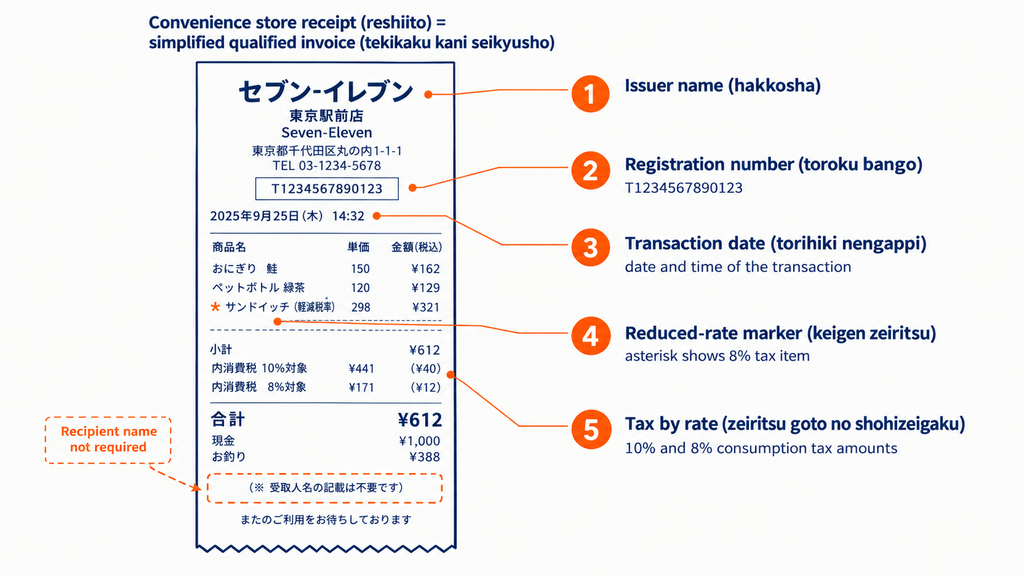
| 適格簡易請求書 (tekikaku kani seikyusho) | Simplified qualified invoice | Shops, restaurants, taxis, parking operators and similar businesses | Till receipts with no customer name | The recipient name can be left off |
A 領収書 proves you paid, a 請求書 tells you what you owe, and only a qualified invoice or its simplified version lets you reduce the consumption tax you hand over.
Annotated examples with field translations
Image 1, a paper 領収書, labelled with:
- 宛名 (atena): the payer’s name. For a business expense, this is your company name, left neither blank nor as 上様 (uesama), the polite stand-in a shop writes when nobody gives a name.
- 但し書き (tadashigaki): what the money was for. お品代 (oshinadai) means “for goods” and tells a reviewer nothing, so ask for the actual item, for example 飲食代 (inshokudai) for food and drink or 書籍代 (shosekidai) for books.
- 金額 (kingaku): the amount, with the tax rate shown separately where possible.
- 発行者 (hakkosha): the issuer’s name, address, and seal.
- 収入印紙 (shunyu inshi): a revenue stamp, required on a paper receipt for ¥50,000 or more under the stamp duty rules. Electronic PDF receipts carry no stamp, because stamp duty attaches to the paper document, and a receipt recording a credit card payment generally falls outside the rule as well.
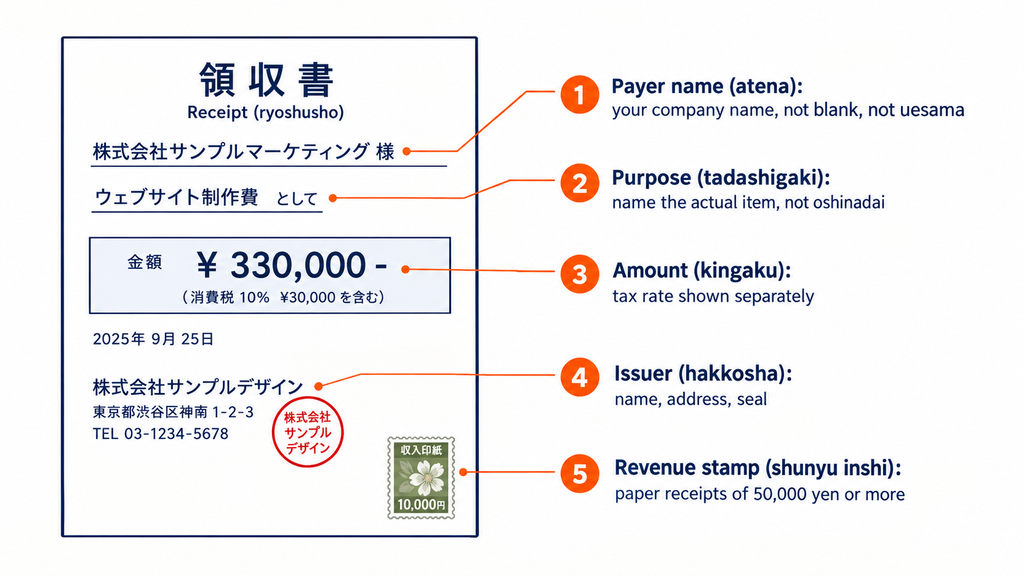
Image 2, a qualified invoice, labelled with its six required fields:
- Issuer name (適格請求書発行事業者の氏名又は名称, tekikaku seikyusho hakko jigyosha no shimei matawa meisho)
- Registration number (登録番号, toroku bango), the letter T followed by 13 digits
- Transaction date (取引年月日, torihiki nengappi)
- Description with a marker on any reduced-rate item (軽減税率の対象品目である旨, keigen zeiritsu no taisho hinmoku de aru mune)
- Totals and consumption tax by rate (税率ごとに区分した合計額及び適用税率、消費税額等, zeiritsu goto ni kubun shita gokeigaku oyobi tekiyo zeiritsu, shohizeigaku to)
- Recipient name (書類の交付を受ける事業者の氏名又は名称, shorui no kofu o ukeru jigyosha no shimei matawa meisho)
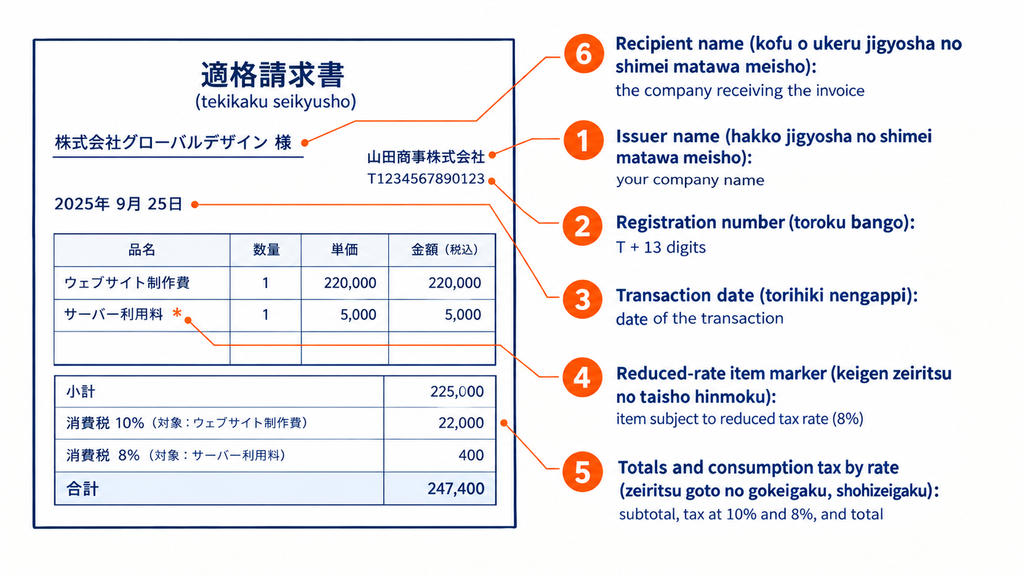
Image 3, a convenience store レシート working as a simplified qualified invoice, which carries the same fields minus the recipient name. This is the document you will handle most often, so it is worth being able to recognise at a glance.
Till receipts without a company name
Shops, restaurants, taxis and a few other business types may issue the simplified version, which drops the customer’s name altogether. A convenience store receipt with nothing in the 宛名 field still supports your input tax credit, as long as it shows the issuer’s registration number and the other simplified fields.
What no receipt can show is why you bought the item, so write the purpose on it or in your expense tool the same day. A coffee bought with a client and a coffee bought on the way to the station look identical three months later.
When you do need your company name and the shop does not use the simplified format, ask for it in these words:
- 領収書をお願いします。宛名は「株式会社〇〇」でお願いします。 (Ryoshusho o onegai shimasu. Atena wa “kabushiki-gaisha marumaru” de onegai shimasu.)
- 但し書きは「飲食代」でお願いします。 (Tadashigaki wa “inshokudai” de onegai shimasu.)
A wider set of Japanese business phrases for counters, calls, and meetings is in our phrase guide.
What changes under the invoice system on October 1, 2026?
Most English guides on this subject still describe a schedule that the 2026 tax reform rewrote, so the figures here come from the National Tax Agency’s own reform page, published in April 2026.
How the system works
Since October 2023, only a business registered as a 適格請求書発行事業者 (tekikaku seikyusho hakko jigyosha), a qualified invoice issuing business, can issue a qualified invoice. Registration is voluntary, and a registered business receives a number in the form of T plus 13 digits that has to appear on every qualified invoice it issues. Registering also makes that business liable for consumption tax even where its sales sit under ¥10 million, which is why many small Japanese suppliers chose to stay outside the system.
As a buyer on the general method, you need a qualified invoice to take the full input credit, and a purchase from an unregistered supplier falls into the transitional rates below. A registration number is not the same thing as the tax ID number in Japan your company already holds, and the two are easy to confuse on a supplier’s paperwork.
The October 2026 transition
The credit available on purchases from unregistered suppliers steps down as follows.
| Goods or services received | Credit available |
| October 1, 2023 to September 30, 2026 | 80% |
| October 1, 2026 to September 30, 2028 | 70% |
| October 1, 2028 to September 30, 2030 | 50% |
| October 1, 2030 to September 30, 2031 | 30% |
| From October 1, 2031 | None |
Under the original design, the rate was going to drop straight to 50% in October 2026 and end in 2029. The reform softened the step and pushed the end date to 2031.
Four practical points come with it.
- The date that matters is when you received the goods or services, not when you paid or when the invoice was issued. Bills that straddle the end of September 2026 have to be split on that basis.
- A ceiling now applies per supplier. For tax periods beginning on or after October 1, 2026, tax-included purchases above ¥100 million from a single unregistered supplier get no transitional credit at all. The previous ceiling was ¥1 billion, so a construction or staffing business may feel this, whereas a software company never will.
- Your books have to record the treatment. The transitional credit requires a note in the ledger that the purchase falls under the measure, which in most accounting software means a tax code such as 70%控除対象 (70% kojo taisho, meaning eligible for a 70% deduction).
- Your software needs updating before October. Accounting and expense systems need the 70% and 30% codes added, and the common error is copying a journal entry from an earlier month that still carries the 80% code.
Two measures ending around the same time
The 2割特例 (ni-wari tokurei), which lets a business that became taxable by registering pay 20% of its output tax, runs until the tax period that includes September 30, 2026. For a sole proprietor, the 2026 return is the last one it covers. Its replacement, the 3割特例 (san-wari tokurei), is open to individual proprietors for the 2027 and 2028 returns only.
If you use either measure, one new provision is worth knowing about. The simplified system (簡易課税, kan’i kazei) normally has to be elected before a tax period starts, but for the period straight after you last used the 2割特例 or 3割特例, you can file the election form (消費税簡易課税制度選択届出書, shohizei kan’i kazei seido sentaku todokedesho) as late as the filing deadline for that same period. The simplified system is open to businesses with base-period taxable sales of ¥50 million or less, and once elected, it binds you for two years, so have that conversation with your 税理士 (zeirishi), your tax accountant, before the deadline rather than after it.
The small-amount exception is separate again. It lets you claim the credit without a qualified invoice on purchases under ¥10,000 tax included; it runs to September 30, 2029, and it applies where base-period taxable sales are ¥100 million or less, or sales in the specified period are ¥50 million or less.
Checking a supplier’s T-number
The National Tax Agency runs a public lookup site for registration numbers. Enter the 13 digits that follow the T, and it returns the registered name, the registration date, and whether the registration has been cancelled. Three habits keep this quick:
- Check each supplier once, at onboarding, rather than invoice by invoice.
- Compare the registered name with the name on the invoice. A mismatch usually means a group company issued the document.
- Keep the result with the supplier record, so your bookkeeper is not looking the same number up every month.
Most Japanese accounting tools now check registration numbers automatically when you add a supplier, which is the easier route if you do not read Japanese.
What do the electronic bookkeeping rules require?
The Electronic Books Maintenance Act (電子帳簿保存法, denshi chobo hozon ho, shortened in Japanese to 電帳法, dencho ho) is a separate law from the invoice system, and it governs how you are allowed to store records rather than whether they earn you a credit. One part of it binds every business, and a small company can satisfy that part without buying any software. The National Tax Agency’s dedicated site holds the current wording.
The three categories
- 電子取引データ保存 (denshi torihiki deeta hozon), keeping electronic transaction data. Mandatory since January 1, 2024, for every corporation and sole proprietor.
- 電子帳簿等保存 (denshi chobo to hozon), keeping computer-made books electronically. Optional.
- スキャナ保存 (sukyana hozon), keeping paper documents as scans. Optional, and covered in the next section.
Electronic transaction data covers emailed PDF invoices and receipts, billing statements downloaded from a SaaS account, e-commerce order confirmations, payment platform receipts, and invoices pulled from a supplier portal. Printing the PDF and filing the paper does not discharge the obligation, because the file itself has to be kept.
Authenticity and visibility
Authenticity (真実性, shinjitsusei) asks for one of three things: a timestamp on the data, a system that records when data went in and logs any correction or deletion, or a written internal procedure for handling electronic records. That written procedure, the 事務処理規程 (jimu shori kitei), is the free option, and the National Tax Agency publishes a template you can adapt in an afternoon. Most small companies adopt it formally and keep it with their company records.
Visibility (可視性, kashisei) asks that the data be searchable by date, amount, and counterparty, and that you can display and print it. Consistent file names or an index spreadsheet meet the search requirement without software, and a business with base-period sales of ¥50 million or less that can hand the data over on request is released from the search function requirement altogether.
The grace measures
Two measures get confused here, including on pages published this year. The 宥恕措置 (yujo sochi), which ran from January 2022 to the end of December 2023, allowed you to print electronic data and keep the paper, and it was abolished on that date.
The 猶予措置 (yuyo sochi) replaced it from January 1, 2024, and has no fixed end date. It lets you skip the authenticity and search requirements where the tax office accepts that you had good reason (相当の理由, soto no riyu) and where you can produce both the data and a printout during an audit. It is relief for a business that cannot comply yet, rather than a period in which nothing is required, and the data still has to be saved electronically. Treat it as a bridge while you put the 事務処理規程 and a file naming rule in place.
How long must I keep Japanese receipts?
Retention by taxpayer type
Which line applies depends on whether you run a company or a sole proprietorship in Japan, and on which return type you file.
| Taxpayer | Receipts and invoices | Notes |
| Corporation (KK or GK) | 7 years | 10 years for a fiscal year in which a loss is carried forward. Books are also 7 years |
| Sole proprietor, blue return (青色申告, aoiro shinkoku) | 7 years | Cash and bank-related documents can drop to 5 years where income two years earlier was ¥3 million or less. Quotes, delivery notes, and similar documents are 5 years, and books stay at 7 |
| Sole proprietor, white return (白色申告, shiroiro shinkoku) | 5 years | The statutory books themselves are 7 years |
| Qualified invoices held for the input credit | 7 years | Applies to whichever return type you file |
| Electronic transaction data | Same periods as the paper equivalent | Kept as data rather than printouts |
The clock does not start on the date printed on the receipt. A corporation counts from the day after the corporate tax filing deadline for that fiscal year, which falls two months after the year ends in the ordinary case, so a company with a March year-end keeps its records for the year to March 31, 2026 until May 31, 2033. A sole proprietor counts from the March 15 filing deadline in the following year. The National Tax Agency sets this out in Tax Answer No. 5930, with the loss carryforward years covered in No. 5762.
One rule that is easier to follow
For a company, keep everything for ten years. The Companies Act already requires you to keep your accounting books and the important materials relating to your business for that long, and the loss carryforward rule pushes tax records to ten years in any year you post a loss, so a single rule for every document type removes the risk of throwing out the wrong folder. For a sole proprietor, seven years covers everything in the table.
How should I scan and store Japanese receipts digitally?
Scanner storage
You can photograph a paper receipt and throw the original away, provided the scan meets the requirements and happens on time. The rules have loosened twice: the 2021 and 2022 reform removed the need for advance approval from the tax office, and the 2023 reform removed the requirement to record and confirm who scanned the document. What remains is short enough to pin above a desk.
- Timing. Scan within roughly two months plus about seven business days of receiving the document. This deadline is the reason a monthly routine beats a year-end scramble.
- Image quality. 200 dpi or higher, in colour for receipts and invoices. A current phone camera clears this comfortably.
- Authenticity. A timestamp, or a system that records the input date and logs corrections and deletions.
- Searchability. By date, amount, and counterparty.
- Display. You must be able to show the document on screen and print it during an audit.
One caution before you start binning paper. If the scan misses a requirement and the original has gone, so has your evidence, so keep the paper in an envelope until the month is closed and the files are named.
Acceptable storage
Whatever tool you use, aim for files searchable by date, amount, and counterparty name, held in one central location rather than a folder per employee, under a naming convention applied from day one. Keep electronic-origin files apart from scans of paper, because different rules apply to each, and back the whole thing up with access limited to the people who need it.
The practice to avoid is the common one: receipts living in a LINE thread, a personal inbox or a phone gallery. None of those is searchable in the way the law requires, and all of them disappear when someone changes phones or leaves.
Tools that handle Japanese requirements
| Tool | English support | JIIMA certified | OCR | Pricing | Best fit |
| freee | Partial | Yes | Yes | Tiered subscription | Founders who want one system for bookkeeping and filing |
| Money Forward クラウド (kuraudo) | Partial | Yes | Yes | Tiered subscription | Teams already using Money Forward payroll or invoicing |
| Yayoi | Japanese only | Yes | Yes | Tiered subscription | Companies whose 税理士 works in Yayoi |
| TOKIUM | Japanese only | Yes | Yes | Quote based | Businesses with high receipt volume that want paper handled for them |
Last checked September 2026. Interfaces, pricing, and certification change often, so confirm with the vendor before you commit.
Two notes on reading that table. JIIMA certification is a shortcut rather than a legal requirement: it tells you the software has been checked against the storage rules, and it is granted per product and per storage category, so check which category applies to what you need. Ask your 税理士 before choosing as well, because most work in one or two systems, and a mismatch means they rekey your data every month. Software costs can sometimes be part-funded, so it is worth checking which subsidies for small businesses are open before you commit to a subscription.
If you would rather not own this at all, our accounting services for startups cover the monthly cycle end to end.
How do I handle the tricky cases?
Foreign currency and overseas receipts
Overseas spending splits into three cases that get different treatment, and mixing them up is where foreign-run companies quietly lose credits.
- Money spent abroad, such as a hotel in Singapore or a taxi in Bangkok, sits outside Japanese consumption tax, so there is no credit to claim. Keep the original receipt, a note of the business purpose, and the yen conversion.
- A foreign vendor selling into Japan, such as a SaaS, cloud hosting, or ad platform, is often creditable, because many large overseas vendors are registered issuers and put a T-number on their invoices. Keep the vendor’s invoice and check the number on the lookup site.
- Imported goods carry import consumption tax paid at customs, which is creditable, and the document that supports the credit is the customs import permit (輸入許可通知書, yunyu kyoka tsuchisho) rather than the supplier’s invoice. If goods crossing the border are central to what you do, this paperwork sits alongside the other rules for running an import and export business in Japan.
Three details are worth getting right. The first is to check rather than assume: run your recurring overseas vendors through the lookup site once, because several of the tools a Japanese startup runs on are registered, and treating their invoices as non-creditable throws money away every month.
The second concerns the currency on the invoice. Where a registered vendor bills you in dollars or euros, the consumption tax on that invoice has to be shown in yen, and a document with no yen tax figure is not doing the job of a qualified invoice.
The third is consistency. Record the rate and the date you used, then apply the same approach across the year. The rate your card issuer charged and the rate on the transaction date are both defensible starting points, and your 税理士 should pick one for you. Where the original is in a language other than Japanese or English, keep a short note of what was bought.
B2B digital services bought from overseas can also fall under reverse charge rules, which change who accounts for the tax. If you buy advertising or platform services from abroad in any volume, raise it with your accountant rather than working it out from a blog post.
Credit card statements
Putting spending on a corporate credit card in Japan makes reconciliation easier, but the statement still only proves that money moved. It does not show what you bought; it does not carry the seller’s registration number, and the card company is not the seller, so it is never a qualified invoice.
Use a statement as backing evidence beside the receipt, and as a fallback where a receipt is genuinely lost, with a written note of what the charge was for. For recurring SaaS charges, download the invoice from the vendor’s portal each month, because that file counts as electronic transaction data and has to be kept as a file.
Missing receipts
Work through these steps in order.
- Ask for a reissue (再発行, saihakko). Most Japanese businesses will do this for a recent purchase, often stamping the replacement 再発行.
- Download a copy. For anything bought online, the order email or the vendor portal holds one.
- Write a 出金伝票 (shukkin denpyo), a payment slip. Record the date, the payee, the amount, what was bought, the purpose, why the receipt is missing, and who approved it.
- Attach whatever evidence exists, such as card statements, bank records, or Suica and PASMO history.
- Log it. Keep a running missing-receipt register for the year, so the pattern stays visible and the explanation exists at the time rather than being reconstructed later.
One limit is worth understanding. A 出金伝票 can support the expense for corporate or income tax, but on its own it generally does not support the consumption tax credit.
Some purchases never come with an invoice, and the rules handle these directly. A note in your books is enough for public transport fares under ¥30,000, vending machine and similar purchases under ¥30,000, and travel allowances paid to employees under your own travel rules. Record which exception applies in the ledger entry.
A small shop whose receipt carries no registration number is most likely unregistered, which is a different situation again. Book it at the transitional rate of 70% from October 2026.
How do I claim expenses the Japanese way?
Meals, meetings and client entertainment (会議費 vs 接待交際費)
Japanese tax law treats entertainment expenses (交際費等, kosaihi to) as non-deductible in principle, with reliefs layered on top, so the split between meeting costs (会議費, kaigihi) and entertainment (接待交際費, settai kosaihi) matters more here than in most countries.

Since April 1, 2024, food and drink involving people outside your company have been excluded from entertainment expenses where the cost per attendee is ¥10,000 or less, up from ¥5,000. Above that figure, the whole bill becomes entertainment rather than only the excess. Tax Answer No. 5265 sets out the record you have to keep for the exclusion to apply:
- The date of the meal.
- The names or company names of the business contacts who attended, and their relationship to you.
- The number of people who attended.
- The amount, plus the name and address of the restaurant.
- Anything else needed to show the cost was a meal.
The second line is the one companies skip, and auditors check, so write the attendees on the back of the receipt before you leave the restaurant, or into your expense app at the table.
Two points sit around that rule. Whether the ¥10,000 test uses tax-inclusive or tax-exclusive figures follows your company’s own consumption tax accounting method. And meals held only for your own directors and staff sit outside the exclusion, though that does not turn every internal cost into entertainment: tea, snacks and bento provided for a meeting fall into their own category, as do staff outings and similar welfare costs.
Even where a cost does land in entertainment expenses, a company with capital of ¥100 million or less can deduct up to ¥8 million a year, or half of its qualifying dining costs. For a company of the size we usually work with, the deduction limit is rarely the problem. Weak records are.
Worked example. You take a prospective client and one colleague to dinner and the bill comes to ¥28,000 for three people, which works out at about ¥9,333 each. That sits under the line, so the cost stays outside entertainment expenses as long as you record the restaurant name and address, the date, the attendees with their companies, and the headcount. The same dinner at ¥33,000 works out at ¥11,000 each, and the full ¥33,000 becomes an entertainment expense, deductible within the ¥8 million allowance.
Employee reimbursement (経費精算, keihi seisan)
A workable cycle for a small team runs monthly: staff submits receipts and a one-line purpose by a fixed cutoff, a manager approves through the internal approval route (稟議, ringi), and the money goes out with the next payroll or on a set reimbursement date. If your first hires sit under an employer of record in Japan, check whose expense policy applies before you write your own.
Three things make the cycle hold up:
- A written expense policy, covering what can be claimed, any per-person meal limits, the receipt standard from the first half of this guide, and the submission deadline.
- A travel rule (旅費規程, ryohi kitei), which is what allows travel allowances to be paid and claimed under the exception described above, so it is worth having in place before your first business trip.
- Speed. Repayment timing is read as a signal about how a company treats its people, more so than in many other markets, and slow reimbursement costs goodwill that is hard to buy back. This connects to wider expectations around Japanese management culture.
What does a practical month-end workflow look like?
| Day | Step | Owner | Output |
| 1 | Collect from every source: paper receipts, emailed invoices, SaaS portal downloads, card and bank statements, IC card history, employee claims | Founder or admin | One inbox folder |
| 2 | Check T-numbers on new suppliers and tag the unregistered ones for the transitional rate | Bookkeeper | Supplier list with registration status |
| 3 | Convert foreign currency items and record the rate and date | Bookkeeper | Conversion log |
| 4 | Match receipts against card and bank lines | Bookkeeper | List of unmatched items |
| 5 | Chase missing receipts and prepare a 出金伝票 where a reissue is not possible | Founder asks, admin prepares | Missing-receipt register |
| 6 | Approve employee claims and schedule payment | Founder or manager | Approved 経費精算 |
| 7 to 8 | Scan remaining paper, name the files, and file everything | Admin | Closed month folder |
| 9 | Spot check: entertainment records, reduced-rate items, transitional tax codes | Founder | Notes for the accountant |
| 10 | Send the handover pack to the 税理士 | Founder | Pack sent |
Running the cycle in the first ten days keeps every scan inside the scanner storage deadline and leaves your accountant time to raise questions before a filing date. One task belongs to October 2026 alone: switch the tax code for unregistered suppliers from 80% to 70%, and check any journal templates you copy from month to month.
Frequently asked questions
Is a receipt made out to 上様 (uesama) valid? It is weak evidence. The tax office can accept it, but a receipt with your company name in the 宛名 field and a real description in the 但し書き removes the argument before it starts, and asking takes one sentence at the till.
Do I need a receipt for train fares? No. Public transport fares under ¥30,000 can be claimed on a book entry alone, and your Suica or PASMO history makes useful supporting evidence.
Is a credit card statement enough for a tax deduction in Japan? It supports the payment rather than the purchase, and it is never a qualified invoice, so keep the receipt or the vendor’s invoice alongside it.
Can I throw away paper receipts after scanning them? Yes, once the scan meets the scanner storage requirements set out above. Hold the paper until the month is closed, then discard it.
What if my supplier is not registered for the invoice system? You can still deduct the expense for corporate tax, and claim 70% of the consumption tax on goods or services received from October 1, 2026, falling to 50% in October 2028. Flag those suppliers in your ledger so the rate is applied consistently.
Conclusion
Five habits cover most of what this guide describes. Know which document you are holding. Check T-numbers when you onboard a supplier rather than at year-end. Keep anything you received electronically as a file. Follow the retention line for your entity type, or keep everything for ten years and stop thinking about it. Run the month-end routine in the first ten days, while the receipts are still in your pocket, and the reasons are still in your head.
Once it’s a routine, none of it takes long, and the companies that get into trouble are almost always the ones that left it until the year closed.
If you would rather hand the whole cycle to someone who does it every month, our accounting services for startups cover bookkeeping, filings, and the handover to your 税理士, in English and Japanese. Before your fiscal year closes, check the deadlines for year-end tax adjustments.
Official sources
Link these inline where each figure appears, and keep the list at the foot of the article.
- Invoice system special site, National Tax Agency
- 2026 tax reform: transitional measures, the ¥100 million ceiling and the 3割特例, and the same content as a printable leaflet
- 2割特例 page, National Tax Agency
- Simplified taxation system, No. 6505, National Tax Agency
- Qualified Invoice Issuer Publication Site, the T-number lookup
- Invoice system Q&A, for foreign currency invoices and the book-only exceptions
- Electronic books and records special site, National Tax Agency
- Electronic transaction data leaflet, covering the grace measures and the 事務処理規程
- Retention of books and documents, No. 5930, National Tax Agency
- Loss carryforward, No. 5762, for the 10-year rule
- Entertainment expenses, No. 5265, for the ¥10,000 rule and its record requirements
- Stamp duty on receipts, No. 7105, National Tax Agency