For those who’re only looking for the full list of universities eligible, click here:
- Key Takeaways
- What Is the J-Find Visa and Who Qualifies?
- How Does J-Find Compare to Other Japan Visa Options?
- What Activities Are Allowed Under J-Find?
- How Do You Apply for the J-Find Visa?
- What Documents Do You Need for J-Find?
- What Is the Timeline for Getting J-Find?
- What Practical Challenges Should You Expect?
- How Long Can You Stay on J-Find?
- Can Family Members Join You on J-Find?
- What Happens After J-Find? Transition Options
- Is J-Find Worth It? Honest Assessment
- Where Can You Get Professional Help?
- Full List of Universities for J-Find Visa
Key Takeaways
- Eligibility is strict. You must graduate from a university ranked top 100 in at least 2 of 3 rankings (QS, THE, ARWU), and graduate within 5 years of the degree conferment date.
- Financial proof is required. Minimum savings listed is ¥200,000, with a recommended buffer of ¥500,000–¥800,000. Budget ¥500,000–¥800,000 for initial settlement is also advised.
- The 2-year limit is absolute. Total maximum stay is 2 years and includes similar programs, with no extensions beyond the cap. Plan your transition by months 15–18.
- Banking and housing are the real friction. Japan Post Bank is highlighted as the main option for new arrivals, with limitations for about 6 months. Sharehouses are often the most accessible housing route without employment.
- Part-time work is allowed, with guardrails. No specific hour cap is noted, but adult entertainment is prohibited. Using the visa mainly for remote work rather than job hunting can create problems. Keep records of genuine job search or preparation activity.
- Launched April 2023, so employers and officials may be unfamiliar. Be prepared to explain it and carry official documentation.
Moving to Japan to start your career or launch a business is an exciting opportunity—but navigating Japan’s visa system can feel overwhelming. For recent graduates from the world’s top universities, the J-Find visa offers a unique pathway: up to two years in Japan to job hunt, prepare your startup, or explore opportunities without needing a job offer first.
In this guide, we’ll walk you through everything you need to know about the J-Find visa—from eligibility requirements and application procedures to practical challenges like banking and housing. Whether you’re exploring career opportunities or planning to launch your business in Japan, this comprehensive resource will help you understand if J-Find is the right path for you.
What Is the J-Find Visa and Who Qualifies?
The J-Find visa—officially called “Designated Activities (Future Creation Individual)” or 特定活動(未来創造人材)in Japanese—is Japan’s immigration pathway specifically designed for recent graduates from globally top-ranked universities. Unlike traditional work visas that require a job offer, J-Find allows you to come to Japan specifically for job hunting or business preparation activities.
The Immigration Services Agency of Japan (ISA) created this visa to attract young, highly educated international talent who can contribute to Japan’s innovation economy.
Core Eligibility Requirements
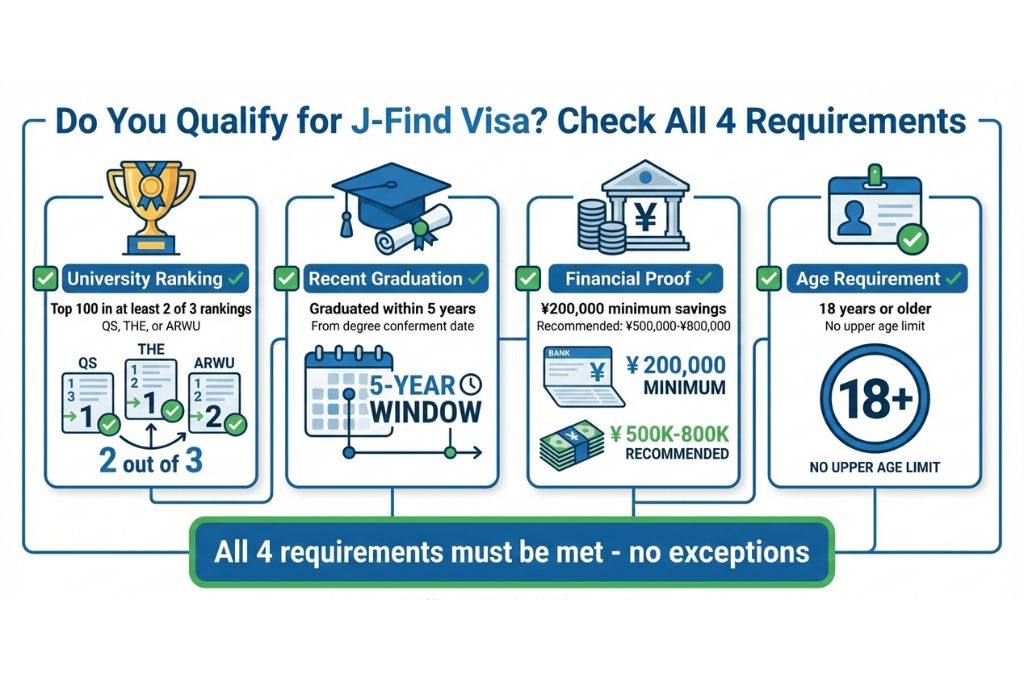
To qualify for the J-Find visa, you must meet all four of these requirements:
Requirement 1: University Ranking
Your university must be ranked in the top 100 in at least 2 out of 3 major global university rankings:
- QS World University Rankings (published by Quacquarelli Symonds)
- THE World University Rankings (published by Times Higher Education)
- Academic Ranking of World Universities / ARWU (published by Shanghai Ranking Consultancy)
Important: University rankings change annually. What matters is whether your university is in the top 100 of at least two rankings at the time you apply, not when you graduated. This means if your university has risen in rankings since graduation, you may now qualify even if you didn’t when you first graduated.
Requirement 2: Recent Graduation
You must have graduated within the past 5 years from the date you received your degree (Bachelor’s, Master’s, or PhD). The 5-year countdown starts from your degree conferment date—the official date your university awarded your degree, not your enrollment date or course completion date.
Requirement 3: Financial Proof
You must show proof of at least ¥200,000 (approximately $1,400 USD) in savings at the time of application. This requirement demonstrates you can support yourself initially upon arrival in Japan.
While ¥200,000 is the official minimum, this amount is barely sufficient for actual living costs in Japan. Most immigration advisors recommend having significantly more—at least ¥500,000-¥800,000—to cover initial settlement expenses like housing deposits, furniture, and living costs before you secure employment.
Requirement 4: Age
You must be 18 years or older to apply. There is no upper age limit specified, though the 5-year graduation window effectively targets younger graduates.
Eligibility Verification Table
| Requirement | What You Need | Where to Verify |
| University Ranking | Degree from university in top 100 of at least 2 rankings | Check MOJ official list and current QS/THE/ARWU rankings |
| Graduation Timeline | Degree conferred within past 5 years | Check your diploma for conferment date |
| Financial Proof | At least ¥200,000 in bank account | Obtain recent bank statement (within 1 month) |
| Age | 18 years or older | Standard requirement |
Verification Note: The list of eligible universities updates periodically as new rankings are published. Always verify your university’s current status with the Immigration Services Agency before investing time in the application process.
How Does J-Find Compare to Other Japan Visa Options?
Understanding how J-Find fits within Japan’s broader visa landscape helps you determine if it’s the best option for your situation. Here’s how J-Find compares to other common pathways for foreigners entering Japan:
| Visa Type | Job Offer Required? | Duration | Capital/Financial Required | Age Limit | Best For |
| J-Find | No | Up to 2 years | ¥200,000 savings | None (18+) | Job hunting & startup preparation |
| Working Holiday | No | 1-2 years (varies by country) | Varies (typically ¥300,000+) | Usually under 30 | Young adults from treaty countries |
| Student Visa | Yes (school admission) | Duration of study | Tuition + living costs | None | Full-time education in Japan |
| Engineer/ Specialist Visa | Yes (job offer required) | 1-5 years, renewable | None | None | Confirmed employment |
| Business Manager | No | 1-5 years, renewable | ¥30,000,000 + employee | None | Established business operations |
| Startup Visa | No | 6-24 months (varies by municipality) | None initially | None | Entrepreneurs with local government endorsement |
Key Differences That Matter
J-Find vs. Working Holiday:
Working Holiday visas are typically easier to obtain and more established (employers are familiar with them), but have strict age limits (usually under 30) and are only available to citizens of specific treaty countries. Recent policy changes have made Working Holiday more attractive—some countries (UK, Canada, Denmark, Austria, New Zealand) can now extend for up to 2 years total, matching J-Find’s duration.
If you’re under 30 and eligible for Working Holiday, it may actually be a more straightforward choice. However, if you’re over 30 or from a non-treaty country, J-Find becomes your best option for entering Japan without a job offer.
J-Find vs. Direct Work Visa:
If you already have a job offer from a Japanese company, applying directly for an Engineer/Specialist in Humanities/International Services visa is typically faster and more straightforward than J-Find. Your employer sponsors your visa, handles much of the paperwork, and provides the employment documentation immigration requires.
J-Find is specifically valuable when you don’t yet have a job offer but want to be physically present in Japan to conduct your job search, attend in-person interviews, and network—activities that are difficult or impossible to do from abroad.
J-Find vs. Business Manager Visa:
The Business Manager visa is for foreign nationals who are actively operating a business in Japan. As of October 2025, the requirements have become significantly stricter: ¥30 million in capital, at least one full-time local employee, Japanese language proficiency (JLPT N2 or equivalent), and 3+ years of management experience.
J-Find, by contrast, is for preparation to start a business—securing office space, registering your company, developing your business plan, and establishing the foundation for operations. Once your business is running and you meet the Business Manager visa requirements, you transition from J-Find to Business Manager status.
For a comprehensive guide on starting a business in Japan, see our article: How to Start a Business in Japan in 12 Steps
What Activities Are Allowed Under J-Find?
The J-Find visa permits three main categories of activities:
Primary Activities (Main Purpose of Your Stay)
1. Job Hunting Activities
You can engage in full-time job searching, including:
- Submitting applications to Japanese companies
- Attending interviews and recruitment events
- Networking at industry events and professional meetups
- Participating in paid or unpaid internships
- Attending career fairs and company information sessions
- Meeting with recruiters and headhunters
2. Business Preparation Activities
If you plan to start a business in Japan, you can:
- Secure office space and negotiate leases
- Register your company (KK or GK incorporation)
- Open business bank accounts
- Develop and refine your business plan
- Meet with potential investors and business partners
- Conduct market research
- Apply for necessary business licenses
3. Employment to Supplement Funds
You’re permitted to work part-time or freelance to support yourself financially while conducting your primary activities (job hunting or business preparation). There are no specified hour limits for part-time work under J-Find, unlike student visas which restrict work to 28 hours per week.
Work Restrictions
The Immigration Services Agency prohibits work in the adult entertainment industry (風俗営業, fuuzoku eigyou). This includes:
- Hostess/host clubs
- Bars and nightclubs with entertainment
- Adult entertainment establishments
- Similar venues
All other types of part-time work are permitted, including:
- Restaurant and retail positions
- English teaching
- Freelance work (writing, design, programming, consulting)
- Temp agency assignments
- Internships (paid or unpaid)
Important Activity Limitation
While part-time work is allowed, J-Find is not intended as a digital nomad visa. Using J-Find primarily to work remotely for a foreign company while living in Japan—rather than genuinely engaging in job hunting or business preparation—could create problems at visa renewal or when transitioning to another visa status.
Immigration expects to see evidence that you’re actively pursuing employment in Japan or seriously preparing to establish a business. Keep records of your job applications, interview confirmations, business meetings, and preparation activities.
Verification Note: Requirements and enforcement policies can change. If you’re planning substantial freelance or remote work during your J-Find stay, confirm the current Immigration Services Agency stance on permissible activities before making plans.
How Do You Apply for the J-Find Visa?
The J-Find application process can be confusing because there are two different pathways depending on your circumstances. Let’s break down both options clearly.
Understanding Certificates of Eligibility (CoE)
Before we explain the application pathways, you need to understand what a Certificate of Eligibility is.
A Certificate of Eligibility (在留資格認定証明書, zairyuu shikaku nintei shoumeisho) is a document issued by Japan’s Immigration Services Agency confirming that you meet the requirements for a specific visa status. Think of it as a pre-approval from the Japanese government. The CoE is issued by the Ministry of Justice (Immigration Services Agency), while the actual visa is issued by the Ministry of Foreign Affairs (Japanese embassies and consulates abroad).
For J-Find, obtaining a CoE is optional in theory—you can apply directly at a Japanese embassy without one. However, in practice, some embassies effectively require or strongly prefer that you obtain a CoE first.
Application Pathway 1: Direct Embassy Application (Without CoE)
This is often the simplest path if your local Japanese embassy accepts J-Find applications without a Certificate of Eligibility.
Step 1: Verify Your Embassy’s Requirements
Contact your local Japanese embassy or consulate to confirm:
- Do they accept J-Find visa applications without a CoE?
- What documents do they require?
- What is their current processing time?
Embassy requirements and procedures vary by country. What works in the United States may differ in the UK, Australia, or Singapore.
Step 2: Gather Required Documents
Standard documents typically include:
- Completed visa application form (specific to your embassy)
- Valid passport with at least 6 months validity
- Passport-sized photograph (4cm × 3cm, white background, taken within last 6 months)
- University diploma (Bachelor’s, Master’s, or PhD)
- University transcript showing graduation date
- Evidence of university ranking (printout from QS/THE/ARWU showing top-100 status)
- Bank statement showing at least ¥200,000 balance
- Brief statement of your intended activities in Japan (job hunting plan or business concept outline)
Step 3: Submit Application at Embassy
Apply in person at the Japanese embassy or consulate with jurisdiction over your place of residence. Some countries allow applications through accredited agencies or visa application centers.
Step 4: Processing Time
Embassy processing typically takes 1-4 weeks depending on the embassy and time of year. Some embassies may consult with the Ministry of Foreign Affairs in Tokyo for J-Find applications since it’s a relatively new visa category, which can extend processing time.
Step 5: Receive Visa and Enter Japan
Once approved, you’ll receive your visa stamp in your passport. You can then travel to Japan. Upon arrival at the port of entry (airport), immigration officers will:
- Verify your visa and entry purpose
- Issue your Residence Card (在留カード, zairyuu kaado)
- Grant you permission to stay for the period indicated on your visa (6 months or 1 year)
Your Residence Card is essential for daily life in Japan—you’ll need it to open bank accounts, rent housing, enroll in National Health Insurance, and more.
Application Pathway 2: Apply for CoE from Within Japan
This pathway requires you to first enter Japan on a tourist visa or visa waiver, then apply for your Certificate of Eligibility while in Japan.
Step 1: Enter Japan on Short-Term Stay
Enter Japan as a tourist or on a short-term business visa. Many nationalities can enter Japan visa-free for tourism for 90 days or less. Check if your country has visa exemption arrangements with Japan: https://www.mofa.go.jp/j_info/visit/visa/short/novisa.html
Step 2: Apply for Certificate of Eligibility
You must be physically present in Japan when applying for the CoE. Immigration requires your passport with the entry stamp to verify you’re in the country.
You can apply in person at a regional Immigration Services Agency office, or you can hire an immigration lawyer (行政書士, gyōseishoshi) to represent you and submit the application on your behalf.
Required documents for CoE application:
- Application Form for Certificate of Eligibility (download from ISA website)
- Passport-sized photograph (4cm × 3cm)
- Copy of your passport (photo page and Japan entry stamp page)
- University diploma
- University transcript
- Proof of university ranking (printout from official ranking sites)
- Bank statement showing ¥200,000+ balance
- Brief written plan of your intended activities in Japan
Step 3: CoE Processing
Immigration Services Agency typically takes 2-4 months to process J-Find CoE applications. Processing times vary by regional office and time of year.
You do not need to remain in Japan during the processing period. You can return to your home country and have the CoE mailed to you (if you provided a Japanese address) or to someone in Japan who can forward it to you.
Step 4: Exit Japan and Apply for Visa
Once you receive your CoE, you must:
- Exit Japan (if you’re still there)
- Apply for the J-Find visa at a Japanese embassy/consulate in your country of residence
- Submit your CoE along with other required documents
Processing at the embassy is usually faster when you have a CoE—often 1-2 weeks.
Step 5: Re-enter Japan with J-Find Visa
Return to Japan with your approved J-Find visa. At the port of entry, immigration will issue your Residence Card.
Which Pathway Should You Choose?
Choose Pathway 1 (Direct Embassy Application) if:
- Your local embassy accepts J-Find applications without CoE
- You want to minimize time and complexity
- You’re not currently in Japan and don’t plan to visit before moving
Choose Pathway 2 (CoE from Within Japan) if:
- Your embassy requires or strongly prefers a CoE
- You’re already in Japan on a short-term stay
- You want to work with an immigration lawyer based in Japan
- You want the highest chance of approval (CoE is essentially pre-approval)
Verification Note: Because J-Find is a relatively new visa (launched April 2023), procedures are still evolving. Some embassies are more familiar and experienced with J-Find processing than others. Always confirm current procedures with your specific embassy before proceeding.
Can You Use an Immigration Lawyer?
Yes, and many J-Find applicants find professional assistance valuable. Licensed immigration lawyers in Japan (gyōseishoshi or 行政書士) can:
- Guide you through the entire application process
- Prepare and review all documents
- Submit CoE applications on your behalf (if you’re in Japan)
- Represent you at the immigration office
- Help avoid common mistakes that delay processing
Typical costs: ¥50,000-¥150,000 for full J-Find application support
When professional help makes sense:
- You’re unfamiliar with Japanese bureaucracy
- You want to maximize approval chances
- You need help translating documents or explaining your case
- You’re applying from within Japan and want representation
For assistance with your J-Find application or connection to qualified immigration professionals, book a free consultation with SmartStart Japan.
What Documents Do You Need for J-Find?
Document requirements vary slightly depending on whether you’re applying directly at an embassy or applying for a Certificate of Eligibility first. Here’s the complete checklist:
Standard Application Documents
□ Application Form
- For embassy applications: Use the specific form your embassy requires
- For CoE applications: Use the Application for Certificate of Eligibility form from the ISA website
□ Passport
- Must be valid for at least 6 months beyond your intended stay
- Provide copy of photo page (and Japan entry stamp if applying for CoE from within Japan)
□ Photograph
- Size: 4cm × 3cm
- Background: White
- Taken within last 6 months
- Clear, front-facing, no hat or glasses
- Professional quality (photo booth quality acceptable)
□ University Diploma
- Bachelor’s, Master’s, or PhD certificate
- Must show your name, degree type, and conferment date
- Original or certified copy (depending on embassy requirements)
- Translation to English or Japanese if original is in another language
□ University Transcript
- Official transcript showing courses and graduation date
- Helps verify your degree and graduation timing
- Translation to English or Japanese if in another language
□ Proof of University Ranking
- Printout from QS World University Rankings showing your university in top 100
- Printout from THE World University Rankings showing your university in top 100
- Printout from ARWU showing your university in top 100
- Must show ranking in at least 2 of the 3 systems
- Include screenshot of the ranking page with date visible
- Alternatively, use the official MOJ list showing your university
□ Bank Statement
- Must show balance of at least ¥200,000
- Should be recent (within 1 month of application)
- In your name (not parents’ or sponsors’ accounts)
- Translation to English or Japanese if in another language
- Official bank letterhead preferred
□ Statement of Intended Activities
- Brief written explanation (1-2 pages) of what you plan to do in Japan
- For job seekers: Target industries, type of positions sought, job search strategy
- For entrepreneurs: Basic business concept, target market, preparation activities planned
- Does not need to be a formal business plan
- Can be in English for most embassies
Additional Documents for Family Members
If your spouse or children will accompany you:
□ Marriage Certificate (for spouse)
- Original or certified copy
- Translation to English or Japanese
□ Birth Certificates (for children)
- Original or certified copy
- Translation to English or Japanese
□ Additional Financial Proof
- Higher bank balance recommended to show support for dependents
- Some advisors suggest adding ¥100,000 per dependent
□ Family Member Photographs
- Same specifications (4cm × 3cm, white background)
Optional But Recommended Documents
□ Resume/CV
- Shows your background and qualifications
- Particularly helpful if your degree field isn’t obvious from diploma
□ Letter of Explanation
- Explains your connection to Japan
- Previous visits, language study, professional interest in Japanese market
- Strengthens your case if you have relevant background
□ Housing Information
- Address where you’ll stay in Japan (friend, relative, temporary housing)
- Shows planning and preparation
Document Preparation Checklist
Before submitting, verify:
- [ ] All documents are originals or properly certified copies (check embassy requirements)
- [ ] All non-English/Japanese documents have official translations
- [ ] Dates are clearly visible on all documents
- [ ] Photos meet exact size and quality specifications
- [ ] Bank statements are recent (within 1 month)
- [ ] Your name appears consistently across all documents
- [ ] Degree conferment date (not course completion date) is clearly shown
- [ ] You have both printed copies and digital backups of everything
Verification Note: Embassy requirements vary significantly by country. The U.S. embassy may require different documents than the UK embassy or the Singapore embassy. Always check your specific embassy’s requirements on their official website or by contacting them directly before gathering documents.
Some embassies provide document checklists specific to J-Find visas, while others may still be developing procedures for this new visa category. If your embassy doesn’t have clear J-Find guidance, ask them directly which documents they require.
What Is the Timeline for Getting J-Find?
Understanding realistic timeframes helps you plan your move to Japan effectively. Here’s what to expect:
Application Timeline by Pathway
Pathway 1: Direct Embassy Application (Without CoE)
| Phase | Duration | Key Activities |
| Document Gathering | 2-4 weeks | Request diploma/transcript from university, obtain bank statements, prepare activity statement |
| Embassy Review | 1-4 weeks | Embassy processes your application, may consult with MOFA in Tokyo |
| Visa Issuance | 1-3 days | Receive visa stamp in passport |
| Travel to Japan | Variable | Book flights, arrange temporary housing |
| Entry Processing | 1 day | Immigration inspection, receive Residence Card |
| TOTAL TIME | 1-2 months | From starting document gathering to arriving in Japan |
Pathway 2: CoE Application from Within Japan
| Phase | Duration | Key Activities |
| Enter Japan | Variable | Arrive on tourist visa/visa waiver |
| Document Gathering | 1-2 weeks | Prepare all documents in Japan |
| CoE Application | 1 day | Submit application at immigration office or through lawyer |
| CoE Processing | 2-4 months | Immigration Services Agency reviews application |
| Exit & Embassy Application | 1-2 weeks | Return to home country, apply at embassy with CoE |
| Visa Issuance | 1-2 weeks | Embassy processing with CoE (typically faster) |
| Return to Japan | Variable | Book return flights |
| TOTAL TIME | 3-5 months | From entering Japan as tourist to returning with J-Find visa |
Real-World Timeline Examples
Example 1: U.S. Applicant, Direct Embassy Application
- Week 1-2: Request university documents, gather bank statements
- Week 3: Submit application at Japanese embassy in Washington, D.C.
- Week 6: Receive visa approval
- Week 7: Fly to Japan, receive Residence Card at airport
- Total: 7 weeks
Example 2: UK Applicant, CoE Pathway
- Month 1: Enter Japan as tourist, explore neighborhoods, make connections
- Month 2: Submit CoE application through immigration lawyer in Tokyo
- Months 3-5: Return to UK while CoE processes
- Month 6: CoE approved, apply at Japanese embassy in London
- Month 7: Return to Japan with J-Find visa
- Total: 7 months from initial tourist visit to J-Find residency
Example 3: Australian Applicant, Complications
- Week 1-3: Gather documents
- Week 4: Submit to embassy, missing university ranking proof
- Week 6: Resubmit with correct documents
- Week 10: Embassy consults with Tokyo
- Week 12: Approval received
- Total: 3 months due to initial document issues
What Practical Challenges Should You Expect?
While J-Find offers tremendous flexibility, it also comes with real practical challenges that traditional work visas don’t face. Understanding these upfront helps you prepare effectively.
Banking: Limited Options Without Employment
The Challenge:
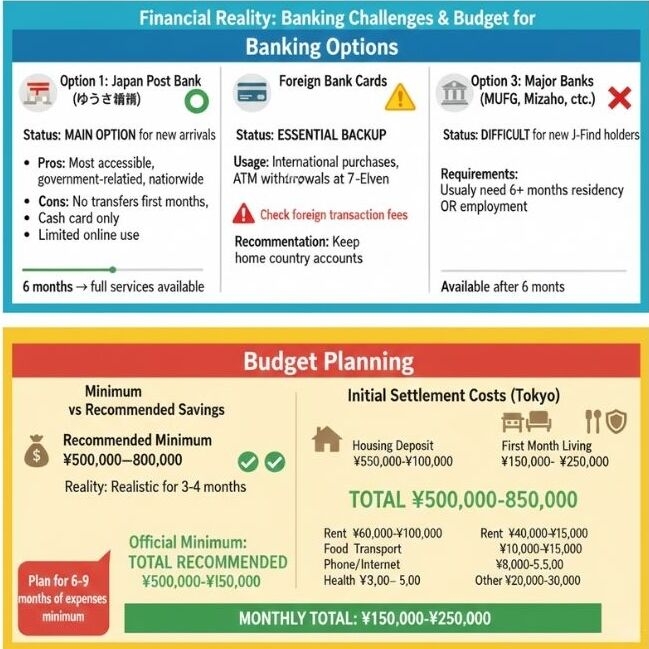
Most major Japanese banks require either proof of employment or 6+ months of residency history before opening an account. As a new J-Find holder, you have neither. This creates an immediate problem—you need a Japanese bank account to receive salary from Japanese employers, pay rent, and manage daily finances.
Your Main Option: Japan Post Bank (ゆうちょ銀行)
Japan Post Bank is the most accessible option for new arrivals without employment. They’re more willing to open accounts for J-Find holders because:
- They’re a government-related institution with broader accessibility mandates
- They have extensive branch network (post offices throughout Japan)
- They’re familiar with serving foreign residents
How to Open Japan Post Bank Account:
- Visit any Japan Post branch (郵便局, yuubinkyoku)
- Bring your Residence Card and passport
- Register your Japanese address first at city hall (住民登録, juumin touroku)
- Complete application form (staff can help in basic English at larger branches)
- Receive cash card within 1-2 weeks
Limitations of Japan Post Bank (Important!):
Based on recent J-Find holder experiences:
- No bank transfers for first 6 months – You can only deposit and withdraw cash
- No international card brands – Cannot get Visa or Mastercard-branded debit card for 6 months
- Cash card only – Can use at post office ATMs and select retailers (7-Eleven, FamilyMart)
- Cannot use for online shopping (in most cases) until you get proper debit card after 6 months
Practical Workaround Strategy:
Most J-Find holders rely on this combination:
- Open Japan Post Bank account for receiving Japanese salary/payments
- Use foreign credit/debit cards from home country for online purchases and international services
- Withdraw cash at 7-Eleven ATMs using foreign cards (most accept Visa/Mastercard)
- After 6 months, qualify for full banking services at Japan Post or major banks
Important Banking Considerations:
- Check with your home country bank about foreign transaction fees (some banks waive these)
- Consider fintech solutions like Wise (formerly TransferWise) for currency exchange and multi-currency accounts
- Notify your home bank you’ll be using cards in Japan to avoid fraud alerts
- Keep sufficient funds in foreign accounts for first few months
Alternative Banking Options (Limited):
Some J-Find holders have reported success with:
- Prestia (SMBC Prestia) – Sometimes accepts J-Find holders, English service available
- Shinsei Bank – Online application possible, but acceptance not guaranteed
- Sony Bank – Online bank, may accept without employment proof
However, these options are inconsistent and may depend on individual circumstances and branch policies.
Verification Note: Banking policies change frequently and vary by branch. The 6-month transfer/card limitation at Japan Post is based on firsthand accounts from 2023-2024 J-Find holders. Call ahead to your nearest Japan Post branch to confirm current policies before arriving in Japan.
Employer Unfamiliarity with J-Find
The Challenge:
J-Find launched in April 2023, making it a very new visa category. Many employers and even immigration office staff are still learning about it. This creates practical complications during your job search.
Common Issues J-Find Holders Face:
1. Employer Confusion About Work Authorization
Employers and HR departments may:
- Not recognize J-Find as a legitimate work visa
- Confuse it with student visa (which has 28-hour work restriction)
- Worry that hiring you violates immigration law
- Request documentation they’ve never seen before
Real Example: One J-Find holder reported receiving multiple inquiries from potential employers asking “Are you even allowed to work part-time?” despite clear immigration regulations permitting this.
Your Response Strategy:
- Prepare simple one-page explanation of J-Find in English and Japanese
- Bring copy of official ISA J-Find documentation
- Explain clearly: “I can work part-time while job hunting, no hour restrictions”
- Offer to have employer contact Immigration Services Agency for confirmation
2. Visa Sponsorship Concerns
Some employers worry about complexity of sponsoring your work visa transition from J-Find.
Reality: Transitioning from J-Find to work visa (Engineer/Specialist) is standard procedure, no more complicated than sponsoring someone from abroad.
Your Response Strategy:
- Emphasize you’re already legally in Japan (no entry complications)
- Note that you’re actively job hunting (showing commitment)
- Offer to handle immigration paperwork with your lawyer if needed
3. Part-Time Position Rejection
Some part-time employers reject J-Find holders due to confusion, preferring familiar visa types like student visas or Working Holiday.
Your Response Strategy:
- Target larger companies with international HR experience
- Apply to positions explicitly open to foreigners
- Consider language schools (tend to understand various visa types)
- Network through foreigner communities for employer recommendations
Immigration Office Staff Unfamiliarity
Early J-Find holders reported even immigration staff being unfamiliar with procedures.
Real Example: First J-Find applicant at Shinagawa Immigration Office had to show immigration staff the official government website explaining J-Find because they weren’t yet trained on the new visa.
This Is Improving: As more people use J-Find, immigration staff are becoming more familiar. However, you may still need to:
- Bring printed copies of official ISA J-Find guidelines
- Reference the specific ministerial notification number
- Be patient with processing as staff learn procedures
Verification Note: The novelty issue should continue improving through 2026 as more J-Find holders enter Japan and employers gain familiarity. However, expect some level of confusion, particularly at smaller companies or regional immigration offices that handle fewer foreign residents.
How Long Can You Stay on J-Find?
Understanding J-Find’s duration rules is critical for planning your job search or business launch timeline.
Initial Stay Period
When you first receive your J-Find visa, immigration will grant you an initial period of stay of either:
- 6 months, or
- 1 year
The immigration officer determines which duration you receive based on their assessment of your application. There’s no fixed formula—it’s discretionary. Most J-Find holders report receiving 1-year initial periods, but 6-month grants also occur.
Maximum Total Duration: 2 Years
The absolute maximum time you can stay on J-Find status is 2 years total. However, this includes all time spent under similar visa programs, not just J-Find specifically.
Time That Counts Toward Your 2-Year Limit:
The following periods of stay are cumulative toward your maximum 2 years:
- J-Find (Future Creation Individual) time
- Designated Activities (Continued Job Hunting) – typically granted to students after graduation
- Municipal Startup Visa programs (Tokyo, Fukuoka, etc.)
- Project for Facilitation of Acceptance of Foreign Entrepreneurs in National Strategic Special Zones
- Designated Activities (Start-up Activities after Graduation)
Example: If you spent 6 months on Fukuoka’s Startup Visa, you have only 18 months remaining for J-Find, not the full 2 years.
*The cumulative time calculation is specified in the Immigration Services Agency’s official J-Find documentation. If you’ve participated in any similar visa programs, confirm your remaining eligible time before applying for J-Find.
Can Family Members Join You on J-Find?
Yes, J-Find allows you to bring your spouse and dependent children to Japan. However, they receive a separate visa status and face some restrictions.
Eligibility for Family Members
Who Can Apply:
- Legal spouse (requires valid marriage certificate)
- Dependent children (minor children or children supported financially by you)
Who Cannot Apply:
- Unmarried partners (not legally married)
- Parents
- Siblings
- Adult children (unless financially dependent due to disability/education)
What Happens After J-Find? Transition Options
J-Find is temporary by design—maximum 2 years. Before your time runs out, you need a plan for either staying in Japan under a different visa or departing. Let’s examine your options.
Transition Option 1: Employment → Work Visa
The most common pathway is securing employment and transitioning to a work visa.
Standard Work Visa Types:
Engineer/Specialist in Humanities/International Services (技術・人文知識・国際業務)
This is the most common work visa for foreign professionals. It covers:
- Engineering and IT positions
- Marketing, finance, business planning
- Translation and interpretation
- Sales and consulting
- Design and creative roles
- Education (corporate training, language instruction)
Requirements:
- Job offer from Japanese company
- Appropriate educational background (degree in related field or 10 years work experience)
- Salary meeting minimum standards (typically ¥250,000+/month)
Duration: 1, 3, or 5 years (immigration determines based on company category and your qualifications)
Transition Process:
- Secure Job Offer: Complete interview process, receive formal offer letter
- Gather Documents: Work with employer’s HR to prepare application documents
- Apply for Change of Status: Submit application to Immigration Services Agency
- Processing: Typically 1-3 months
- Approval: Receive new Residence Card with work visa status
Timeline Recommendation: Start job hunting by Month 15-18 of your J-Find to allow time for interviews, offer negotiation, and visa processing before your 2-year limit.
Transition Option 2: Start Business → Business Manager Visa
If you’re using J-Find to prepare for entrepreneurship, you’ll eventually transition to Business Manager Visa (経営・管理).
Business Manager Visa Requirements (Effective October 2025):
The requirements changed dramatically in October 2025, making this transition significantly more challenging:
Capital Requirement: ¥30,000,000
- Must invest ¥30 million yen (approximately $200,000 USD) in your business
- This represents a 6x increase from the previous ¥5 million requirement
- Capital must be verifiable in business bank account
Employee Requirement: At Least 1 Full-Time Local Employee
- Must hire at least one full-time Japanese employee
- Part-time workers and contractors don’t count
- Employee must be Japanese national, permanent resident, or long-term resident visa holder
Japanese Language Requirement: B2 Level (JLPT N2 or Equivalent)
- Either you OR your employee must have B2-level Japanese proficiency
- JLPT N2 generally considered B2-equivalent
- Other standardized tests may be acceptable
Experience/Education Requirement:
- 3+ years of business management experience, OR
- Master’s degree or higher in a relevant field
Business Plan Requirement:
- Must be verified by certified professional
- Acceptable verifiers: Small and Medium Enterprise Management Consultant, CPA, or Licensed Tax Accountant
- Plan must demonstrate viability and comply with Japanese business regulations
Physical Office Requirement:
- Dedicated business premises appropriate for your operations
- Virtual offices or residential addresses generally not acceptable
- Office must be secured before visa application
Verification Note: The October 2025 Business Manager Visa changes are significant policy shifts. Requirements listed here are based on official Ministry of Justice announcements. Transitional measures exist for current BM visa holders until October 2028, but new applicants face full requirements immediately.
Realistic Assessment:
For comprehensive guidance on business establishment, see: How to Start a Business in Japan in 12 Steps
Transition Option 3: Highly Skilled Professional (HSP) Visa
The Highly Skilled Professional visa (高度専門職) offers preferential treatment for highly qualified foreign nationals.
How HSP Works:
Japan’s HSP visa uses a points-based system. You earn points based on:
- Educational background (PhD = more points)
- Work experience (more years = more points)
- Annual salary (higher income = more points)
- Age (younger = more points)
- Japanese language ability (higher level = more points)
- Additional factors (Japanese university degrees, research achievements, etc.)
Points Requirements:
- 70+ points: Eligible for HSP visa
- 80+ points: Eligible for permanent residence after 1 year
Advantages of HSP:
- 5-year visa duration
- Faster path to permanent residence (3 years for 70+ points, 1 year for 80+ points)
- Spouse can work without additional permission
- Can bring parents under certain conditions
- Priority immigration processing at airports
HSP Requirements:
- Must have job offer or operate business
- Must accumulate sufficient points
- Must meet specific activity category requirements (academic research, specialized/technical, or business management)
J-Find → HSP Transition:
If you secure high-paying employment or can demonstrate exceptional qualifications:
- Calculate your HSP points using official calculator
- If 70+ points, apply for HSP instead of standard work visa
- Enjoy preferential treatment and faster permanent residence path
Transition Option 4: Other Status Changes
Spouse/Child of Japanese National
- If you marry a Japanese citizen while on J-Find
- Allows you to work freely in Japan
- Path to permanent residence/naturalization
Is J-Find Worth It? Honest Assessment
After understanding all requirements, challenges, and processes, you might wonder: Is J-Find actually the right choice for you? Here’s an honest evaluation.
J-Find Is Ideal For:
✓ Recent Top-University Graduates (Within 5 Years)
This is the core target. If you graduated from a top-100 university within the past 5 years, J-Find opens doors that other visa categories don’t:
- No job offer needed
- Time to explore job market in person
- Flexibility to attend interviews and network
- Up to 2 years to find your path
✓ Those Over 30 (Not Eligible for Working Holiday)
Working Holiday visas typically have age cutoffs around 30. If you’re 31+ and want to come to Japan to job hunt without a confirmed position, J-Find is your best option.
✓ Career Changers Targeting Japan
If you’re pivoting careers and want to be physically present in Japan to make connections, attend industry events, and demonstrate commitment to potential employers, J-Find provides the legal framework.
✓ Entrepreneurs Needing Preparation Time
If you have a viable business concept but need time to:
- Conduct market research in Japan
- Build local partnerships
- Navigate company registration
- Secure office space and establish operations
J-Find gives you 2 years to build your foundation before needing to meet full Business Manager visa requirements.
✓ Those Wanting to Test Japan Before Committing
J-Find lets you experience living in Japan—work culture, daily life, language challenges—before committing to long-term employment or business investment.
Consider Alternatives If:
✗ Under 30 and Eligible for Working Holiday
Working Holiday visas are:
- More established (employers and landlords know them)
- Easier application process in most cases
- Similar duration (1-2 years depending on country)
- Often include 2-year extensions now for certain countries
Reality Check: If you’re 25 and eligible for Working Holiday from the UK, that’s likely an easier path than J-Find.
Exception: If your Working Holiday window is closing soon (approaching 30) or your country has stricter Working Holiday terms, J-Find might be better.
✗ Already Have Job Offer in Japan
If a Japanese company wants to hire you, apply directly for an Engineer/Specialist work visa:
- Employer sponsors your visa
- Faster process (no J-Find intermediate step)
- Immediate stable income
- No 2-year deadline to transition
J-Find makes sense when you don’t yet have a job offer.
✗ Graduated More Than 5 Years Ago
Hard requirement—no exceptions. If your degree conferment was more than 5 years ago, you’re not eligible for J-Find.
Alternative pathways:
- Apply directly for jobs and have employer sponsor work visa
- Startup Visa programs (some municipalities)
- Business Manager Visa if you meet new requirements
- Return to school for graduate degree (resets 5-year clock)
✗ University Not in Top 100 of Required Rankings
If your university doesn’t rank in the top 100 of at least 2 out of 3 required rankings, you don’t qualify. No amount of personal achievement or work experience overrides this.
Check the official list: https://www.moj.go.jp/isa/content/001394994.pdf
Alternative: Some universities might be borderline—check all three rankings carefully. Rankings change yearly.
✗ Limited Financial Resources
If you have only ¥200,000 (the official minimum), you’re cutting it very close. Realistic costs:
- Initial settlement: ¥500,000-¥800,000
- Monthly living (Tokyo): ¥150,000-¥250,000
Without additional funds or immediate income, you’ll struggle. Better to:
- Save more before applying
- Secure remote work you can do from Japan
- Have financial safety net from family
The October 2025 Business Manager Visa Change Impact
Critical Consideration for Entrepreneurs:
If you’re planning to use J-Find specifically to prepare for starting a business in Japan, the October 2025 Business Manager visa changes significantly increase the difficulty:
New Requirements:
- ¥30,000,000 capital (6x previous amount)
- 3+ years management experience
- Japanese language proficiency (JLPT N2)
- Verified business plan from certified professional
Reality: Most recent graduates don’t have 3 years management experience or ¥30 million in capital.
Recommendation: If entrepreneurship is your goal:
- Be realistic about transition feasibility
- Consider raising investment from Japanese/foreign investors
- Look at municipal Startup Visa programs as bridge
- Plan alternative pathways if Business Manager proves unattainable
- Consult immigration lawyer about partnership structures or alternative approaches

Final Verdict: Who Should Apply
Strong Match for J-Find:
- Graduated from top university within 5 years ✓
- Over 30 or not eligible for Working Holiday ✓
- No job offer yet but want to job hunt in Japan ✓
- Financial resources for 12+ months ✓
- Japanese language ability (even N4-N3 helps) ✓
Moderate Match:
- Graduated 4-5 years ago (time pressure)
- Limited financial resources (6-9 months)
- No Japanese language but strong technical skills
- Entrepreneurial goals (note Business Manager challenges)
Poor Match:
- Not qualified by age, graduation timing, or university
- Already have job offer (just get work visa directly)
- Under 30 and eligible for simpler Working Holiday
- Minimal financial resources
- No realistic transition plan for after 2 years
Verification Note: This assessment is based on current immigration policies as of January 2026 and experiences from the first 2+ years of J-Find implementation (2023-2025). Individual circumstances vary significantly. Consider consulting with an immigration lawyer for personalized evaluation of your specific situation.
Where Can You Get Professional Help?
SmartStart Japan
SmartStart Japan provides comprehensive support for visa applicants and foreign entrepreneurs in Japan.
✓ Specialized Japan Market Expertise: We understand both immigration requirements and practical realities of living and working in Japan
✓ Foreign Entrepreneur Focus: Specifically designed for international professionals and entrepreneurs
✓ Comprehensive Support: From initial visa application through business establishment
✓ Network Access: Connections to immigration lawyers, real estate agents, business advisors, and entrepreneur community
✓ Transparent Pricing: Clear fee structures, no hidden costs
Additional SmartStart Resources
Related Guides:
- How to Start a Business in Japan in 12 Steps
- Japanese Business Phrases Guide
- Business Networking in Japan
- Chambers of Commerce in Japan
Full List of Universities for J-Find Visa
United States
| University Name | Country |
|---|---|
| Boston University | United States |
| Brown University | United States |
| California Institute of Technology | United States |
| Carnegie Mellon University | United States |
| Columbia University | United States |
| Cornell University | United States |
| Duke University | United States |
| Georgia Institute of Technology | United States |
| Harvard University | United States |
| Johns Hopkins University | United States |
| Massachusetts Institute of Technology (MIT) | United States |
| New York University | United States |
| Northwestern University | United States |
| Princeton University | United States |
| Purdue University – West Lafayette | United States |
| Stanford University | United States |
| The University of Texas at Austin | United States |
| University of California, Berkeley | United States |
| University of California, Irvine | United States |
| University of California, Los Angeles | United States |
| University of California, San Diego | United States |
| University of California, Santa Barbara | United States |
| University of Chicago | United States |
| University of Illinois at Urbana-Champaign | United States |
| University of Michigan-Ann Arbor | United States |
| University of Minnesota, Twin Cities | United States |
| University of North Carolina at Chapel Hill | United States |
| University of Pennsylvania | United States |
| University of Southern California | United States |
| University of Washington | United States |
| University of Wisconsin – Madison | United States |
| Vanderbilt University | United States |
| Washington University in St. Louis | United States |
| Yale University | United States |
United Kingdom
| University Name | Country |
|---|---|
| Imperial College London | United Kingdom |
| King’s College London | United Kingdom |
| London School of Economics and Political Science | United Kingdom |
| The University of Edinburgh | United Kingdom |
| The University of Glasgow | United Kingdom |
| The University of Manchester | United Kingdom |
| University College London (UCL) | United Kingdom |
| University of Bristol | United Kingdom |
| University of Cambridge | United Kingdom |
| University of Oxford | United Kingdom |
| University of Southampton | United Kingdom |
Hong Kong
| University Name | Country |
|---|---|
| City University of Hong Kong | Hong Kong |
| The Chinese University of Hong Kong | Hong Kong |
| The Hong Kong Polytechnic University | Hong Kong |
| The Hong Kong University of Science and Technology | Hong Kong |
| The University of Hong Kong | Hong Kong |
China
| University Name | Country |
|---|---|
| Fudan University | China |
| Nanjing University | China |
| Peking University | China |
| Shanghai Jiao Tong University | China |
| Tsinghua University | China |
| University of Science and Technology of China | China |
| Zhejiang University | China |
Japan
| University Name | Country |
|---|---|
| Kyoto University | Japan |
| The University of Tokyo | Japan |
South Korea
| University Name | Country |
|---|---|
| Korea Advanced Institute of Science and Technology (KAIST) | South Korea |
| Seoul National University | South Korea |
| Yonsei University | South Korea |
Australia
| University Name | Country |
|---|---|
| Monash University | Australia |
| The Australian National University | Australia |
| The University of Melbourne | Australia |
| The University of New South Wales (UNSW Sydney) | Australia |
| The University of Queensland | Australia |
| The University of Sydney | Australia |
Canada
| University Name | Country |
|---|---|
| McGill University | Canada |
| University of British Columbia | Canada |
| University of Toronto | Canada |
Netherlands
| University Name | Country |
|---|---|
| Delft University of Technology | Netherlands |
| Erasmus University Rotterdam | Netherlands |
| University of Amsterdam | Netherlands |
| University of Groningen | Netherlands |
Germany
| University Name | Country |
|---|---|
| Heidelberg University | Germany |
| LMU Munich (University of Munich) | Germany |
| Technical University of Munich | Germany |
| University of Bonn | Germany |
France
| University Name | Country |
|---|---|
| Institut Polytechnique de Paris | France |
| Paris-Saclay University | France |
| PSL Research University Paris | France |
| Sorbonne University | France |
Switzerland
| University Name | Country |
|---|---|
| Swiss Federal Institute of Technology Lausanne (EPFL) | Switzerland |
| Swiss Federal Institute of Technology Zurich (ETH Zurich) | Switzerland |
| University of Zurich | Switzerland |
Sweden
| University Name | Country |
|---|---|
| Karolinska Institute | Sweden |
| KTH Royal Institute of Technology | Sweden |
Belgium
| University Name | Country |
|---|---|
| KU Leuven | Belgium |
Russia
| University Name | Country |
|---|---|
| Lomonosov Moscow State University | Russia |
Singapore
| University Name | Country |
|---|---|
| Nanyang Technological University | Singapore |
| National University of Singapore | Singapore |
Last updated: January 2026 | Immigration policies subject to change
This guide is for informational purposes only and does not constitute legal advice. Always verify current requirements with the Immigration Services Agency of Japan or a qualified immigration lawyer before making visa decisions.