Setting up a company in Japan usually starts with one decision: should you register a Kabushiki Kaisha, Godo Kaisha, branch office, or operate as a sole proprietor?
A Kabushiki Kaisha, often called a KK, is Japan’s most recognized company structure. It is the structure that many Japanese clients, banks, investors, employees, and government-related organizations associate with an established business.
This guide explains what a Kabushiki Kaisha is, who should choose one, how it compares with a GK and sole proprietorship, what costs to expect, how the Business Manager Visa affects foreign founders, and what mistakes to avoid before registering a KK in Japan.
The information in this article has been checked by a scrivener in Japan.
Key Takeaways
- A Kabushiki Kaisha is usually best for founders who plan to raise investment, want to issue shares, or expect to work with traditional Japanese corporations, investors, banks, or government-related clients.
- A GK is usually better if you want a cheaper and faster setup, do not plan to raise venture capital, do not plan to go public, and do not need the extra credibility that comes with a KK.
- A KK requires more paperwork than a GK because the Articles of Incorporation must be notarized, and the registration process is often more complicated than that of a GK.
- Business Manager Visa applicants need more than a registered KK. Under the revised standards, applicants generally need ¥30 million in capital, at least one qualifying full-time employee, Japanese language ability from the applicant or employee, management experience or relevant education, expert confirmation of the business plan, and a dedicated physical office.
What is Kabushiki Kaisha (KK) in Japan?
A Kabushiki Kaisha, or KK, is a Japanese joint-stock company. It is similar to a corporation in many other countries.
A KK separates ownership and management. Shareholders own the company through shares. Directors manage the company.
This makes the KK structure useful when you want to bring in investors, issue shares, create a formal ownership structure, or build a company that may later need stock options, outside directors, or more formal governance.
A KK also gives shareholders limited liability. In normal cases, shareholders are only liable up to the amount they invested in the company.
For foreign founders, the main benefit of a KK is credibility. The main drawback is that it costs more to set up and takes more paperwork than a GK.
Should You Choose a KK, GK, or Sole Proprietorship?
Before setting up a KK, compare it with the other common options.
| Your Situation | Best Structure |
| You want the strongest corporate credibility in Japan | KK |
| You plan to raise venture capital | KK |
| You want to issue shares | KK |
| You plan to go public in the future | KK |
| You will work with traditional Japanese corporations or government clients | KK |
| You are hiring Japanese staff, and employer branding matters | KK has an advantage |
| You want the cheapest and fastest setup | GK |
| You are a solo founder with no VC plans | GK |
| You want flexible profit distribution between members | GK |
| You are a foreign company setting up a simple Japanese subsidiary | GK or KK |
| You want the simplest possible structure with no incorporation cost | Sole proprietorship |
| You do not need limited liability | Sole proprietorship |
| You are applying for the Business Manager Visa | KK or GK |
In simple terms, a KK is usually better when credibility, shares, fundraising, hiring, or a formal corporate structure matter.
A GK is usually better when you want limited liability but do not need the higher cost or formality of a KK. Please note that you can change from a GK to a KK in the future and vice versa. For a more detailed explanation, see our article on Godo Kaisha in Japan.
A sole proprietorship is the simplest option, but it does not give you the same liability protection, corporate image, or company-level separation.
Who Is a Kabushiki Kaisha Actually For?
A Kabushiki Kaisha is often the right choice for five types of founders.
1. Founders planning to raise capital
If you plan to raise money from investors, a KK is usually the better structure.
A KK can issue shares. This makes it easier to structure ownership, investment rounds, shareholder rights, and future financing.
Venture capital firms, angel investors, and institutional investors are also more familiar with KKs. A GK can work well for many small businesses, but it is not suitable for venture-backed fundraising, where they will want to purchase shares or future shares and want to sell them as well.
Also, Japanese angel and venture investors typically do not invest in corporations that are incorporated outside of Japan and prefer a structure in Japan. Corporate Venture Capital is an exception as they actively invest overseas. Some venture capitalists may make exceptions for Delaware-based startups.
2. Companies that need credibility in Japan
A KK carries the strongest corporate image in Japan.
This matters when you are trying to build trust with Japanese corporations, banks, landlords, investors, government-related clients, or traditional industries.
3. Businesses that want to hire Japanese employees
Japanese job seekers usually understand KK more easily than GK.
A KK may feel more familiar, stable, and established to candidates. This can matter when you are hiring full-time employees, especially for roles where candidates care about company stability.
This does not mean a GK cannot hire good people. Many GKs do. But if hiring is a major part of your growth plan, a KK may help.
4. Foreign companies building a serious Japan presence
A foreign company entering Japan can choose either a GK or a KK.
A GK can be simpler when the Japanese entity is mainly a wholly owned subsidiary with limited outside visibility. A KK may be better when the Japanese entity faces customers, hires local staff, works with major Japanese clients, or represents the company in a more public way.
If the Japanese company needs to look established from the start, the KK structure may be worth the added cost.
5. Founders who want a long-term corporate structure
A KK is usually better if you expect to add shareholders, issue shares, create stock options, raise capital, appoint directors, or build a larger organization.
If your plan already points in that direction, starting with a KK can avoid conversion work later.
Who Should Not Choose a Kabushiki Kaisha?
A KK is not always the best choice.
You may not need a KK if:
- You are a solo founder with no plans to raise capital
- You want the cheapest and fastest setup
- Your clients do not care whether you are a KK or a GK
- You do not need to issue shares
- You want flexible profit distribution between founders
- You are testing a small business idea and want to keep things simple
In these cases, a GK may be enough.
A sole proprietorship may also be enough if you are doing small freelance work, do not need limited liability, and do not need a company name for contracts, hiring, banking, or client trust.
Do not choose a KK only because it sounds more prestigious. Choose it because the structure supports your business plan.
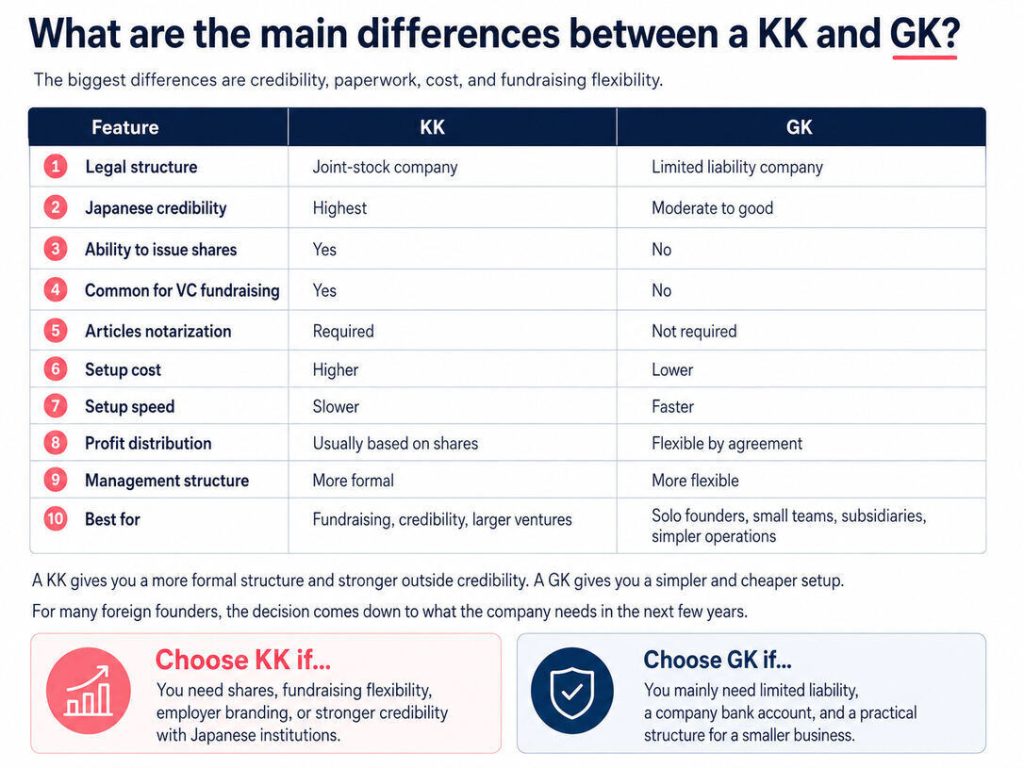
What are the main differences between a KK and a GK?
The biggest differences are credibility, paperwork, cost, and fundraising flexibility.
| Feature | KK | GK |
| Legal structure | Joint-stock company | Limited liability company |
| Japanese credibility | Highest | Moderate to good |
| Ability to issue shares | Yes | No |
| Common for VC fundraising | Yes | No |
| Articles notarization | Required | Not required |
| Setup cost | Higher | Lower |
| Setup speed | Slower | Faster |
| Profit distribution | Usually based on shares | Flexible by agreement |
| Management structure | More formal | More flexible |
| Best for | Fundraising, credibility, and larger ventures | Solo founders, small teams, subsidiaries, simpler operations |
A KK gives you a more formal structure and stronger outside credibility. A GK gives you a simpler and cheaper setup.
For many foreign founders, the decision comes down to what the company needs in the next few years.
If you need shares, fundraising, employer branding, or stronger credibility with Japanese institutions, a KK usually makes sense.
If you mainly need limited liability, a company bank account, and a practical structure for a smaller business, a GK may be enough.
What paperwork is required to create a KK?
A KK requires more paperwork than a GK because it has a more formal structure.
The main documents and steps usually include:
| Document or step | Required for KK? | Required for GK? |
| Articles of Incorporation (定款) | Yes | Yes |
| Notarization of Articles | Yes (~¥50,000 + ¥40,000 stamps) | No |
| Certified copy of notarized articles | Yes | No |
| Promoter / Member’s resolution | Yes | Yes |
| Director / Executive Manager acceptance form | Yes | Yes |
| Seal certificate or signature certificate | Yes | Yes |
| Capital deposit evidence | Yes | Yes |
| Application for registration (登記申請書) | Yes | Yes |
| Registration tax payment (登録免許税) | Yes (¥150,000 min or 0.7%) | Yes (¥60,000 min or 0.7%) |
| Company seal creation & registration | Yes | Yes |
| Company seal documents (印鑑届書) | Yes | Yes |
| Typical incorporation time | 3–4 weeks | 1–2 weeks |
| Minimum govt registration cost | ~¥240,000+ | ~¥60,000+ |
The Articles of Incorporation are especially important. They set out the company name, business purpose, head office location, capital amount, shares, directors, fiscal year, and other basic company rules.
How much does it cost to set up a KK in Japan?
The exact cost depends on the capital amount, whether you use electronic or paper Articles of Incorporation, and whether you hire a professional.
The main costs usually include:
| Cost item | Typical amount |
| Registration tax | ¥150,000 or 0.7% of capital, whichever is higher |
| Registration tax at ¥30 million capital | ¥210,000 |
| Notarization fee | ¥30,000 to ¥50,000, depending on capital |
| Paper Articles stamp duty | ¥40,000, waived if using electronic articles |
| Certified copies | Around ¥2,000 |
| Company seals | Around ¥5,000 to ¥30,000 |
| Professional support | Often ¥150,000 to ¥350,000+ |
For founders applying for the Business Manager Visa, the registration tax is usually higher because the visa now requires ¥30 million in capital. At a ¥30 million capital, the 0.7% registration tax is ¥210,000.
Can Foreigners Own 100 Percent of a KK?
Yes. Foreigners can own 100 percent of a Kabushiki Kaisha in Japan.
Japan does not require a Japanese shareholder. It also does not legally require a Japan-resident director just to register the company.
That said, there is a difference between what is legally possible and what is easy to operate.
If all directors live outside Japan, banking, tax communication, lease signing, government paperwork, and day-to-day administration become harder.
This is why many foreign-owned KKs appoint a Japan-resident representative or work with a local professional during setup.
Depending on the investor’s nationality, industry, and business activity, foreign investment reporting under the Foreign Exchange and Foreign Trade Act may also apply. This should be checked before incorporation if the business is in a regulated or sensitive sector.
Foreign-Owned KK Setup
The Legal Part Is Easy. The Operations Part Is Not.
- KK incorporation handled end to end, fully in English
- Corporate bank account preparation and support
- Representative director services for overseas founders
- Tax registration and ongoing compliance support
- Trusted by 100+ companies incorporated across Japan
Can You Use a KK for the Business Manager Visa?
Yes, a KK can be used for the Business Manager Visa.
But choosing a KK does not reduce the visa requirements.
Company registration and visa approval are separate. You can register a KK without needing ¥30 million in capital. However, if you use the KK as part of a Business Manager Visa application, the visa standards apply.
This is also true when a company and an individual both own the KK. Immigration will still look at whether the Business Manager Visa applicant is actually managing the business, whether the company has enough capital, whether the employee and office requirements are met, and whether the business plan is credible.
Under the revised standards that took effect on October 16, 2025, Business Manager Visa applicants generally need to satisfy stricter requirements around capital, hiring, Japanese language ability, management background, business plan confirmation, and office setup.
The Business Manager Visa now generally requires:
- ¥30 million in paid-in capital or equivalent business investment
- At least one qualifying full-time employee
- Japanese language ability from either the applicant or the qualifying employee
- Three or more years of management experience, or a relevant graduate-level degree
- Business plan confirmation by a qualified external expert
- A dedicated physical office
- Proper tax, social insurance, and business operation planning
For the employee requirement, the full-time employee must be a qualifying person. This generally means a Japanese national, special permanent resident, permanent resident, spouse or child of a Japanese national, spouse or child of a permanent resident, or long-term resident.
If a foreign corporation will be one of the shareholders, prepare the corporate ownership documents early. Immigration, banks, and registration professionals may need to confirm who owns the foreign company, who has authority to sign, where the capital is coming from, and how the Japanese entity fits into the wider business.
This is especially important when the KK is being used for a Business Manager Visa because the company structure, capital source, office, employee plan, and management role all need to make sense together.
Can work visa holders start a KK?
This is one of the most important issues for foreign founders already living in Japan.
If you currently hold a normal work visa, such as an Engineer/Specialist in Humanities/International Services, you could set up your own company in Japan, meaning no one will stop you from setting up a company at the legal bureau.
However, Company directorship and business management fall outside the activities allowed under most work visa categories, with the exception being HSP-C visas, and running a company while under a work visa is a violation of your work visa, and your visa can be revoked if discovered. The same applies to those who own a company outside of Japan and set up a Japanese subsidiary to hire themselves to avoid the 30 million yen requirement
As long as you have a work visa, you are not allowed to run a company in Japan.
If you have a visa without work restrictions, such as a permanent resident, spouse of a Japanese national, spouse of a permanent resident, or long-term resident, you can create a company in Japan, and it would be within the parameters of your visa permissions.
What Should You Know About Opening a Corporate Bank Account with a KK?
Opening a corporate bank account is often one of the hardest steps for foreign-owned KKs.
Even though a KK has strong credibility as a structure, banks still screen new companies carefully. A new company with foreign ownership, no sales history, no Japanese representative, a virtual office, or unclear business activity can face rejection.
Banks usually look at:
- Who owns the company
- Who the representative director is
- Whether the representative lives in Japan
- Whether the office is real
- Whether the business model is clear
- Whether there are contracts, invoices, or customers
- Whether the capital amount makes sense
- Whether the company has proper tax and registration documents
Virtual offices are a major problem. For banking, they are not just a small risk. They will most likely be rejected even by many online banks.
If you are also applying for the Business Manager Visa, a virtual office is not acceptable for visa purposes.
For foreign-owned companies, internet banks such as GMO Aozora, Rakuten Bank, and PayPay Bank are often more accessible than megabanks. Shinkin banks, regional banks, and Japan Post Bank may also be options depending on your location and documents.
Megabanks such as MUFG, SMBC, and Mizuho are usually the most difficult, especially for new companies without operating history.
To improve your chances, prepare:
- A Japanese business plan
- A physical office address
- A company website or profile
- Contracts, invoices, or proof of expected customers
- Clear explanation of the source of funds
- Tax office notification documents
- Identification and address documents for directors
- Company seal and registration documents
Do not treat the bank account as a simple follow-up step after incorporation. Plan it from the beginning.

Is a KK Cheaper for Tax Than a GK?
No. A KK is not automatically cheaper or more expensive for tax filing than a GK.
Tax and accounting costs depend more on the actual work involved than on the company structure.
Accountants usually look at things such as:
- Number of invoices
- Number of expenses
- Number of bank accounts
- Payroll activity
- Foreign currency transactions
- Consumption tax registration
- Whether you use the Invoice System
- Whether you have inventory, loans, or cross-border transactions
A simple KK may be cheaper to file than a complicated GK. A complicated KK may be more expensive than a simple GK. The company structure matters less than transaction volume and complexity.
One tax point matters at setup. Companies with capital under ¥10 million may often be exempt from consumption tax for the first two fiscal years, unless they register for the Invoice System or meet another exception.
Business Manager Visa applicants should be careful here, because the ¥30 million capital requirement generally removes the under ¥10 million consumption tax advantage.
What Common Mistakes Should You Avoid?
There are several mistakes that foreign founders often make when setting up a KK in Japan.
1. Choosing a KK Only Because It Sounds More Impressive
A KK has the strongest reputation, but that does not mean every founder needs one.
If you do not plan to raise capital, issue shares, hire aggressively, or work with traditional Japanese corporations, a GK may be enough. Do not pay for the extra formality unless it supports your business plan.
2. Mixing Up Company Registration and Visa Requirements
You can register a KK without meeting the Business Manager Visa requirements. But if you need the visa, the visa requirements control the real plan.
That means ¥30 million in capital, one qualifying full-time employee, a proper physical office, Japanese ability, management background, and a certified business plan.
3. Using a Virtual Office for a Visa or Bank Account
A virtual office may work for basic company registration, but it is a major problem for banking and a disqualifier for the Business Manager Visa.
If you need a visa or a serious bank account, plan for a real office from the beginning.
4. Missing KK Notarization Costs
KK setup requires notarization of the Articles of Incorporation.
Do not confuse the ¥40,000 paper Articles stamp duty with the separate notarization-related cost that can reach ¥50,000. Electronic Articles can remove the ¥40,000 paper stamp duty, but they do not remove the notarization requirement for a KK.
Struggling To Set Up a KK in Japan?
Setting up a KK in Japan is easier when the structure, incorporation documents, banking plan, tax filings, and visa strategy are handled together.
This is especially useful if you are a foreign founder applying for the Business Manager Visa, a company entering Japan for the first time, a startup planning to raise capital, a founder choosing between KK and GK, or a business that needs a corporate bank account quickly.
SmartStart Japan can help you compare KK and GK, prepare the incorporation documents, coordinate the registration process, plan the bank account application, and support the first steps after establishment.
Final Thoughts
A Kabushiki Kaisha is the right structure when credibility, fundraising, shares, hiring, and a long-term corporate image matter.
It is not the cheapest or simplest structure in Japan. A GK is usually faster and less expensive. A sole proprietorship is even simpler if you do not need limited liability or a company name.
If you are building a company that needs to look established, work with Japanese corporations, raise investment, issue shares, hire staff, or operate as a serious Japanese entity for the long term, a KK is often the better choice.
For foreign founders, the biggest mistake is thinking that incorporation is the hard part. The harder parts are often the Business Manager Visa, bank account, tax filings, employee setup, and immigration timeline.
Choose the structure based on your actual business plan, not only the registration cost.
For help with KK incorporation, banking introductions, Business Manager Visa planning, or post-establishment compliance, book a consultation with SmartStart Japan.